
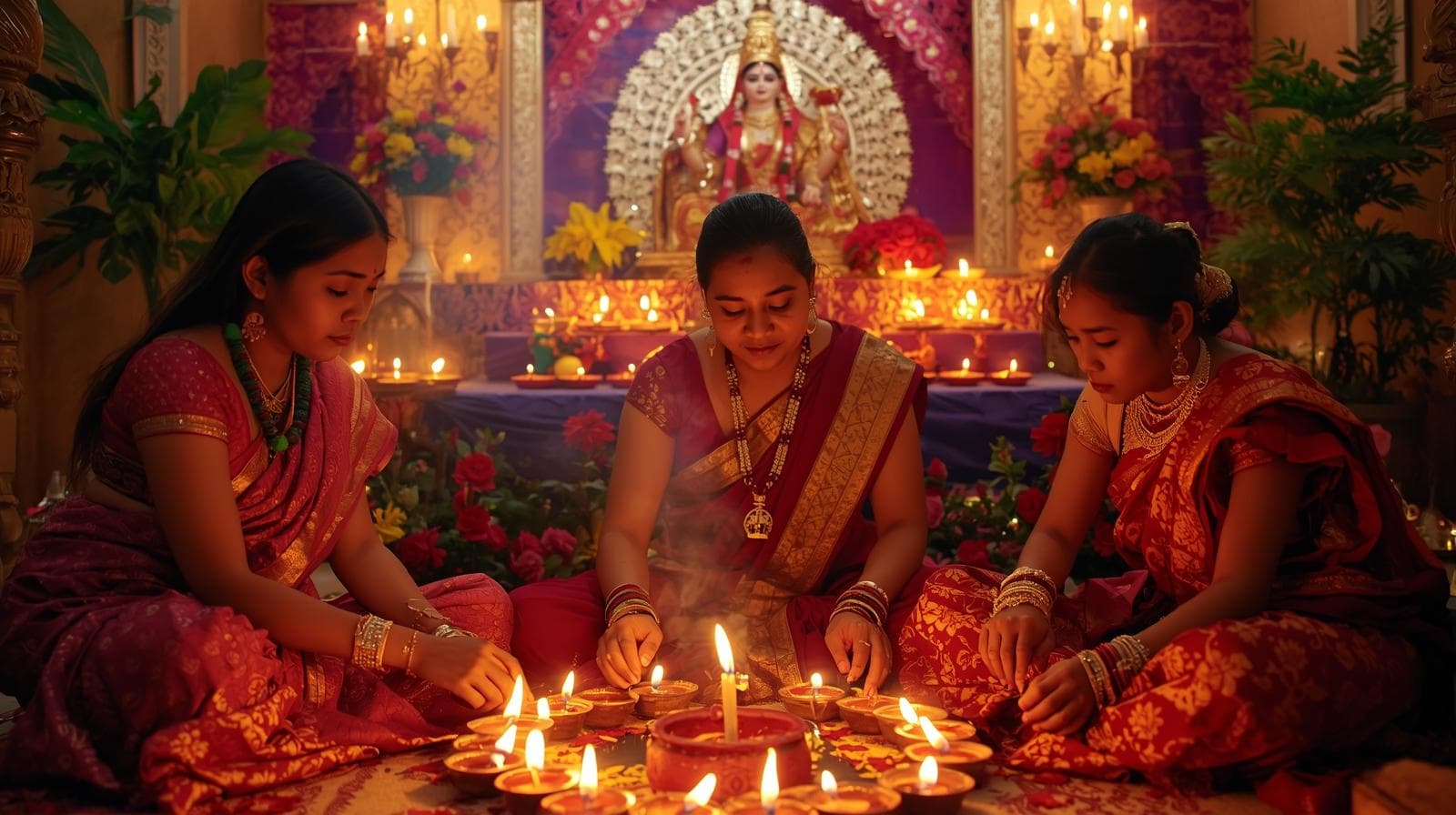
Ever wondered why Diwali lands on different civil dates in different cities—or even in two pamphlets you picked from the same market? It’s not random. It’s a clean rule based on tithi and a daily evening window called pradosh kala. I’ll spell out the logic in plain words so you can fix Lakshmi-puja muhurat the classical way, confidently, for your own city.
Meaning & Mood
Diwali’s ritual heart and the tithi-first lens
Diwali (Deepavali) means rows of diyas. The center of the festival is Lakshmi-puja on Kartik Amavasya, done in pradosh kala—the evening twilight just after your local sunset. Around it there’s a five-day flow people call Deepotsav: Dhanteras (Trayodashi) → Narak Chaturdashi → Lakshmi-puja / Diwali (Amavasya) → Govardhan Puja (Pratipada) → Bhai Dooj (Dwitiya).
Key idea: Hindu festivals listen to tithi, not the printed midnight-to-midnight date. And for Diwali, we don’t just ask “which day is Amavasya?” We ask a sharper question: Does Amavasya run during pradosh kala in my city?
Gloss (one-liners)
Cultural Layer
Deep daan across nights; Diwali night fixed by digest rule
Purana chapters on Kartik maas (like Skanda Purana’s Kartik Mahatmya) praise deep daan over multiple nights—starting Krishna Dwadashi, peaking on Amavasya. So Deepotsav isn’t a one-evening show. It’s a sequence. Still, when you need a firm call—which exact evening for Lakshmi-puja?—you go to the digest tradition: Dharma-sindhu and Nirnaya-sindhu. That’s what most Panchang makers also follow.
1) The Backbone: What a "Tithi" Actually Is
Why tithi can straddle civil dates
A tithi is the time Moon needs for its angle from the Sun to grow by 12°. Because the Moon’s speed changes a bit, a tithi is about 19–26 hours. It does not start at midnight or sunrise. It can start late morning and end next day before sunrise.
Why it matters: Festival rules look at which tithi is running during a ritual window. For Diwali, that window is pradosh kala (the evening window after sunset). So we check Amavasya during pradosh, not just “which civil date is Amavasya.”
2) Which Amavasya Is “Diwali”?
Common North Indian usage and decisive switch
In common North Indian (purnimanta) usage, Diwali is on Kartik Amavasya. The five-day lamp festival starts with Krishna Dwadashi, includes Trayodashi pradosh (Dhanteras), Chaturdashi morning (Narak Snan), Amavasya pradosh (Lakshmi-puja), then Pratipada (Govardhan). Classical Skanda Purana passages talk of deep daan across these nights. But the decisive switch that fixes the Lakshmi-puja night is the Dharma-digest rule.
3) The Rulebook: Dharma-sindhu / Nirnaya-sindhu on Lakshmi-puja
Pradosh decides; tie-breakers refine
Core rule for Diwali (Lakshmi-puja)
Do Lakshmi-puja and deep daan in pradosh kala on Kartik Amavasya.
- If Amavasya spans two civil dates, check which date’s pradosh kala it touches.
- If only one date has Amavasya at pradosh, that date is Diwali.
- If both dates have Amavasya at pradosh, pick the second date.
- If neither date’s pradosh has Amavasya, use tie-breakers:
- Prefer the date with Amavasya occupying ≥ 3 yama of daytime (about 9 hours).
- Or prefer when there is Amavasya–Pratipada yoga (Amavasya conjoined with Pratipada).
In one line: Pradosh decides, tie-breakers refine.
Note: All this is location-specific. Your pradosh depends on your sunset. So Delhi vs Dubai vs Dallas can differ even on the same “date.”
4) What Exactly Is “Pradosh kala”?
Daily twilight band; don’t confuse with Pradosh-vrat
Pradosh is the twilight band around and just after sunset. It exists every day. People sometimes mix it with Pradosh-vrat. That vrat is a Trayodashi fast and pooja to Shiva. The kala (time window) named pradosh is daily. Dharma-sindhu uses that daily pradosh to place Lakshmi-puja on Amavasya.
Tip: Most Panchangs print a Lakshmi-puja muhurat starting a little after sunset and running roughly 1.3–2 hours. That’s your workable pradosh span.
5) And What About Kali-puja?
Nishith kala can shift the civil date
In Bengal/Assam/Odisha, Kali-puja also sits on Kartik Amavasya, but the decision window is nishith kala (midnight), not pradosh. So in some years, Lakshmi-puja (pradosh) and Kali-puja (nishith) can land on different civil dates in the same city. That’s not a clash. It’s two different clocks within the same lunar day.
6) Walk Through a Realistic Example
Amavasya noon→noon case
Case: Amavasya runs 21 Oct noon → 22 Oct noon in your city.
- Pradosh on 21 Oct: Amavasya is active (it began at noon). So eligible.
- Pradosh on 22 Oct: Amavasya ended at noon; by evening, it’s Pratipada. So not eligible.
Verdict: 21 Oct evening is Diwali (Lakshmi-puja) in your city. If Amavasya covers pradosh on both evenings, take the second evening per Dharma-sindhu.
7) Dhan-Trayodashi (Dhanteras) & Narak-Chaturdashi
Lead-ins to Lakshmi-puja
Dhanteras (Trayodashi pradosh): Simple Shiva–Dhanvantari orientation in many homes. People light diyas at pradosh, tidy tools, place small kuber bartan if that’s their tradition, and begin the lamp festival vibe.
Narak Chaturdashi (pre-dawn): Abhyang snan before sunrise is the highlight. Many regions also do a Yam-diya in the south direction.
These are lead-ins to Lakshmi-puja. Check your city-specific sunrise and pradosh for clean timing.
8) Astronomical Logistics: Why Two Panchangs Can Differ
Same shastra rule, different inputs
- Location & time zone: Tithi is a global astronomical state, but sunset (pradosh) and midnight (nishith) are local.
- Ayanansh choice & model: Different schools pick slightly different ayanansh, adopt different constants, and round differently.
- Topocentric vs geocentric nuances and rounding can push a boundary right into or out of your pradosh window.
- Standardization efforts: India’s Rashtriya Panchang (Positional Astronomy Centre, Kolkata) publishes unified numbers. Many, not all, Panchangs use it.
Practical tip
9) How to Read “Pradosh kala” Without Overthinking
Simple three-step
- Identify your local sunset.
- Take the post-sunset twilight band generally printed as Lakshmi-puja muhurat by your Panchang.
- Check whether Amavasya is running during that span.
Same for nishith kala in Kali-puja regions: check if Amavasya is alive at your local midnight window.
Note: Many homes keep the ghar ka pradosh clean and calm. Don’t make it a stress test of seconds.
10) A Compact Algorithm You Can Trust
Classical-rule compliant
Decision flow (concise)
- Compute tithi boundaries for your lat/long. A tithi changes whenever Moon–Sun longitude difference crosses a multiple of 12 degrees.
- Compute local sunset for both candidate dates and define a pradosh interval (your Panchang’s Lakshmi-puja muhurat).
- Decide Lakshmi-puja:
- If only Day-A has Amavasya at pradosh → Diwali = Day-A.
- If both have it → Diwali = Day-B (second day).
- If neither has it → prefer the day with Amavasya ≥ 3 yama of daytime or with Amavasya–Pratipada.
- If you also publish Kali-puja → check Amavasya at nishith. Handle special cases per your sampradaya note if given.
11) Why Lamps? A Small Purana Touch
Purana texts call the deep a part of the Sun’s light that removes darkness and fear. In Kartik, lamps have special punya. So the tradition spreads deep daan across many nights, not just one. That’s why you see streets glowing from Dhanteras to Bhai Dooj. The math places the muhurat. The lamp keeps the mood.
Do / Avoid Lists (Tithi-First, Calm-Heart)
Context-wise guidance
For Lakshmi-puja Night (Amavasya, pradosh)
Do
- Start on time in pradosh. Keep ghar, mandir sthan clean and lit.
- Offer simple naivedya, deep daan, Lakshmi–Kuber archana as per your ghar parampara.
- Keep phones aside; chant a short Sri Suktam or Lakshmi Ashtottar if familiar.
Avoid
- Stretching too late into night unless your Panchang’s muhurat says so.
- Arguing over the civil date. Pradosh + Amavasya is the key.
- Treating timings as “guaranteed outcomes.” They’re guidelines. Your bhav matters.
For Kali-puja Regions (Amavasya, nishith)
Do
- Confirm if Amavasya is active at nishith for your city.
- Arrange mantra-japa, deep arcana, bhog suitable for midnight worship.
Avoid
- Expecting Lakshmi-puja and Kali-puja to always share the same civil date.
For Dhanteras (Trayodashi pradosh)
Do
- Light diyas at pradosh, do Dhanvantari remembrance, clean hisab-kitab books, tools.
- If you buy something symbolic, keep it sajha, not showy.
Avoid
- Making shopping the main event; pooja is the anchor.
For Narak Chaturdashi (pre-dawn)
Do
- Abhyang snan before sunrise. Light a small Yam-diya in the south.
- Keep it humble and protective in tone—raksha more than display.
Avoid
- Mixing it up with the Lakshmi-puja frame. Different mood, different time.
Gentle Mitigations (When the Day Looks “Mixed”)
- Prarthana & dhairya: Do your best with the rule; don’t panic.
- Daan: A small deep, grains, or food to someone in need.
- Saumyata: Polite voice, no shouting near the mandir.
- Continuity: If family can gather only a day later, still do a sankalp deep then, keeping the main puja at the correct muhurat.
Boundary note: This is about ritual timing, not medical, legal, or financial guidance. No guarantees; niyat (intention) carries a lot of weight.
FAQs
Straight answers for common doubts
Q: Two Panchangs show different Diwali dates for my city. Now what?
Pick the one that: (a) shows your city clearly, (b) prints sunset and pradosh muhurat, (c) says it follows Dharma-sindhu / Nirnaya-sindhu. Stay with it for the year. Consistency helps.
Q: Is pradosh only for Trayodashi?
No. Pradosh kala exists daily. Pradosh-vrat is on Trayodashi. For Diwali, we need Amavasya at pradosh.
Q: If Amavasya runs 21 Oct noon to 22 Oct noon, which evening is Diwali?
21 Oct evening. Because Amavasya covers pradosh on the 21st but not on the 22nd.
Q: What if Amavasya covers both evenings’ pradosh?
Then take the second evening for Lakshmi-puja. That’s straight from the digest rule.
Q: What if neither evening’s pradosh has Amavasya?
Use the tie-breakers: prefer the day where Amavasya occupies ≥ 3 yama of daytime, or where Amavasya–Pratipada yoga appears.
Summary & Takeaway (5 bullets)
- →Diwali = Kartik Amavasya at pradosh; Kali-puja (where observed) uses Amavasya at nishith.
- →If Amavasya spans two days: both pradosh → second day; only one → that day; neither → tie-breakers (≥ 3 yama daytime, or Amavasya–Pratipada).
- →Tithi is boss; civil date isn’t. Compute locally with your city’s sunset.
- →Panchang differences come from inputs (sunset, ayanansh, rounding), not different shastras.
- →Keep bhav bright: deep, daan, saumyata. Guidance, not guarantees.
Note on Sources (what Panchangs actually lean on)
- Dharma-sindhu (Kashinath Upadhyaya): puts Lakshmi-puja at pradosh on Kartik Amavasya, gives the both-days → second day rule, and the 3 yama / Amavasya–Pratipada tie-breakers.
- Nirnaya-sindhu (Kamalakara Bhatta): echoes the same logic; north Indian almanacs quote it a lot.
- Skanda Purana (Kartik Mahatmya): spreads lamp-rites from Krishna Dwadashi to Pratipada.
- Siddhanta basics: tithi = 12-degree Moon–Sun separation.
- Rashtriya Panchang (PAC Kolkata): modern ephemeris many Panchangs use for raw numbers.
Tip: A Quick Home Checklist
Note: This guide offers traditional Panchang timing guidance. It does not replace medical, legal, or financial counsel. Use the rule calmly—your intention and preparation carry real weight.