
Calculate Planetary Strength
Enter birth details — get Shadbala, Bhavbala & Ishta-Kashta analysis instantly
What is Shadbala in Vedic Astrology?
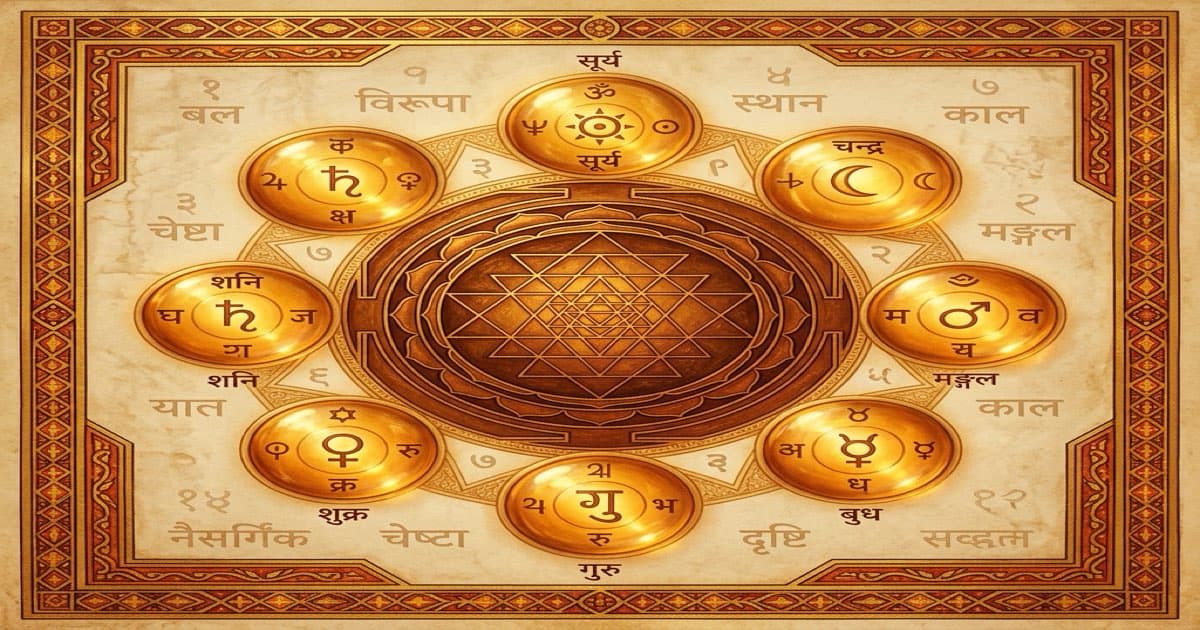
Your kundali has seven key planets — but they're not equally powerful. Some dominate your chart. Others barely register during their Dasha. Shadbala (षड्बल) is how the Parashara system of Vedic astrology separates the two. Defined in the Brihat Parasara Hora Shastra (BPHS), it measures each planet's strength across six dimensions — positional, directional, temporal, motional, natural, and aspectual — and produces a precise score in Rupas. Our calculator runs this full BPHS-compliant computation and shows you the results visually, planet by planet.
The Six Components of Shadbala
Sthaana Bala
Positional Strength
Sthaana Bala measures the power a planet draws from its placement in the zodiac — its sign, its exaltation or debilitation degree, its divisional chart positions, and its relationship with the sign's lord. A planet in its own sign (swakshetra) or exaltation (uccha) earns its highest Sthaana Bala.
💡 Jupiter in Sagittarius (own sign) scores close to maximum Sthaana Bala.
Dig Bala
Directional Strength
Put Jupiter in the 1st house and it thrives. Move it to the 7th and it loses all directional power. That's Dig Bala — each planet has one preferred quadrant house (1st, 4th, 7th, or 10th) where it gains maximum directional strength, and the further it moves from that sweet spot, the weaker it gets.
💡 Sun and Mars gain full Dig Bala in the 10th house (south); Jupiter and Mercury in the 1st (east); Moon and Venus in the 4th (north); Saturn in the 7th (west).
Kaala Bala
Temporal Strength
Born at 3 AM on a Krishna Paksha night? Your nocturnal planets — Moon, Mars, Saturn — already carry a temporal advantage. Kaala Bala captures the power a planet draws from when you were born: the hour, the half of the day, the lunar fortnight, the month, the season, and the solstice period. It is the most complex of the six components, with sub-calculations including Nathonnatha Bala, Paksha Bala, and Tribhaga Bala.
💡 Sun, Jupiter, and Venus are stronger by day (diurnal planets); Moon, Mars, and Saturn are stronger by night (nocturnal). Mercury is strong both times.
Chesta Bala
Motional Strength
Chesta Bala measures the strength a planet draws from its motion — its current speed relative to its mean speed, and whether it is direct, retrograde, or stationary. A retrograde planet (vakri), moving opposite to its natural direction, is considered particularly energised and receives high Chesta Bala. Sun and Moon do not retrograde, so their Chesta Bala is always 0 — this is by classical design, not an error.
💡 A retrograde Mars moving slowly "against the current" expends the most effort and scores highest in Chesta Bala. Fast-moving planets score lower.
Naisargika Bala
Natural / Innate Strength
Naisargika Bala is the one component that never changes. It represents each planet's fixed, eternal luminosity — its intrinsic brightness and power, independent of any chart. The hierarchy is fixed by BPHS: Sun ranks highest, followed by Moon, Venus, Jupiter, Mercury, Mars, and Saturn at the lowest. This is the baseline all planets carry into every horoscope.
💡 Sun always has the highest Naisargika Bala (60 virupas); Saturn always has the lowest (8.57 virupas). Every chart shares this ranking.
Drik Bala
Aspectual Strength
Drik Bala measures the net effect of all planetary aspects received. Benefic aspects from Jupiter, Venus, Mercury, and waxing Moon strengthen a planet; malefic aspects from Saturn, Mars, and Rahu weaken it. Here's the important part: Drik Bala can go negative — meaning a planet is under net malefic influence. A negative value should never be clamped to zero; it carries real interpretive weight.
💡 A Moon aspected by Jupiter gains positive Drik Bala; the same Moon aspected by Saturn and Mars may have strongly negative Drik Bala — it is under pressure from the heavies.
What Did Parashara Prescribe? — Minimum Strength Thresholds
Minimum Rupas per planet as defined by Brihat Parasara Hora Shastra
| Planet | Min Rupas | Min Virupas |
|---|---|---|
| Sun | 6.5 | 390 |
| Moon | 6 | 360 |
| Mars | 5 | 300 |
| Mercury | 7 | 420 |
| Jupiter | 6.5 | 390 |
| Venus | 5.5 | 330 |
| Saturn | 5 | 300 |
Ishta Phala vs Kashta Phala — Is Your Planet Helping You?
Shadbala tells you how strong a planet is. But Ishta Phala and Kashta Phala answer a different question: is that strength working in your favour?
Ishta Phala (इष्ट फल) measures a planet's capacity to grant blessings — it rises with brightness, speed, and benefic dignity. A high Ishta Phala means the planet is primed to help when its Dasha activates.
Kashta Phala (कष्ट फल) measures the opposite — the planet's capacity to create difficulty. It rises with dimness, slowness, and malefic pressure. High Kashta Phala does not mean the planet is evil; it means it is carrying more weight than it can easily bear.
The healthiest configuration is high Ishta Phala relative to Kashta Phala. A strong planet (high Shadbala ratio) with high Ishta Phala is a true asset. A strong planet with disproportionately high Kashta Phala is a "powerful but stressed" planet — it will act, but perhaps not smoothly.
Reading Your Results — What the Numbers Mean
Each planet's strength is measured in Virupas — think of them as strength-points. 60 Virupas = 1 Rupa. The Brihat Parasara Hora Shastra defines a minimum Rupa requirement for each planet.
If a planet exceeds its minimum, it's "Bal-Yukta" (strong). Below it? "Balaheena" (weak). The ratio column shows this at a glance: above 1.0× = strong, below = needs attention.
A ratio of 1.5× means the planet has 50% more strength than its minimum. A ratio of 0.8× means it falls 20% short. Both are useful numbers — they tell you exactly how much room the planet has to work with.
When Should You Use Shadbala?
Before Wearing a Gemstone
Check if the planet is actually weak. Wearing a gemstone for a planet that's already at 1.5× is wasteful — and can overstimulate an already strong planet.
During Dasha Transitions
The Dasha lord's Shadbala tells you how intense the coming period will be. A strong Dasha lord acts decisively; a weak one may deliver slow or diluted results.
View your Vimshottari Dasha →After a Kundali Reading
A pandit said your Jupiter is "strong"? Validate with Shadbala. The ratio gives you objective confirmation — no guesswork, just BPHS mathematics.
Generate your Janam Kundali →For Muhurat Selection
A strong Dasha lord + strong relevant house = better timing for important decisions. Shadbala helps you pick the right window from the right chart.
Find auspicious Muhurats →Myths vs. Reality — Common Shadbala Misconceptions
❌The strongest planet in my chart will make me successful
✅Strength ≠ beneficence. A strong Saturn at 2.0× ratio doesn't guarantee success — it guarantees that Saturn's significations (discipline, delay, structure) will act with full force. Whether that helps depends on house placement and Dasha timing.
❌Low Shadbala means my planet is useless
✅A planet at 0.85× ratio isn't dead — it's below the benchmark. It still acts, just with less horsepower. A weak Jupiter still gives some wisdom; it just won't dominate your life the way a 1.8× Jupiter would.
❌Retrograde planets are always bad
✅In Shadbala, retrograde (vakri) planets score highest in Chesta Bala. The system treats retrograde motion as high effort — like swimming upstream. Effort ≠ bad. A retrograde Jupiter may give delayed but deep wisdom.
❌Shadbala replaces reading the full chart
✅Shadbala measures raw horsepower. It doesn't tell you which house a planet rules, what Dasha you're in, or what yogas are present. It's one lens — arguably the most precise one — but never the only one.
Want Deeper Kundali Insights?
Your Shadbala analysis is just one layer of your birth chart. Generate your complete Janam Kundali to explore Doshas, Yogas, Dasha periods, and house analysis together.
Shadbala FAQs — Planetary Strength Questions Answered
What is Shadbala in Vedic astrology?+
How is Shadbala calculated?+
Which planet is the strongest in my kundali?+
What does it mean if a planet has low Shadbala?+
What are the remedies for a weak planet in the horoscope?+
What is the difference between Shadbala and Bhavbala?+
Can a strong planet still give bad results?+
What is Drik Bala and why is it sometimes negative?+
Why is my Sun's or Moon's Chesta Bala zero?+
What are the minimum Rupas required according to BPHS?+
Shadbala calculations follow the classical method described in the Brihat Parasara Hora Shastra (BPHS) — the foundational text of Parashara Astrology. Planetary strength is one of many factors in Jyotish interpretation. For major life decisions, consult a qualified Vedic astrologer who can assess the full chart context.