
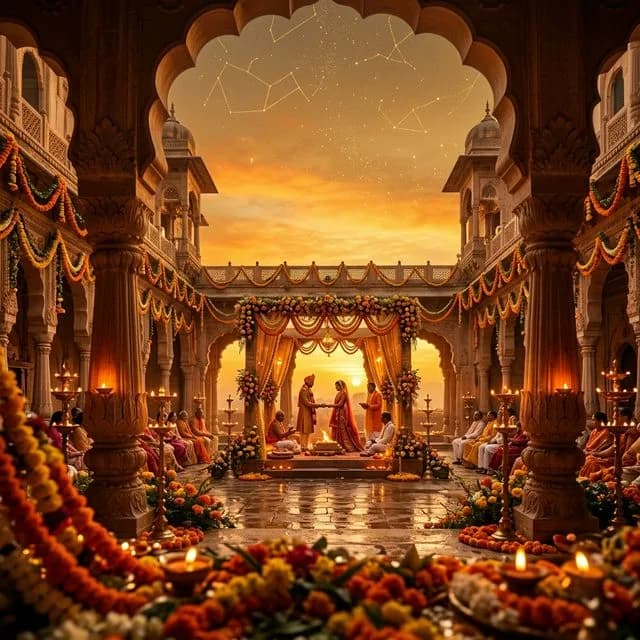
No panchang-pure shubha muhurats are available in this month.
No panchang-pure shubha muhurats are available in this month.
No panchang-pure shubha muhurats are available in this month.
No panchang-pure shubha muhurats are available in this month.
Auspicious wedding dates in 2026 — New Delhi
Panchanga-pure muhurat calculations based on Nakshatra, Tithi & planetary positions
Shubh Muhurat by Season in 2026 — New Delhi
Based on the actual panchang calculation loaded above for New Delhi, 2026.
February–March, May: Peak Season for Auspicious Dates
February–March, May together carry 27 shubha muhurat dates — the richest window of 2026 for planning in New Delhi. Chaturmas has not begun and favourable nakshatras align most frequently during these months.
January, August–October: Why Shubh Muhurat Dates Disappear
January, August–October shows zero shubha muhurat dates. This is typically caused by Chaturmas, Kharmas, or Venus/Jupiter combustion (Tara Asta). Our calculator checks all conditions dynamically; dates only appear when every classical filter passes.
April, June–July, November–December: Second Window for Shubh Muhurat Dates
April, June–July, November–December offers 29 additional shubha muhurat dates — useful if you couldn't find a date during the primary window. Planetary positions and nakshatra combinations in these months can still deliver high-quality muhurat windows.
Every Vivah Muhurat Date Above Has Passed a Classical Panchang Check
Every date marked Shubha in the calendar above has cleared not one but seven classical panchang filters, drawn from Brihat Parasara Hora Shastra and Muhurta Chintamani — the two texts Jyotish practitioners have relied on for centuries to identify auspicious Vivah Muhurat windows.
This is why January might show 9 auspicious wedding dates and March might show 14 — the count isn't an estimate. It's a location-precise calculation anchored to your city's exact sunrise, nakshatra transition, and tithi boundaries for that day.
On top of the classical rules, we've built a modern heliacal rising and setting algorithm to detect Tara Asta — the combustion of Venus (Shukra) and Jupiter (Guru) when they're too close to the Sun to be visible. Both planets are karaka for marriage in Vedic Jyotish, and tradition holds that no Vivah Muhurat should be fixed while they're combust. Most manual panchang lookups miss this layer entirely. Ours doesn't.
How We Calculate Shubh Vivah Muhurat Dates
When Vivah Muhurat Cannot Be Fixed — Classical Prohibitions
If any month in the calendar shows zero dates, one of these classical blocks is in effect —
Chaturmas — The Classical Marriage Prohibition (Jul–Oct)
From Ashadha Shukla Ekadashi (Devshayani) to Kartik Shukla Ekadashi (Devuthani) — a span of roughly four lunar months — Lord Vishnu is in yoganidra and all auspicious rites including Vivah Muhurat are prohibited. The exact start and end dates shift by a few days every year based on the lunar calendar. Our engine computes these boundaries dynamically for each year rather than using fixed calendar dates, which is why the void period may differ slightly from what a printed almanac shows.
Tara Asta — Venus & Jupiter Combustion (Shukra Asta / Guru Asta)
When Venus (Shukra) or Jupiter (Guru) are too close to the Sun to be visible above the horizon, they are said to be combust — Shukra Asta or Guru Asta respectively. Vedic tradition holds that both planets, being the primary karakas for marriage, must be visible and unobstructed for a Vivah Muhurat to be valid. Most panchang apps and printed almanacs do not check this programmatically, which is why they may show dates during combust periods. We use astronomical heliacal rising and setting data to check every single date — a date appears on this calendar only when both planets are confirmed visible.
Khar Maas (Malmaas) — Sun in Sagittarius or Pisces
When the Sun transits Sagittarius (mid-December to mid-January) or Pisces (mid-February to mid-March), the period is called Khar Maas or Malmaas. North Indian traditions observe a prohibition on marriages during these solar months. This is why early January and mid-February to mid-March may show fewer or no auspicious wedding dates depending on prevailing nakshatra and tithi combinations. South Indian traditions typically do not observe this restriction.
Vivah Muhurat — Frequently Asked Questions
More Auspicious Muhurat Calculators
Based on classical Vedic Panchanga rules. Consult a qualified Jyotish practitioner for major ceremonies.