
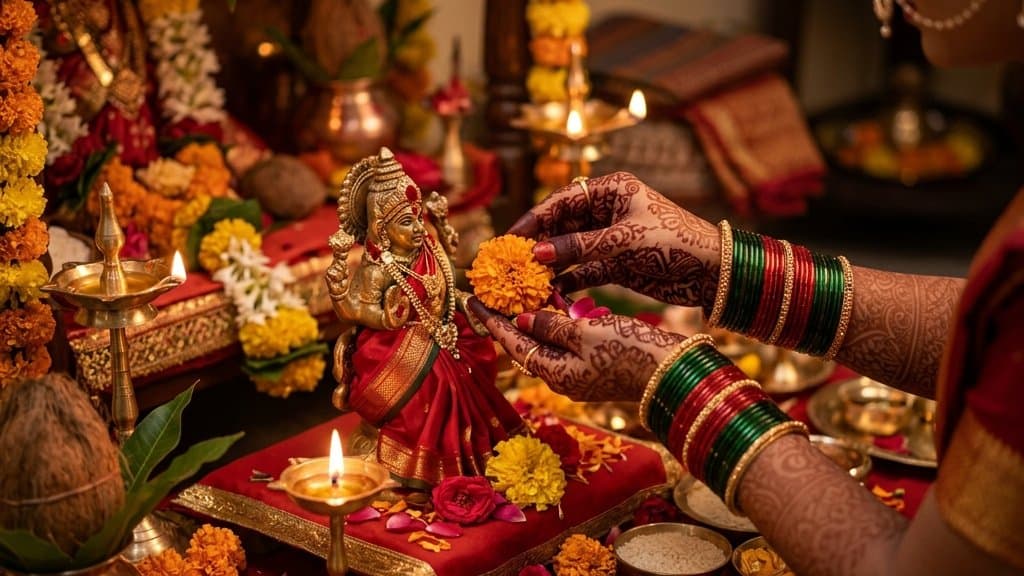
Mangala Gauri Vrat is the Tuesday observance of Sawan, dedicated to Goddess Gauri — a gentle form of Parvati. Married women, and especially newly married ones, keep it for the long life and wellbeing of their husbands and for harmony in the home.
In 2026 the vrat falls on all four Tuesdays of the North Indian (Purnimanta) Shravan — 4, 11, 18 and 25 August. Below are the dates, the full puja vidhi and samagri, the traditional vrat katha, and why the vrat is held so dear.
Mangala Gauri Vrat 2026 at a glance
Vrat
Mangala Gauri Vrat
Total Days
4 Tuesdays of Sawan
First Vrat
Tue, 4 August 2026
Last Vrat
Tue, 25 August 2026
Deity
Goddess Gauri (Parvati)
Kept by
Married women
Mangala Gauri Vrat 2026 dates
The four Tuesdays of Sawan to keep the fast
Tuesday, 4 August
First Sawan Tuesday
Tuesday, 11 August
Tuesday, 18 August
Tuesday, 25 August
Also Bhaum Pradosh
Mangala Gauri puja vidhi
How the Tuesday worship is performed
The observant woman rises before sunrise, bathes and wears clean or festive clothes, then takes a sankalp to keep the vrat. On a wooden seat she installs an idol or picture of Goddess Gauri and offers her the sixteen items of shringar — bangles, sindoor, bindi, mehndi and the rest — along with sixteen flowers, garlands, laddoos and betel nuts. A lamp of wheat flour with sixteen wicks is lit before the goddess. She then reads or listens to the Mangala Gauri Vrat Katha, performs the aarti and prays for the wellbeing of her husband and family. The fast is kept through the day and broken after the evening worship; the shringar and offerings are given to a Brahmin woman or an elder married woman.
Puja samagri — what to keep ready
The offerings, gathered in sixteens
- 1A clay or metal idol/photo of Goddess Gauri
- 2Sixteen items of shringar (bangles, bindi, sindoor, kajal, mehndi, comb, etc.)
- 3Sixteen each of flowers, garlands, laddoos, betel nuts, cloves and cardamom
- 4A wheat-flour lamp with sixteen wicks
- 5Roli, akshat (rice), moli, incense and dhoop
- 6Fruits, dhatura, bilva leaves and pure water for the offering
Mangala Gauri Vrat Katha
The story behind the vow
The best-known katha tells of a wealthy but childless merchant who, after long worship of Goddess Gauri, was granted a son — but the son was destined to a short life. Through the merit of the Mangala Gauri Vrat, kept devotedly by the women of the family, and by the grace of the goddess, the boy was saved and blessed with a long life and a good marriage. The story is read on each Tuesday of the vrat as a reminder that sincere devotion to Gauri protects the family and lengthens the life of a woman's husband.
Significance of the vrat
Why married women hold it so dear
Sawan is Shiva's month, and Gauri is his consort; worshipping her on the Tuesdays alongside the Monday worship of Shiva completes the devotion to the divine couple. For a married woman the vrat is an act of love for her husband and household — a prayer for his long life, for children, and for an unbroken, contented married life. The offerings in sixteens, echoing the solah shringar, make the vrat a celebration of saubhagya, the auspicious married state.
Solah Shringar
Find your city's Tuesday timings
These dates are for New Delhi. For your city's exact sunrise, tithi and the day's auspicious windows, use our live tools.
Frequently asked questions
Mangala Gauri Vrat 2026 dates and vidhi