
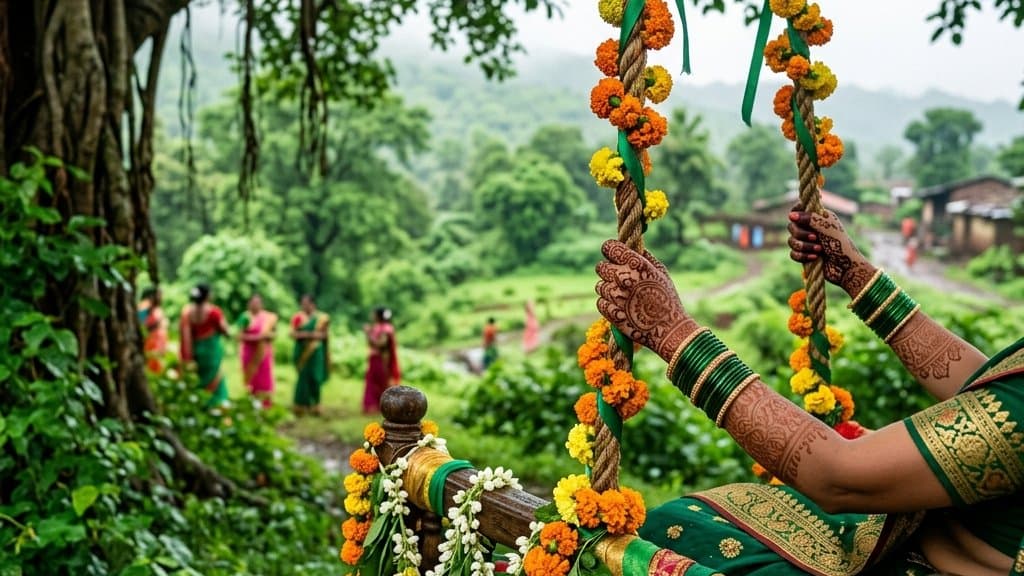
Hariyali Teej is the green festival of Sawan — a day when married and unmarried women dress in green, apply mehndi, swing on flower-decked jhulas and keep a vrat for Shiva and Parvati. Falling on the Shukla Tritiya of Shravan, it celebrates the reunion of Shiva and Parvati and the greening of the land under the monsoon.
In 2026, Hariyali Teej falls on Saturday, 15 August. Below are the exact Shukla Tritiya timings for New Delhi, the morning puja muhurat, the Teej vrat puja vidhi, the vrat katha, and the meaning of the green and the swing at the heart of the festival.
Hariyali Teej 2026 at a glance
Festival day
Sat, 15 August 2026
Tithi
Shukla Tritiya
Tritiya begins
14 Aug, 18:48
Tritiya ends
15 Aug, 17:30
Puja muhurat
15 Aug, ~05:54 – 09:07
Kept by
Married & unmarried women
Hariyali Teej 2026 date & puja muhurat
The Shukla Tritiya timings and the morning window
Puja muhurat
05:54 – 09:07
15 August, morning (New Delhi)
Shukla Tritiya
14 Aug 18:48 → 15 Aug 17:30
In 2026 the Shukla Tritiya of Shravan begins at 18:48 on 14 August and ends at 17:30 on 15 August (New Delhi). Because the Tritiya is present at sunrise on the 15th, Hariyali Teej is observed on 15 August. The morning is auspicious for the puja — roughly between 05:54 and 09:07 — and many women also worship in the evening pradosh period. The exact windows shift with your city's sunrise and sunset.
Teej vrat puja vidhi
How the Teej vrat is kept and Shiva-Parvati worshipped
Women keep a nirjala (waterless) or phalahar fast from dawn. They bathe, dress in green, apply mehndi and wear green bangles and bindi. Idols of Shiva and Parvati, often shaped from clay or sand, are placed on a chowki and worshipped with roli, akshat, flowers, fruit, sweets, and sindoor offered to Parvati. The Teej katha is read, Parvati is prayed to for marital happiness, and the aarti is performed. Decorated swings are hung from trees, Teej songs are sung, and women gather to celebrate. The fast is broken after the moon or the evening worship, per family tradition.
The Hariyali Teej vrat katha
Parvati's penance and reunion with Shiva
The Teej katha recalls how Parvati undertook a severe penance across many births to win Shiva as her husband. In one telling, her father wished to marry her elsewhere, so her friends (sakhis) spirited her away to a forest — the origin of the name Hartalika in the later Teej — where she made a Shivling of sand and worshipped it with unbroken devotion. Pleased at last, Shiva accepted her as his consort. Hariyali Teej celebrates this union, and women keep the vrat invoking that same steadfast devotion for their own married life.
The green, the jhula and married women
Why Hariyali Teej matters
Hariyali — greenery — names the festival, for it falls when Sawan rains turn the earth green and the season is at its most alive. Women wear green, the colour of Parvati and of fertility and renewal, and swing on jhulas hung from trees, singing songs of longing and union. For married women the vrat is for the long life of their husbands and household harmony; for unmarried girls, a prayer for a worthy partner. If marriage is on your mind, our Kundali Matching tool offers a Vedic compatibility reading.
If marriage is on your mind
Check the Teej timings for your city
These timings are for New Delhi. For your city's sunrise, tithi and the day's auspicious windows, use our live tools.
Frequently asked questions
Hariyali Teej 2026 date, muhurat and vrat