
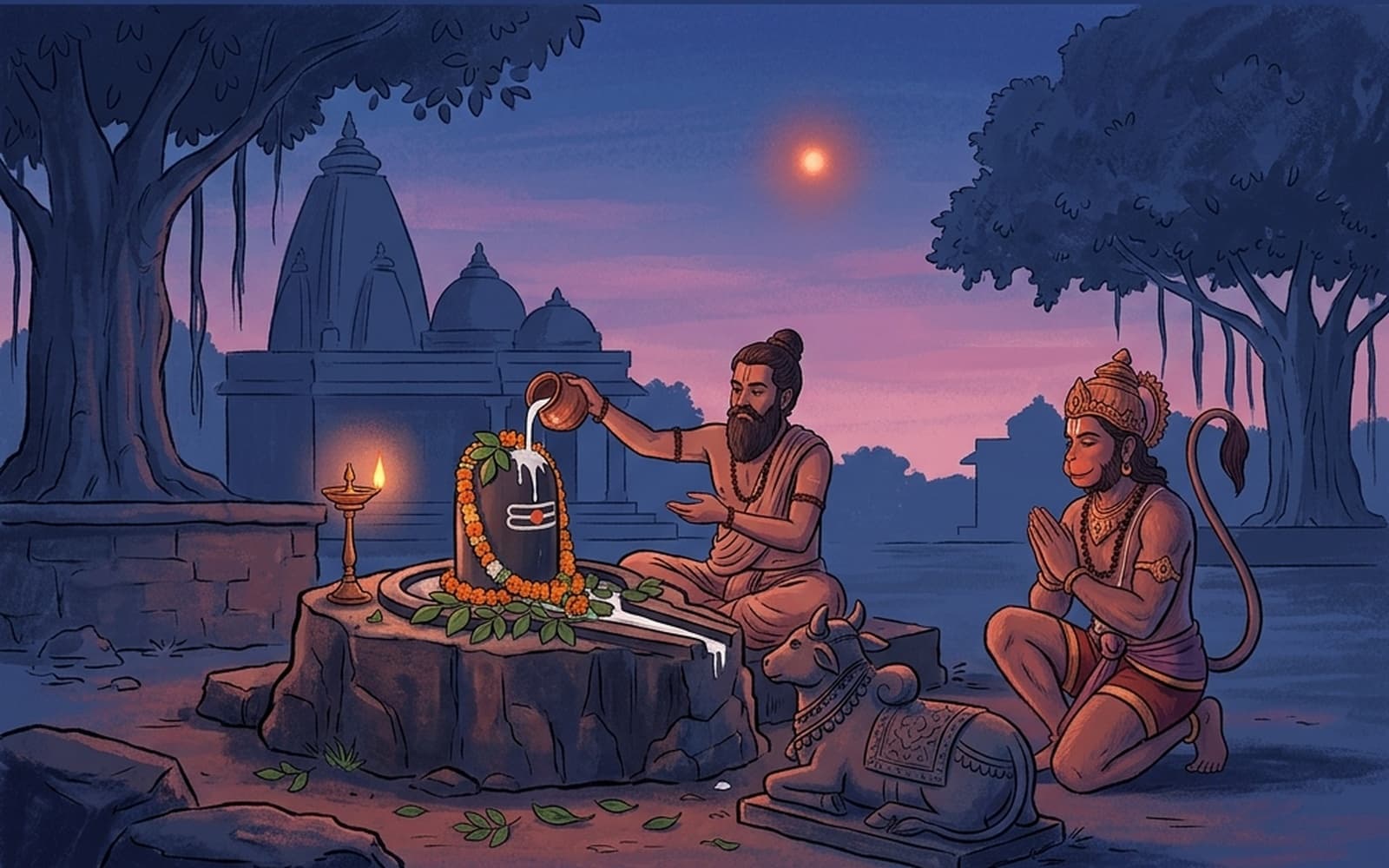
The next Bhaum Pradosh is on Tuesday, 5 January 2027. In New Delhi the Pradosh kaal for Shiva puja is from 5:38 PM to 8:02 PM.
Bhaum Pradosh Vrat is a Pradosh — a fast for Lord Shiva on the Trayodashi, the thirteenth tithi — that happens to fall on a Tuesday. Every Pradosh is kept in the Pradosh-kaal, the roughly ninety-minute twilight around sunset when Shiva is worshipped, and the vrat takes its name from the weekday it lands on. Tuesday belongs to Mangal, the planet Mars, so when Shiva's evening tithi meets Mars's day the fast is called Bhaum Pradosh — Bhauma being another name for the red planet.
That pairing is what people come to it for. Mars governs courage, blood and energy, and in the practical reading of a chart he stands for the burden of loans; Tuesday is also Hanuman's day. So devotees turn to Bhaum Pradosh above all for Rin Mochan — release from debt — and for relief from a difficult Mars, whether that shows as Manglik dosha in a chart or as restlessness and conflict in daily life. The day belongs to no fixed month; it arrives whenever a Trayodashi lands on a Tuesday, which happens only a few times in a year.
Bhaum Pradosh at a glance
Date in 2027
Tuesday, 5 January 2027
Presiding deity
Lord Shiva
Tithi
Trayodashi (13th tithi)
Weekday & lord
Tuesday · Mangal (Mars)
Observance
Day-long fast, Pradosh-kaal Shiva puja
Date & the Pradosh-kaal
The next Tuesday Trayodashi and its evening puja window for your city
Pradosh-kaal begins
05 January 2027, 05:38 PM
Pradosh-kaal ends
05 January 2027, 08:02 PM
| Upcoming dates | Day |
|---|---|
| 5 January 2027 | Tuesday |
| 12 October 2027 | Tuesday |
| 8 February 2028 | Tuesday |
Times shown for New Delhi; pick your city on the Pradosh Vrat calendar for local timings.
Where Shiva's tithi meets Mars
Why the Tuesday Trayodashi becomes Bhaum Pradosh
Pradosh is Shiva's own twilight. Trayodashi, the thirteenth tithi, is observed in the Pradosh-kaal — the short window that spans sunset — because tradition holds that Shiva is at his most gracious in that hour, when day gives way to night. This tithi comes twice each lunar month, once in the waxing fortnight and once in the waning, so a Pradosh can land on any weekday. Its name simply records which one.
When it falls on a Tuesday it becomes Bhaum Pradosh, after Bhauma — Mangal, the planet Mars. In Jyotish, Mars is the soldier among the planets: he rules courage, drive, physical strength and blood, and he presides over Tuesday. Layered over the base worship of Shiva, that martial dimension is what gives this Pradosh its particular reputation — a day to settle a restless, over-heated Mars and to ask for the strength to carry a heavy burden. Because Tuesday is also sacred to Hanuman, many keep the two together.
Keeping the fast and the evening puja
From the morning sankalp to the Pradosh-kaal abhishek
The vrat runs the length of the day. Devotees bathe in the morning, take a sankalp to keep the fast, and pass the day on water or a single light, fruit-based meal, saving the main worship for the evening. As the Pradosh-kaal opens near sunset, they bathe again and sit for Shiva puja.
The heart of it is the abhishek — bathing a Shivling with water, and often with milk — followed by the offering of bilva (bel) leaves, held especially dear to Shiva, along with white flowers, sandal, dhatura and a lamp. The Pradosh vrat katha is read or heard, the mantra Om Namah Shivaya is chanted, and on a Tuesday many add a reading of the Hanuman Chalisa. The fast is broken only after the Pradosh-kaal worship is complete, usually with the prasad. None of this needs to be elaborate; the tradition values steadiness and sincerity over show.
Courage, Mangal dosha and Hanuman's grace
Steadying a difficult Mars
Mars is a benefic when he is well placed — the source of decisiveness, stamina and the nerve to act — and a source of friction when he is afflicted, or when he sits as Manglik dosha in certain houses from the ascendant, Moon or Venus. A troubled Mars is felt as a short temper, accidents, disputes, or strain in marriage. Bhaum Pradosh is the day many set aside to worship Shiva for that Mars to settle.
The Tuesday link to Hanuman runs deep here. Hanuman is himself a devotee of Rama and a form of Shiva's own energy, and tradition holds that his grace tempers Mars's heat; reading the Hanuman Chalisa, or offering him sindoor and a jasmine-oil lamp, is a common part of the day. Some also give red items — masoor dal, red cloth, jaggery — in charity. Read these as ways to steady the mind and turn Mars's energy toward patience and effort, not as a switch that removes every difficulty.
Kept in the spirit of faith
Rin Mochan — the prayer to be free of debt
Why the indebted keep this Pradosh
The theme that sets Bhaum Pradosh apart is Rin Mochan — literally, release from debt. Mars, as the planet of loans and liabilities in the practical reading of a chart, is petitioned on his own day, folded into the worship of Shiva, to lift the weight of borrowing. Those struggling with loans keep the fast with this specific prayer, and some recite the Rin Mochan Mangal Stotra, a hymn to Mars for freedom from debt, during the Pradosh-kaal.
The tradition frames this as clearing a karmic account as much as a financial one. It is meant to renew resolve, discipline and the will to repay honestly — not to make a debt vanish of its own accord. Kept in that spirit, alongside real budgeting and steady effort, the observance is a source of composure for anyone carrying a heavy load.
If debt has become a real burden
See today's live panchang for your city
Tithi, nakshatra, sunrise and the day's muhurat, computed for wherever you are.
Bhaum Pradosh — questions answered
The Tuesday Trayodashi, the Pradosh-kaal and relief from debt and Mangal