
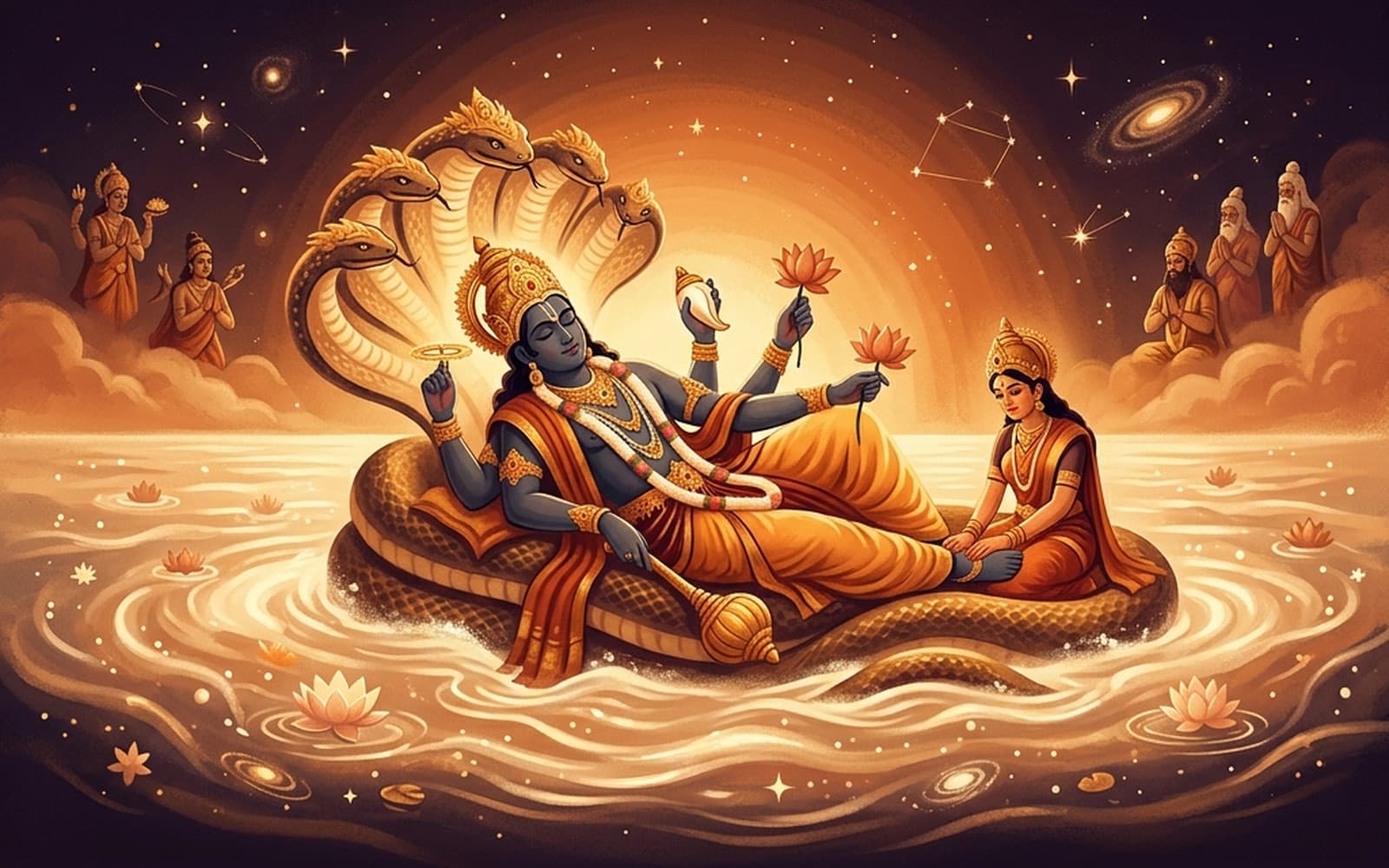
Devshayani Ekadashi is one of the year's turning points. It is the eleventh tithi of the bright fortnight of Ashadha, kept as a fast for Lord Vishnu — and the day he is said to lie down in yoga-nidra, a four-month cosmic sleep. From here the season of Chaturmas begins.
The day carries several names — Ashadhi, Hari Shayani, Padma, Devpodhi. All of them point to the same idea: the divine order settling into rest, and the household turning from outward ventures toward devotion until Vishnu wakes in Kartik.
Devshayani Ekadashi at a glance
Date in 2027
Wednesday, 14 July 2027
Lunar month
Ashadha · Shukla Paksha
Deity
Lord Vishnu
Marks
Start of Chaturmas
Also called
Ashadhi · Hari Shayani · Padma
Date & tithi timing
Observance day and tithi window for your city
In 2027, Devshayani Ekadashi is observed on Wednesday, 14 July 2027. The Ekadashi tithi begins 13 July 2027, 12:09 PM and ends 14 July 2027, 01:11 PM.
Tithi begins
13 July 2027, 12:09 PM
Tithi ends
14 July 2027, 01:11 PM
| Year | Observance day |
|---|---|
| 2026 | Saturday, 25 July 2026 |
| 2027 | Wednesday, 14 July 2027 |
Times shown for New Delhi; pick your city on the Ekadashi calendar for local timings.
Why this Ekadashi matters
Vishnu's yoga-nidra and the turn of the year
The image at the heart of this day is Vishnu reclining on Shesha, the cosmic serpent, adrift on the ocean of milk. For the four months that follow, tradition holds that he withdraws from active governance of the world. That is why Devshayani is treated less as a festival of celebration and more as a threshold: a day to fast, to steady the mind, and to begin the discipline the coming season asks for. The Ekadashi katha is read, tulsi is offered, and the evening is given to Vishnu's names.
Chaturmas begins here
The four months of restraint and devotion
Chaturmas — literally four months — runs from Devshayani Ekadashi to Prabodhini (Dev Uthani) Ekadashi in Kartik, when Vishnu wakes. Because the divine order is understood to be at rest, these months are held apart from new beginnings: weddings, housewarmings, thread ceremonies and other auspicious starts are traditionally deferred until they close. In their place comes a season of vows — many give up a food or a habit for the four months — and of quieter, inward practice.
How the vrat is kept
Fasting, worship and the day's discipline
Observance is simple in form and demanding in spirit. Most keep a day-long fast, setting grains aside and taking only fruit, milk and water; some keep it without water at all. The day opens with a bath and a sankalp, moves through worship of Vishnu with tulsi leaves and a lamp, and closes with the Ekadashi katha in the evening. The fast is broken the next morning, on Dwadashi, within the parana window. Keep to what your family tradition and your health allow — this is offered for understanding, not as prescription.
Breaking the fast — parana
The window that completes the vrat
Parana is the breaking of the fast, and its timing completes the vrat. It is done the next morning on Dwadashi — after sunrise, before the Dwadashi tithi ends, and never during Hari Vasara, the first quarter of Dwadashi. Breaking too early or too late is held to undo the fast, which is why the next day's sunrise matters as much as the Ekadashi date itself. The precise window shifts with your city; check the day's panchang for the exact minute.
Mind the parana window
See today's live panchang for your city
Tithi, nakshatra, sunrise and the day's muhurat — computed for wherever you are.
Devshayani Ekadashi — questions answered
Chaturmas, fasting rules and parana