
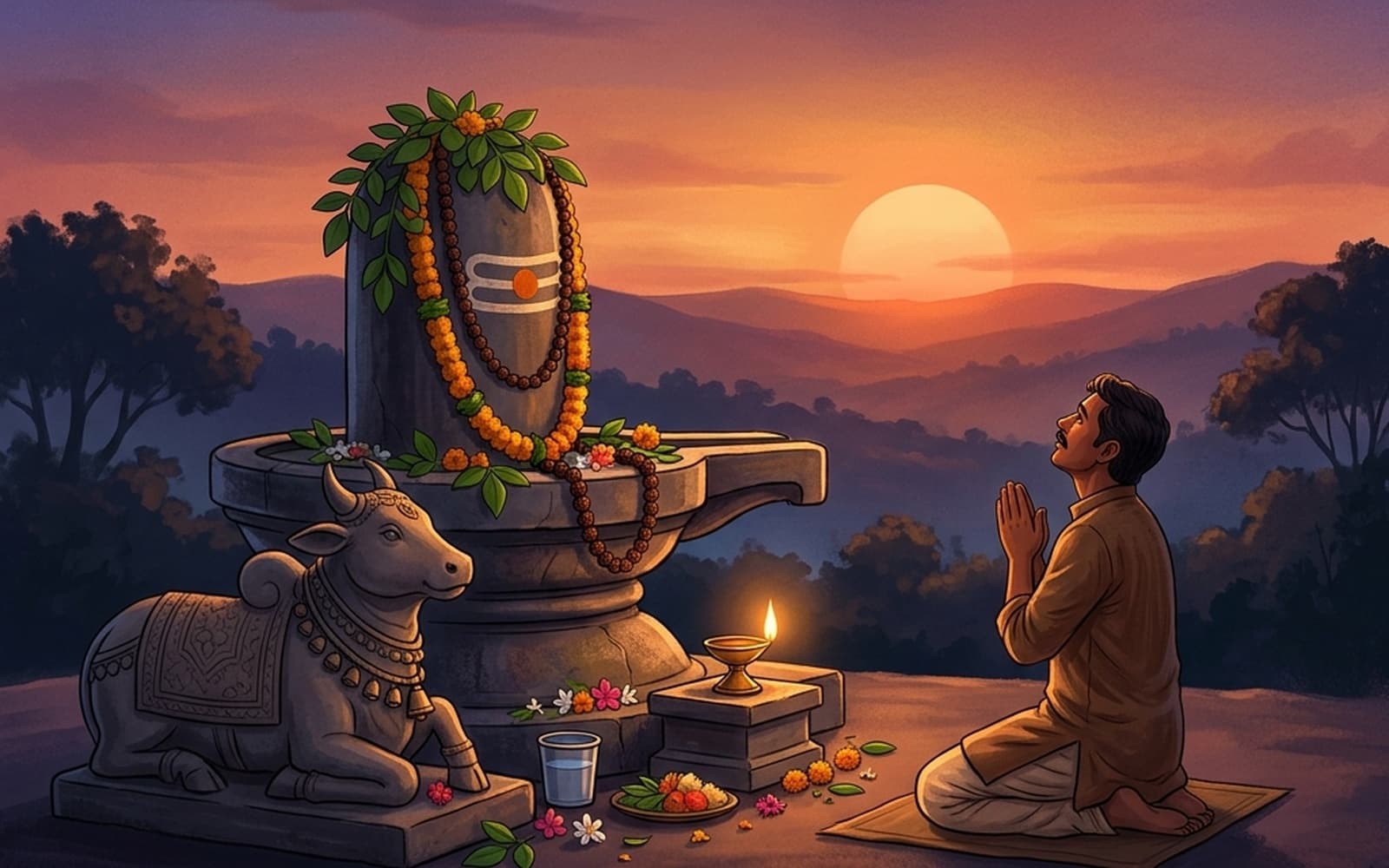
The next Ravi Pradosh is on Sunday, 22 November 2026. In New Delhi the Pradosh kaal for Shiva puja is from 5:25 PM to 7:49 PM.
Ravi Pradosh is the Pradosh Vrat that falls on a Sunday. Pradosh itself is the twilight worship of Lord Shiva kept on Trayodashi, the thirteenth tithi, in the short window around sunset called the Pradosh-kaal. Its name changes with the weekday it lands on, and when a Trayodashi meets a Sunday — the Sun's own day — it is kept as Ravi Pradosh, also known as Bhanu Pradosh, Ravi and Bhanu both being names of Surya.
The base of the day is unchanged: a fast held through daylight and Shiva puja offered in the Pradosh-kaal. What Sunday adds is the Sun's dimension — health, vitality and long life, and the clearing of obstacles that stand in the way of one's work and good name. Ravi Pradosh keeps no fixed month; it arrives only when a Trayodashi falls on a Sunday, which happens a few times across the year.
Ravi Pradosh at a glance
Date in 2026
Sunday, 22 November 2026
Tithi & Paksha
Trayodashi · both fortnights
Presiding deity
Lord Shiva
Weekday & lord
Sunday · Surya (Sun)
Observance
Pradosh-kaal Shiva puja
Date & Pradosh-kaal timing
The next Sunday Trayodashi and its twilight worship window for your city
Pradosh-kaal begins
22 November 2026, 05:25 PM
Pradosh-kaal ends
22 November 2026, 07:49 PM
| Upcoming dates | Day |
|---|---|
| 22 November 2026 | Sunday |
| 6 December 2026 | Sunday |
| 4 April 2027 | Sunday |
Times shown for New Delhi; pick your city on the Pradosh Vrat calendar for local timings.
Why Sunday makes it Ravi Pradosh
Where Shiva's Trayodashi meets the Sun's day
Pradosh belongs to Lord Shiva. Twice each lunar month, on the Trayodashi of the waxing and waning fortnights, devotees fast through the day and worship him in the Pradosh-kaal, the roughly hour-and-a-half of twilight that gathers around sunset. It is held to be the hour Shiva is most gracious, and the vrat is the same whichever weekday it falls on.
What gives each Pradosh its name and its extra colour is that weekday's planetary lord. Sunday is ruled by Surya, the Sun — in Jyotish the karaka of the self, of vitality and health, of the father, and of standing, authority and good repute. When a Trayodashi lands on a Sunday, the tradition reads Shiva's twilight worship as carrying the Sun's blessing as well, and the day is kept as Ravi Pradosh. It is called Bhanu Pradosh too, for Ravi and Bhanu are both old names of the Sun.
Keeping the fast, dawn to dusk
The vrat through the day and the Pradosh-kaal puja
The observance begins at dawn. After bathing, the devotee takes a sankalp — a quiet resolve to keep the fast — and passes the day without a full meal; many take only fruit, milk and water, while the stricter keep a waterless fast, and grains, lentils and salt are set aside. Some also offer arghya, a handful of water raised to the rising Sun, before the day's work, a gesture that suits Sunday well.
The heart of the vrat is the evening. Shortly before sunset the devotee bathes again and sits for Shiva puja as the Pradosh-kaal opens. Shiva, or a Shivalinga, is bathed (abhishek) with water, milk or panchamrit; bilva (bel) leaves, white flowers, sandal, dhatura and a ghee lamp are offered, and the Pradosh katha is read or heard. The fast is broken after the worship, once the Pradosh-kaal has passed.
Kept in the spirit of faith
For health, vitality and long life
The Sun's gift on a Sunday Pradosh
The reason many single out Ravi Pradosh is the Sun. The tradition treats Surya as the source of the body's vital fire — the ojas and tej that show as energy, immunity and steadiness of health — and holds him the karaka of longevity itself. So the day is kept above all for aarogya, sound health, and for a long and unhurried life, whether for oneself or on behalf of an ailing parent or child.
Hold this in its right sense. The vrat is meant to steady the mind, renew discipline and turn attention toward one's well-being — not to work as a cure or to make illness simply lift. The traditional counsel is plain enough: worship strengthens resolve, and resolve, kept up, is what mends a life. Where there is real illness, the day's worship sits alongside a doctor's care, never in its place.
If health is a real concern
For standing, work and self-belief
Clearing what blocks career and good name
The Sun's other domain is the outer life — one's place in the world. Surya stands for authority and recognition, for the father and those in charge, and for pratishtha, the good name a person carries. Where work has stalled, where credit is withheld or reputation has taken a knock, Ravi Pradosh is kept to ask that such obstacles ease and that one's rightful standing be restored.
With it comes an inward gift the Sun is also said to grant: confidence and the steadiness to lead. Many keep the day less for a specific favour than to shake off self-doubt and face their work with a firmer heart. As with all such observance, it is meant to sharpen effort rather than replace it — the day renews resolve, and the work still has to be done.
See today's live panchang for your city
Tithi, nakshatra, sunrise, sunset and the day's muhurat, computed for wherever you are.
Ravi Pradosh — questions answered
The Sunday Pradosh, its twilight window and how it is kept