
Sarva Pitru Amavasya 2027 is on Wednesday, 29 September. In New Delhi the Amavasya tithi runs from 10:56 AM on Wednesday, 29 September to 8:06 AM on Thursday, 30 September.
Sarva Pitru Amavasya is the new moon of Ashwina and the last day of Pitru Paksha, the fortnight set aside each year for the dead. Sarva means all: where the earlier days of the fortnight are kept for ancestors according to the tithi on which each one died, this final day gathers them together. It is the day to remember every forefather at once — the near and the distant, the named and the long forgotten.
Its other name, Mahalaya, means the great abode or the great dissolving, and it carries the weight of the whole fortnight to a close. For most households it is the single most important shraddha of the year, and above all it is the day for those whose date of passing was never recorded or has since been lost — the ancestors who cannot be honoured on any other tithi find their place here.
Sarva Pitru Amavasya at a glance
Date in 2027
Wednesday, 29 September 2027
Lunar month
Ashwina · Krishna Paksha
Dedicated to
All ancestors (Pitru)
The day marks
Close of Pitru Paksha · Sarva Pitru Shraddha
Also called
Mahalaya · Pitru Visarjani · Sarvapitri
Date & tithi timing
The Amavasya day and tithi window for your city
Tithi begins
29 September 2027, 10:56 AM
Tithi ends
30 September 2027, 8:06 AM
| Upcoming dates | Day |
|---|---|
| 29 September 2027 | Wednesday |
| 18 September 2028 | Monday |
Times shown for New Delhi; pick your city on the Amavasya calendar for local timings.
The day that closes Pitru Paksha
Why the last new moon gathers every ancestor
Pitru Paksha is the dark fortnight of Ashwina, a span of roughly a fortnight given over entirely to the dead. Through those days a family performs shraddha for each ancestor on the tithi that matches their day of death — a grandfather who passed on Navami is remembered on Navami, an elder who passed on Panchami on Panchami. The fortnight becomes, in effect, a calendar of remembrance laid over the waning moon.
Sarva Pitru Amavasya is where that calendar ends and everything it could not hold is gathered in. The Ashwina new moon is the last tithi of the fortnight, and on it the shraddha is offered not to one ancestor but to all of them at once — sarva pitru, every forefather of the line. Whatever was missed in the earlier days, whether through circumstance or through not knowing the date, is meant to be completed here.
This is why the day is also called Mahalaya, the great gathering or great abode, and why it is treated as the culmination rather than merely the close. In many homes it is the one shraddha kept without fail even when the tithi-days are not — which is why it is so often called simply the most important day of the fortnight.
Part of Pitru Paksha
Shraddha, tarpan and pind daan
How the day is traditionally kept
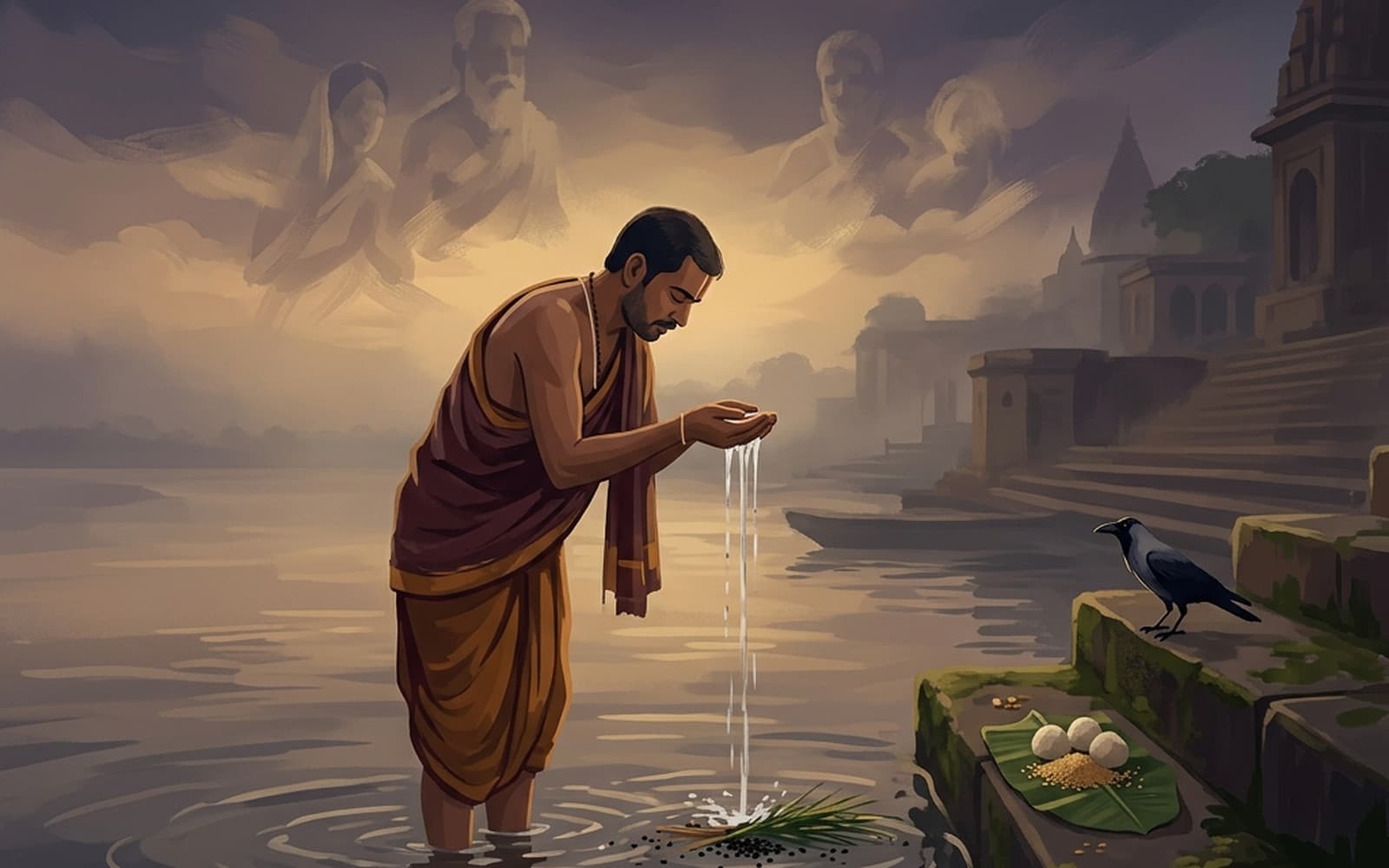
The heart of the day is shraddha, the rite of faith by which food and water are offered to the ancestors. Tarpan is the offering of water: with the sacred thread worn over the right shoulder in the ancestral manner, water mixed with black sesame, barley and kusha grass is poured out in the name of the departed so that the offering reaches those it is meant for. Where a family keeps the fuller rite, pind daan is added — balls of cooked rice and barley shaped and offered as symbolic sustenance for the forefathers.
Feeding is the other half of the day. Tradition holds that the ancestors are satisfied when the living are fed in their name, so a portion of the day's food is set aside for a brahmin, for the needy, and for a cow, a dog and a crow — the crow above all, which folk belief treats as a messenger carrying the offering to the dead. Many keep the day plain and sattvik, without onion or garlic, and give in charity as their means allow.
Where a family has a priest and a river ghat, the rites are often done there around midday, the hour tradition assigns to the ancestors; where that is not possible, a bath, a lamp, water offered at home and food given with a sincere heart are held to carry the same intent. The forms differ by region, community and family custom.
Kept in the spirit of faith
Who keeps it, and for whom
The day for ancestors whose tithi is unknown
By long custom the shraddha is performed by a son — most often the eldest — and where there is none, by a brother, grandson, nephew or the nearest male relative of the line; in many families today a daughter or wife keeps it where no son can, and tradition records women performing shraddha as well. What matters in practice is that someone of the family remembers the dead with faith.
Sarva Pitru Amavasya is above all the day for the ancestors who have no other. If the tithi on which a forefather died was never recorded, or has been forgotten across the generations, there is no day in the fortnight on which to remember them — and it is exactly for these that the last day exists. On it a single shraddha is offered to all the pitrus at once, so that no ancestor is left unhonoured for want of a date.
It is also the day to make good a shraddha that was missed. Anyone who could not keep the proper tithi during the fortnight — through travel, illness or circumstance — is meant to complete it here; and by the same reckoning the day takes in the ancestors of the mother's line and other departed elders who fall outside the direct male line.
What tradition attaches to the day
Pitru rin, blessings and peace of the line
The day rests on the old idea of pitru rin, the debt owed to those who came before — the debt of the very body and name a person carries. Shraddha is understood as the repayment of that debt in the only currency the living can offer the dead: remembrance, water and food given in their name. To keep it is, in this view, less a request than an acknowledgement.
In return tradition speaks of pitru kripa, the grace of contented ancestors. It is held that when the forefathers are remembered and satisfied they bless the family with continuity, health and peace, and that a line which honours its dead is steadied by them. A shraddha left undone, by the same belief, sits as an unease over the household — part of why the all-inclusive day carries such weight.
Set against the fasts and festivals of the year, this is a quiet observance, turned toward gratitude rather than gain. Its promised fruit is not fortune but settledness — the sense of a line at peace with its own past, and of a duty to the dead carried out in full.
See today's live panchang for your city
Tithi, nakshatra, sunrise and the day's timings — computed for wherever you are.
Sarva Pitru Amavasya — questions answered
The day, the vidhi, unknown death-dates and Pitru Paksha