
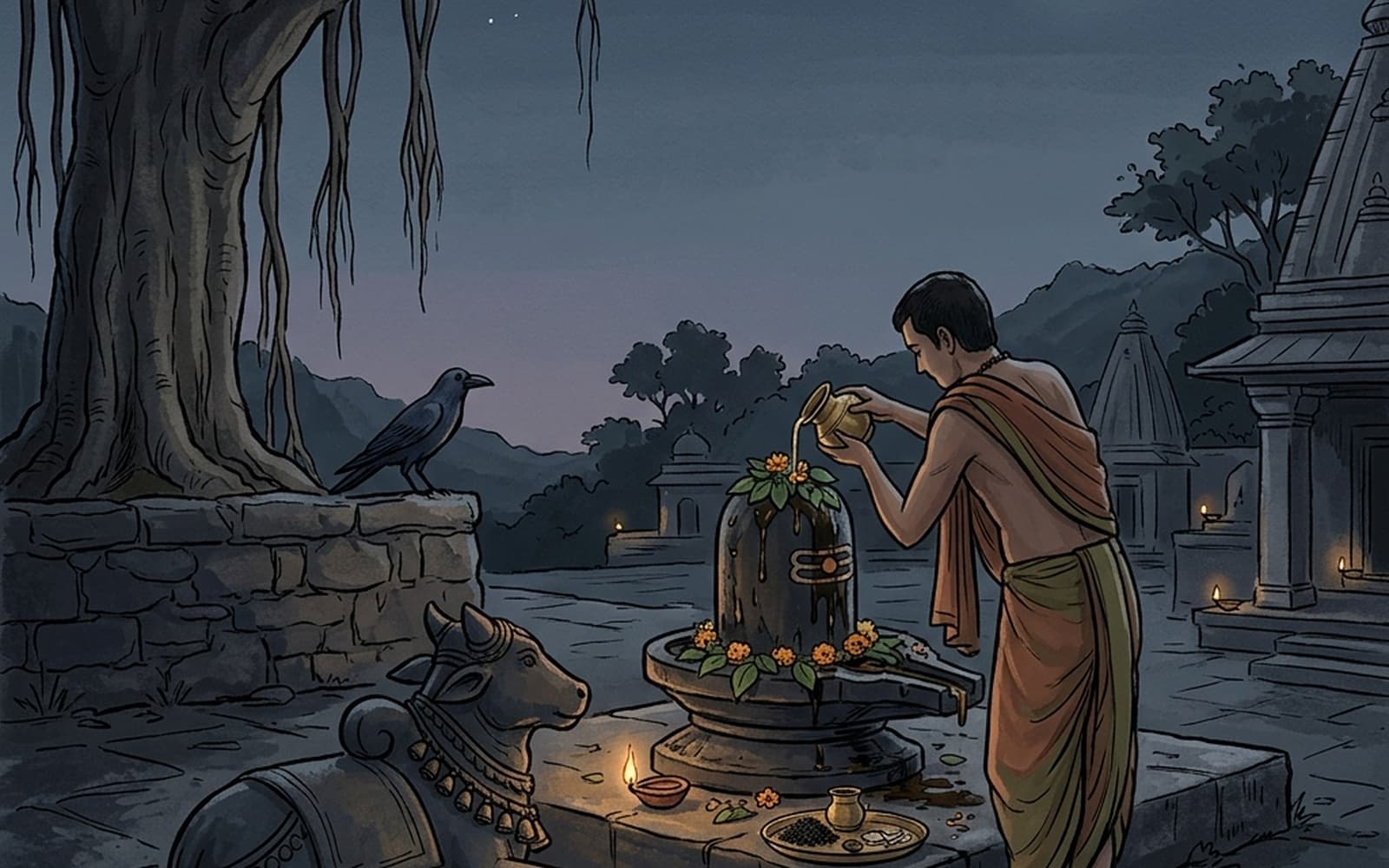
The next Shani Pradosh Vrat is on Saturday, 20 March 2027. In New Delhi the Pradosh kaal opens at 6:32 PM and the Trayodashi ends at 8:46 PM, so do the Shiva puja between the two.
Shani Pradosh Vrat is the Pradosh fast — a day-long fast for Lord Shiva, kept on the Trayodashi tithi — that happens to fall on a Saturday. Every Pradosh centres on the Pradosh-kaal, the roughly ninety-minute twilight around sunset when Shiva is worshipped; and Saturday is Shani Dev's own weekday. When Shiva's Trayodashi and Saturn's day coincide, tradition treats the occasion as doubly potent, and it becomes the most sought-after of all the Pradosh vrats. The exact date and the Pradosh-kaal window for your city are shown in the card below.
This is why so many keep it. Because Saturday belongs to Shani, the evening is turned in particular toward relief from his long, testing periods — Sade Sati and the Dhaiya — laid over the everyday grace a Pradosh fast is believed to bring: health, harmony at home and the settling of obstacles. Shani Pradosh belongs to no fixed month; it arrives only when a Trayodashi lands on a Saturday, which happens a handful of times in a year.
Date & Pradosh-kaal timing
The next Saturday Trayodashi and its worship window for your city
Pradosh-kaal begins
20 March 2027, 06:32 PM
Pradosh-kaal ends
20 March 2027, 08:56 PM
| Upcoming dates | Day |
|---|---|
| 20 March 2027 | Saturday |
| 31 July 2027 | Saturday |
| 14 August 2027 | Saturday |
Times shown for New Delhi; pick your city on the Pradosh Vrat calendar for local timings.
Shani Pradosh Vrat at a glance
Date in 2027
Saturday, 20 March 2027
Tithi
Trayodashi · 13th tithi
Presiding deity
Lord Shiva
Weekday & lord
Saturday · Shani (Saturn)
Observance
Pradosh-kaal Shiva puja
Why Shani Pradosh is the strongest Pradosh
Where Shiva's Trayodashi meets Saturn's day
Pradosh Vrat is, at its heart, a fast for Shiva. It is kept on the Trayodashi — the thirteenth tithi of a lunar fortnight — and its worship falls not in the morning but at pradosh, the meeting of day and night. Shiva is the ascetic among the gods, the one who absorbs what others cannot bear, and the twilight fast is offered to ask him for health, calm and release from whatever has grown heavy.
Saturday carries its own weight. It is the weekday of Shani — Saturn — the slow-moving judge of the planets, who governs discipline, labour and the long working-out of one's karma. When a Trayodashi falls on his day, the tradition reads Shiva's mercy and Shani's justice as meeting in a single evening: the god who can lift a burden and the planet that placed it there. That rare pairing is what makes Shani Pradosh the most sought-after of the Pradosh vrats, kept above all by those living under a difficult Saturn.
The Pradosh-kaal and how the vrat is kept
Fasting through the day, worship at twilight
The Pradosh-kaal is the short window around sunset — roughly the ninety minutes bridging the last of daylight and the first of night. Tradition holds that Shiva is at his most gracious in this hour; the old telling has him dancing between the horns of Nandi at pradosh while the gods look on, which is why the tithi's worship waits for dusk rather than dawn.
Those who keep the vrat fast through the day, many taking only water or fruit. In the late afternoon they bathe and prepare, and as the Pradosh-kaal opens they worship Shiva — at a temple, or before a Shivling at home. The Shivling is bathed (abhishek) with water and milk, offered bilva (bel) leaves, white flowers, sandal and dhatura, and the Pradosh vrat katha is read or heard. The fast is broken only after this twilight worship is complete.
The Saturday remedies for Shani
Oil, black sesame and service to the needy
On a Shani Pradosh the evening's Shiva worship is joined by observances turned toward Saturn. Many bathe the Shivling — or a Shani image at a Shani temple — with mustard or sesame oil, the oils long tied to him, and offer black sesame (kala til), black urad and a piece of iron. Some light a mustard-oil lamp beneath a Peepal tree at dusk, a tree held dear to Shani.
The offerings share a colour and a temper. The same items, with food and warm clothing, are given in charity to labourers, the elderly and the needy, for Shani is the planet of the overlooked and service to them is counted as his truest worship. Devotees recite the Shani mantra or the Dasharatha-krita Shani Stotra, and many remember Hanuman, whom tradition holds can soften Saturn's hardest gaze.
Kept in the spirit of faith
Relief during Sade Sati and Dhaiya
Facing Saturn's long transits with patience
Sade Sati is the roughly seven-and-a-half-year passage of Saturn across the twelfth, first and second signs from a person's birth Moon; the Dhaiya is his shorter transit, about two and a half years, through the fourth or eighth. Both are remembered as demanding stretches — of work, health, means and resolve — and a Shani Pradosh is the evening many set aside to ask that their weight ease.
It helps to hold these periods in proportion. Sade Sati is neither a sentence nor a curse; the tradition reads it as a stern but fair teacher — one that settles old accounts and steadies a person for the road ahead. Many look back on it as the season that made them patient and self-reliant. The observances of this evening are meant to settle the mind and renew resolve, not to promise that difficulty will simply vanish.
If you are truly struggling
See today's live panchang for your city
Tithi, nakshatra, sunrise and the day's muhurat, computed for wherever you are.
Shani Pradosh Vrat — questions answered
The Saturday Trayodashi, the Pradosh-kaal and Saturn remedies