
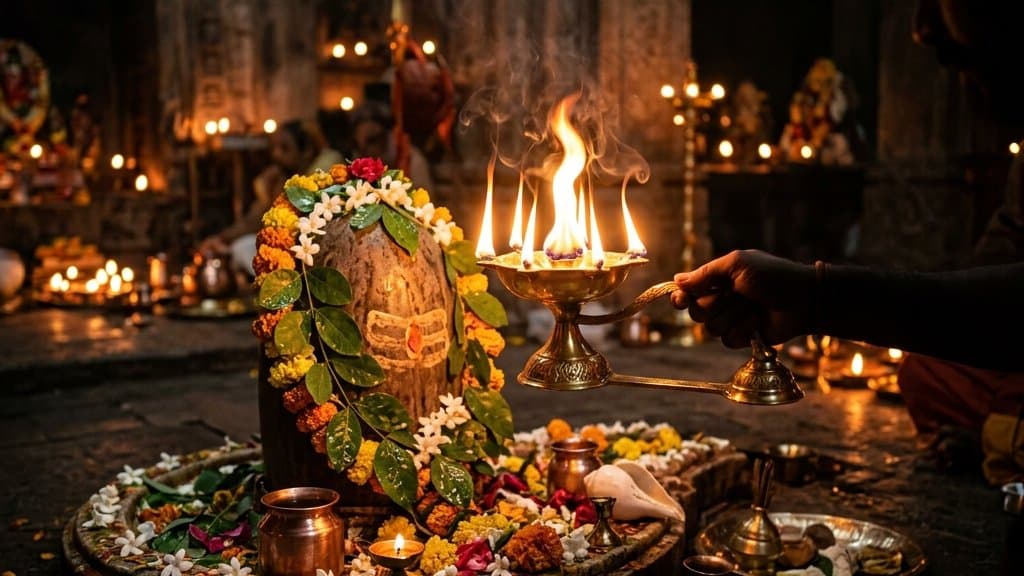
At the end of Shiva’s worship, as a lit lamp is circled before him, the household or the temple breaks into song — most often the beloved aarti “Om Jai Shiv Omkara.” It is the moment the puja is gathered up and offered, the day’s water and bilva leaves sealed with praise.
This guide explains what the Shiv Aarti is, the meaning of its opening lines, when and how it is sung, and why it holds a special place through Sawan. We quote only the well-known opening lines here; the complete verified aarti will follow on a dedicated page.
What the Shiv Aarti is
The song that closes Shiva’s worship
The Shiv Aarti is the song of devotion offered to Lord Shiva at the close of worship, sung while a lit lamp is circled before him. The most widely sung of all is “Om Jai Shiv Omkara.” Written in simple, singable Hindi, its verses praise Shiva’s form, his consort, his ornaments and his boundless compassion. Where the abhishek offers water and the Chalisa offers words, the aarti offers light — and marks the puja complete.
The opening lines
“Om Jai Shiv Omkara”
ॐ जय शिव ओंकारा, स्वामी जय शिव ओंकारा। ब्रह्मा, विष्णु, सदाशिव, अर्द्धांगी धारा॥
Meaning
Om, victory to Shiva who is Omkara, the primal sound; O Lord, victory to you. In you Brahma, Vishnu and the eternal Shiva are held, and you bear your consort as half of your own form.
Note
These are the opening lines of the aarti — the refrain returned to after every verse. Only this well-known opening is given here.
What the opening means
Shiva as Omkara, the primal sound
The opening hails Shiva as Omkara — the eternal sound Om, from which all creation is said to arise. It salutes him as the supreme reality in whom Brahma, Vishnu and the timeless Shiva are one, and names him as Ardhanarishvara, bearing the Goddess as half his form. The verses that follow describe his three eyes, his garland of serpents, his ash-smeared body and his grace. It is a song of praise and surrender, not a list of requests.
When the aarti is sung
In daily worship and through Sawan
The aarti is sung at the very end of worship, after the abhishek and offerings, as the lamp is circled before the deity. In daily practice it is sung morning and evening. Through Sawan it carries special weight: devotees sing it after the Monday jalabhishek, on Pradosh evenings and at Maha Shivratri, often together in temples where the shared voices lend it real force. Ending the Sawan Monday puja with the aarti is regarded as its fitting close.
How the aarti is performed
The lamp, the bell and the gathering
Light the aarti lamp — usually with an odd number of wicks, or with camphor — and stand before the Shivling or a Shiva image. Circle the lamp slowly in a clockwise motion while singing, ringing a bell where it is the custom. Sing without haste, clearly, and together with others where possible. When the aarti ends, it is usual to take the flame gently in the hands and touch it to the eyes, receiving the light as blessing.
Close each Sawan Monday well
For your city’s sunrise and sunset, the day’s tithi and its auspicious windows for the evening aarti, use our live tools.
Frequently asked questions
The Shiv Aarti and its practice