
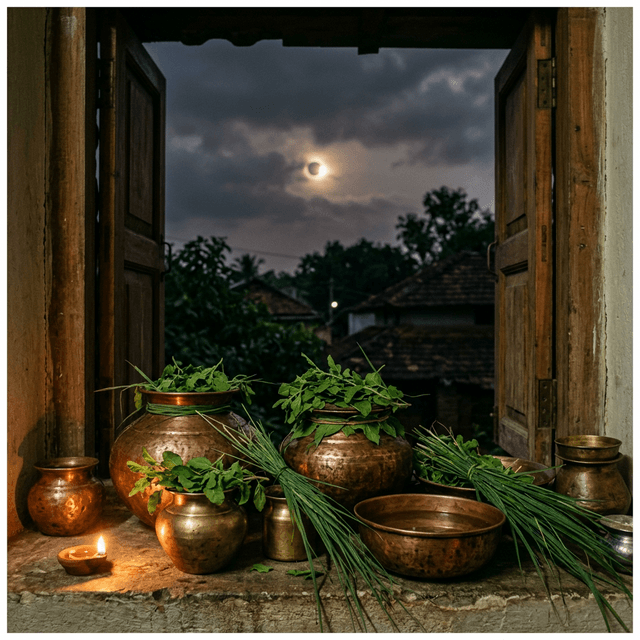
Hours before the first sliver of shadow touches the Sun or the Moon, something shifts inside an Indian household. The stove is turned off. Cooked food is covered or quietly set aside. Tulsi leaves appear in the mouth of the dal container, on the rim of the water matka, across the lid of the pickle jar. The kitchen — the most active room in the house, the room that never stops — goes still.
If you grew up in a household that observes Sutak, you know this silence. You know the particular look on your grandmother's face as she lays Kusha grass across the steel dabbas: not fearful, not superstitious, just matter-of-fact. As if the sky had given her an instruction and she was following it. The same way she follows the Panchang for everything else — when to fast, when to sow, when to begin a journey.
What most people encounter as a list of "eclipse rules" — do not eat, do not cook, do not step out — is, when you look closer, a system. And the system did not arrive yesterday. It was built into the oldest working calendar tradition on the planet: the Hindu Panchang, which has been tracking the Sun, the Moon, and the shadow points where eclipses are born for longer than most civilisations have existed.
This page is about that system. Not about whether you should follow it. That is between you and your family and the Panchang that hangs on your wall. This is about what Sutak is, where it comes from, why it works the way it does, and what it looks like across the many kitchens, temples, and traditions of this country. For the full story of eclipses — the mythology of Rahu-Ketu, the astronomy, the Vedic mathematics — see our Grahan Guide. This page picks up where that guide's Sutak section ends and goes deeper.
What Is Sutak? The Word and the Idea
The word Sutak (सूतक) comes from the Sanskrit root that also gives us the concept of ritual impurity associated with birth and death in a family. In Dharmashastra literature, sutak and patak mark periods when the normal rhythms of life — cooking, worshipping, conducting business, beginning new things — are suspended. Not as punishment. As acknowledgement. Something significant is happening. The ordinary rules do not apply.
In the context of Grahan, Sutak Kaal is the window of hours preceding an eclipse during which the atmosphere, the food, and the body are considered vulnerable to the eclipse's influence. The logic is not that the eclipse is "evil." The logic is that the eclipse is a disruption — the very grahas that regulate time and season are in a state of conflict — and during a disruption, you hold still.
The Panchang's Operating Principle
The Panchang does not separate "the sky" from "the ground." In this system, the position of the Sun determines when you wake, when you eat, when certain rituals become permissible. The Moon's phase determines the tithi — and the tithi determines fasting days, festival days, the rhythm of the fortnight. The nakshatras determine the quality of a given stretch of hours.
When the Sun or Moon enters a Grahan — when Rahu's shadow crosses their path — the Panchang treats it as the luminaries losing their ordinary strength. And if the luminaries are compromised, then everything downstream is affected: the quality of time, the potency of food, the receptivity of the body.
Sutak is the Panchang's way of saying: the source of your timing has been disrupted. Pause until it restores itself.
The Dharmashastra Framework
The concept appears across several Dharmashastra and Smriti texts. The Manu Smriti references periods of ritual impurity in relation to celestial events. The Yajnavalkya Smriti outlines specific Sutak durations for solar and lunar eclipses. The Nirnaya Sindhu and Dharma Sindhu — the legal digests that Panchang makers have relied on for centuries — codify the rules in detail: when Sutak starts, when it ends, who is exempt, what must be done with food and water.
These are not obscure texts. They are the working manuals of the tradition. Every family Panchang, every printed almanac, every Pandit who announces "Sutak begins at such-and-such time" is drawing from this lineage.
Sutak and Grahan: The Inseparable Pair
Sutak does not exist independently. There is no "Sutak on a normal Tuesday." It is activated only by a Grahan — and it is inseparable from the eclipse's timeline.
Think of it this way: the Grahan is the event. Sutak is the preparation zone. The way a hospital sterilises a room before surgery — not because the room is dirty, but because what is about to happen demands a higher standard of care.
Why Sutak Begins Before the Eclipse
This is the part that surprises people unfamiliar with the tradition. Sutak does not begin when the eclipse starts. It begins hours earlier — 12 hours before a solar eclipse, 9 hours before a lunar eclipse.
The traditional explanation is that the eclipse's influence on the atmosphere begins before the shadow is visible. The grahas are already in motion towards the alignment. The disturbance begins in the subtle sphere before it manifests in the visible sky. By the time you can see the shadow, the Sutak window is already well underway.
There is a practical dimension too. If you have to stop cooking, dispose of prepared food, protect stored grains, and brief the household — you need lead time. The Sutak window gives families a structured run-up to the eclipse, so that when the shadow arrives, the household is already still.
The Relationship to Eclipse Type
| Eclipse Type | Sutak Duration | Notes |
|---|---|---|
| Surya Grahan (Solar Eclipse) | 12 hours before eclipse start | 4 Prahars. The longer window reflects the Sun's primacy in the Panchang system. |
| Chandra Grahan (Lunar Eclipse) | 9 hours before eclipse start | 3 Prahars. The Moon's eclipse is considered less severe but still demands preparation. |
| Penumbral Lunar Eclipse | Traditionally, no Sutak | The shadow is too faint for a true Grahan in most Panchang traditions. Some families observe voluntarily. |
Sutak ends when the eclipse ends — not when totality ends, but when the last sliver of shadow lifts from the disc of the Sun or Moon. After that, the first act is bathing. Then the household reopens.
When Does Sutak Begin? The Prahar Clock
To understand Sutak timing, you need to understand the Prahar — an ancient Indian unit of time that the Panchang still uses.
What Is a Prahar?
A day in the Panchang is divided into 8 Prahars — four during the day (sunrise to sunset), four during the night (sunset to sunrise). Each Prahar is approximately 3 hours, though the exact length varies by season because Panchang divisions are based on actual sunrise and sunset, not the clock.
This is an important point. The Panchang does not run on clock time. It runs on sky time. A Prahar in June, when days are long, is not the same length as a Prahar in December. Sutak timings, therefore, shift with the season — even if the rule (4 Prahars for Surya Grahan, 3 for Chandra Grahan) stays constant.
Calculating Sutak Start Time
For Surya Grahan: Take the eclipse's start time (the moment of first contact). Count backwards 12 hours. That is when Sutak begins.
For Chandra Grahan: Take the eclipse's start time. Count backwards 9 hours. That is when Sutak begins.
Example — Total Lunar Eclipse, March 3, 2026:
The partial phase begins at about 3:20 PM IST. Sutak (3 Prahars = 9 hours before) therefore begins at about 6:20 AM IST on March 3 — the morning of the eclipse day, while the Moon is still far below the horizon. The kitchen closes after an early breakfast and stays closed until moksha at about 6:47 PM.
This is why Sutak is not just an eclipse observance. It reshapes the schedule of the entire preceding half-day.
Who Gets a Shorter Window?
The tradition makes clear exceptions:
- Children — Sutak is observed only for one Prahar (roughly 3 hours) before the eclipse.
- The elderly and unwell — Same one-Prahar window. The full duration is not expected of those whose bodies cannot sustain a 9- or 12-hour fast.
- Infants and nursing mothers — Some Panchang traditions exempt them entirely. Others suggest a symbolic observance. The variation is regional and familial.
The principle is consistent: Sutak is a discipline, not a hardship. The tradition adjusts for the vulnerable. It always has.
The Visibility Rule: The Most Misunderstood Part of Sutak
This needs its own section because it is the single most common error people make about Sutak.
Sutak applies only when the eclipse is visible from your location.
If a Grahan is happening on the other side of the planet — visible from South America but not from India — then Sutak does not apply for anyone in India. Full stop. This is not a modern relaxation, not a shortcut, and not an opinion of one school over another. It is the stated rule in the Dharma Sindhu, the Nirnaya Sindhu, and every traditional Panchang text that addresses the question.
Why Visibility Matters
The logic is consistent with the Panchang's worldview. Sutak exists because the luminaries above your head are weakened. If the eclipse is not happening in your sky — if your Sun and your Moon are untouched from where you stand — then there is nothing to observe Sutak against. The sky above your head is the only sky that matters.
This is why Panchang makers always compute eclipses for a specific city. It is not enough to know that a Grahan is occurring. You need to know whether the shadow will cross your meridian.
What About Partial Visibility?
If only the partial phase of an eclipse is visible from your city — a brief partial phase at moonrise, say — Sutak still applies. The degree of eclipse may be mild, but the principle is binary: any visible contact of the shadow triggers the Sutak window.
If the eclipse begins while the Moon is below your horizon and becomes visible only after moonrise, some traditions count Sutak from the moment the eclipse becomes visible to you rather than from its astronomical start. This nuance matters for the March 2026 lunar eclipse: the partial phase begins at 3:20 PM IST, while the Moon is below the horizon for all of India. The northeast, with its earlier moonrise, catches the end of totality itself; Delhi and points west see only the closing partial phase before moksha at 6:47 PM.
The Practical Takeaway
Before any eclipse, check two things:
- Is the eclipse visible from my city? If no — no Sutak. Go about your day.
- Which phases are visible? Sutak begins 9 or 12 hours before the first visible phase, not before the astronomical start of the eclipse.
PanchangBodh's eclipse timings page shows city-specific visibility and Sutak windows. Use it.
What to Do During Sutak: The Traditional Observances
The prescriptions that follow are drawn from Dharmashastra sources and from the living practice of Hindu households across India. They are presented here as the tradition carries them — not as medical advice, not as commandments, but as a system that millions of people follow, and that the Panchang has encoded for centuries.
Fasting
This is the central observance. During the entire Sutak window and through the eclipse, no food is consumed — neither cooked nor raw, neither solid nor liquid. Water is the only exception in most traditions, and even water is restricted in some stricter observances.
The fast breaks only after the eclipse ends and a purifying bath has been taken. Not before.
Food Handling
Any cooked food prepared before Sutak is traditionally considered unfit for consumption after the eclipse. In many households, it is discarded. Stored dry goods — grains, flour, lentils, spices, pickles — are protected by placing Kusha grass (Darbha) or Tulsi leaves in or on the containers.
Milk and dairy are treated with particular care. In many traditions, milk set aside during Sutak is not consumed. Curd culture started before Sutak is discarded. Fresh milk drawn after the eclipse and after bathing is considered clean.
Personal Conduct
- No personal grooming. Oil, combs, toothbrushes, razors — all set aside during the eclipse.
- No physical intimacy. The tradition is explicit on this point.
- No new beginnings. A direct extension of the Panchang's muhurat logic. If ordinary muhurat calculations exclude Rahu Kaal and Bhadra Kaal from auspicious work, an eclipse — the most extreme disruption — naturally prohibits all new undertakings.
Temple and Puja
Temple doors close before the eclipse and reopen only after it ends and the temple is ritually purified. Home puja pauses — idols are sometimes covered, offerings are not made, lamps are not lit during the eclipse itself.
The exception: mantra chanting intensifies. Gayatri Mantra, Mahamrityunjaya Mantra, Aditya Hridayam — these are chanted through the eclipse, and the tradition holds that their effect is multiplied during this period.
The apparent contradiction — temples close, but mantras grow louder — is not a contradiction at all. The physical practices pause; the inner ones deepen. The outward world goes quiet so the inward work can sharpen.
Sleep
A point often missed: sleep is discouraged during Sutak. The tradition asks you to remain aware, not unconscious, during the eclipse. This is consistent with the idea that the eclipse is an opportunity for heightened spiritual practice, not just a period of restriction. You are not meant to sleep through it. You are meant to be present for it.
Sutak and Food: Why the Kitchen Shuts Down
Food gets more attention in Sutak observance than any other topic. There is a reason for this. In the Indian household, the kitchen is not just where meals are prepared. It is the centre of domestic ritual — the place where Anna (grain) becomes Prasad, where fire and water meet daily, where the health of the family is literally cooked into existence. When the kitchen goes silent, the message is unmistakable: something out of the ordinary is happening.
The Three Categories of Food During Sutak
1. Cooked food prepared before Sutak — Discard after the eclipse. This is the clearest rule and the one most commonly followed. The thinking: food that was prepared and exposed to the atmosphere during the Sutak hours has absorbed the disturbance.
2. Stored dry goods — Protect with Kusha grass or Tulsi. Grains, dal, atta, spices, pickles — things in sealed or semi-sealed containers do not need to be thrown away. But they need a layer of protection. Kusha grass placed across the mouth of the container, or Tulsi leaves dropped into the contents, is considered sufficient.
3. Fresh food prepared after the eclipse — Clean. Once the eclipse has ended and the household has bathed, cooking resumes with fresh ingredients. The first meal after Sutak is, in many homes, a fresh, simple meal — khichdi, curd rice, something light and quick. The body has fasted for many hours. The kitchen is easing back into rhythm.
The Temperature Argument
There is a line of reasoning — often cited in science-friendly communities — that the Sutak food rules may have a microbial basis. During an eclipse, ambient temperature drops rapidly and then climbs back, sometimes within ninety minutes. In a tropical climate, this kind of thermal swing can accelerate bacterial growth in uncovered cooked food.
But it would be a mistake to reduce the entire tradition to a food safety protocol. The Panchang is not a hygiene manual. The Sutak food rules are part of a larger architecture that treats the eclipse as a disruption of the cosmic order — and food, in this architecture, is the most intimate point of contact between the cosmos and the body. When the order is disturbed, you do not eat from that disturbance.
What About Refrigerated Food?
The traditional texts, naturally, do not address refrigerators. Modern Panchang commentators vary. The conservative view: refrigerated cooked food prepared before Sutak should still be discarded. The practical view adopted by many urban families: sealed and refrigerated food is treated as protected, similar to dry goods shielded by Kusha grass.
The tradition gives you the principle. The application, in details the ancients could not have anticipated, is yours.
Sutak and Pregnancy: What the Tradition Carries
No Sutak topic generates more questions — or more anxiety — than this one. The rules around pregnant women during eclipses are among the most widely known and most emotionally charged aspects of the tradition.
What the Tradition Says
During the eclipse (and, in stricter observances, during the entire Sutak window), pregnant women are traditionally asked to:
- Stay indoors. Not step out of the house, and particularly not be under open sky during the eclipse.
- Avoid sharp objects. No knives, scissors, needles, or blades. No cutting, no sewing, no chopping.
- Avoid eating. The Sutak fast applies, though many families relax this — allowing water, light snacks, or a shorter fasting window.
- Avoid sleeping. Remain awake and, ideally, engaged in chanting or prayer.
What the Medical Evidence Says
There is no clinical evidence — no peer-reviewed study, no epidemiological data — linking eclipse exposure to adverse pregnancy outcomes. Eclipses are gravitational and optical events. The light that reaches the Earth during a lunar eclipse is the same moonlight, only dimmer. During a solar eclipse, the change is equivalent to passing cloud cover, albeit more dramatic.
The View from Here
This guide is not going to tell you what to do. Your elders have their reasons. Your doctor has theirs. What is worth saying is this: the tradition, at its core, asks a pregnant woman to rest, to stay out of the heat, to avoid exertion, to spend the eclipse period in stillness and prayer. Whatever the reasoning behind the rules, the net effect — rest, protection, quiet — is not harmful.
The anxiety that sometimes builds around these customs can be more damaging than the customs themselves. If a pregnant woman in your family is worried about Sutak, the kindest thing you can do is not to dismiss the tradition or enforce it rigidly, but to make the hours comfortable and calm. That, too, is a form of observance.
How Different Regions Observe Sutak
Sutak is observed across India, but it is not observed identically. The Dharmashastra texts provide the framework. The regional traditions fill in the texture.
North India (Hindi Belt, Rajasthan, UP, MP)
The strictest and most elaborate Sutak observance. Kitchens shut down at the precise Sutak start time. Tulsi and Kusha grass are placed in all food and water stores. Pregnant women stay indoors — in many families, they are asked not to use scissors or pins even for clothing adjustments. Post-eclipse bathing is done with Ganga Jal where available. Charity (daan) of sesame seeds (til), grains, and clothing is given immediately after the eclipse.
The North Indian approach tends to treat Sutak as a household-wide discipline — everyone participates, regardless of personal belief.
South India (Tamil Nadu, Karnataka, Kerala, Andhra Pradesh)
Sutak is observed but with a somewhat different emphasis. Temple ritual takes a central role — the closing and reopening of temple doors, the purification of the sanctum after the eclipse, the specific abhishekam performed once the shadow lifts. Food rules are similar to the North, but South Indian households often emphasise re-cooking everything from scratch after the eclipse rather than relying on Kusha-protected stored food.
In Kerala, the Panchangam tradition has its own computed Sutak windows based on the Vakya system of astronomical calculation, which can differ slightly from the Surya Siddhanta-based calculations used in the North.
Bengal and the East
Bengali households observe Sutak but also layer it with specific Vaishnava and Shakta practices. Mantra chanting during the eclipse — particularly recitation of the Chandi Path or Vishnu Sahasranama — is common. Some tantric traditions consider the eclipse window as especially potent for certain sadhanas.
Post-eclipse bathing in the Ganga (for those near Kolkata or in Bengal's riverine geography) is a significant communal practice. In cities like Varanasi and Prayagraj — where North and East overlap — the Sangam ghats draw massive crowds for post-Grahan snan.
Gujarat and Western India
Jain communities in Gujarat and Rajasthan observe Sutak with particular rigour, given the Jain tradition's emphasis on non-violence and purity of consumption. Food restrictions may begin even earlier than the standard Sutak window. The Jain Panchang (Tithi Darpan and similar texts) aligns the Sutak computation with its own calendar system.
In Gujarati Hindu households, the practice of making charitable donations of food and cloth immediately after the eclipse — grahan daan — is a significant cultural event, sometimes organised at the community level through temples and trusts.
The Common Thread
The details differ. The architecture does not. Every region treats the eclipse as a disruption that requires preparation, restraint, and a structured return to normalcy. The Prahar-based timing, the food rules, the post-eclipse bath — these constants run through every tradition. What varies is the accompaniment: which mantras, which charity items, which community practices surround the core observance.
After Sutak Ends: Snaan, Daan, and the Return
Sutak does not fade away gradually. It ends with a sharp line: the last contact of the eclipse shadow. From that moment, the tradition prescribes a specific sequence.
Step 1: Bathing (Snaan)
This is the immediate first act. Before you eat, before you drink, before you speak to anyone about anything substantial — you bathe. The bath is understood as the ritual boundary between the Sutak period and the return to normal life.
The bath is traditionally taken with cold water. Where available, Ganga Jal is added. Some families add a pinch of raw turmeric (haldi) or black sesame (kala til) to the water. In river-adjacent communities, the post-eclipse bath is taken in the river itself. On major eclipses, the ghats of Varanasi, Haridwar, Prayagraj, Ujjain, and Nasik draw enormous congregations. The Grahan Snan at a Tirtha is considered one of the most auspicious acts in Hindu dharma.
Step 2: Charity (Daan)
Immediately after bathing, the tradition turns to giving. This is not optional in the strict traditional view — it is an integral part of the eclipse observance:
- Sesame seeds (til) — the most commonly prescribed item for Grahan Daan.
- Grains and pulses — rice, wheat, lentils, given to the needy or to a temple.
- Clothing — particularly new cloth, sometimes with a coin placed inside.
- Gold or silver — a small piece donated during a Grahan is considered especially meritorious.
- Cow donation — in the older texts, go daan during a Grahan is held in the highest regard. In modern practice, this has largely been replaced by monetary donation to Gaushalas.
The principle behind Grahan Daan is elegant: the eclipse is darkness; counter it with light. The eclipse is contraction; counter it with generosity. You have fasted for hours. You have sat still. Now give.
Step 3: Fresh Cooking and the First Meal
Once bathing and daan are done, the kitchen reopens. A fresh meal is prepared from scratch. In many families, this meal is deliberately simple: rice and dal, or khichdi, or curd rice. The body is coming off a long fast. The household is easing back to normalcy.
There is something in this sequence — silence, then bathing, then giving, then eating — that has the shape of a ritual rebirth. The old food is thrown away. The body is washed. Something is given. And then, from fresh ingredients and clean hands, life starts again.
Common Sutak Mistakes
"Sutak applies even if the eclipse is not visible from my city."
No. This is incorrect and it is the most common error. Sutak is tied to visibility. If the eclipse cannot be seen from where you are, Sutak does not apply. This is stated in the Dharma Sindhu, the Nirnaya Sindhu, and every serious Panchang text. It is the original rule, not a modern concession.
"Sutak lasts for 24 hours."
Never. Sutak for a solar eclipse is 12 hours before. For a lunar eclipse, 9 hours. It ends when the eclipse ends. The total window is somewhere between 10 and 15 hours depending on the eclipse's duration. A 24-hour Sutak has no basis in any Panchang tradition.
"Penumbral lunar eclipses require Sutak."
Debated. The majority of traditional Panchang makers do not prescribe Sutak for penumbral eclipses, because the shadow is too faint to constitute a true Grahan. Some cautious families observe a voluntary Sutak. The tradition allows this but does not require it.
"You should not look at the eclipse during Sutak."
This conflates two different things. Looking at a lunar eclipse is perfectly safe with naked eyes — eclipse or no eclipse. Looking at a solar eclipse requires certified ISO 12312-2 solar filters, always. The Sutak rules are about food, conduct, and restraint — not about averting your eyes.
"Sutak food rules are superstition."
They are ritual practice embedded in a calendrical system. You can choose not to follow them. But calling them superstition misses the point. The Panchang is a system. Sutak is one of its operating rules. Within that system, the food rules are as logical as any other Panchang prescription — no different, in principle, from avoiding Rahu Kaal for an important meeting or choosing Shubh Muhurat for a wedding.
"Modern science has disproved Sutak."
Modern science has not studied Sutak at all. There are no controlled experiments, no peer-reviewed papers, no systematic investigations into whether Sutak observance has measurable effects. Absence of study is not disproof. The honest position is: we do not know, scientifically, whether these rules correspond to anything measurable. What we know is that they are old, they are internally consistent, and a very large number of people follow them.
Sutak Kaal for 2026 Grahan
Four eclipses occur in 2026. Only one is visible from India — and it falls on the night of Holika Dahan. Here is the complete Sutak picture for the year.
2026 Grahan & Sutak Timings — All Eclipses
| Date | Eclipse | Visible in India? | Sutak Window |
|---|---|---|---|
| Feb 17 | Annular Solar | No — Antarctica, S. hemisphere | No Sutak |
| Mar 3 | Total Lunar | Yes — partial to total | ~6:20 AM → ~6:47 PM, Mar 3 (≈12.5 hrs) |
| Aug 12 | Total Solar | No — Europe, N. Asia | No Sutak |
| Aug 28 | Partial Lunar | No — Europe, Americas | No Sutak |
Sutak applies only when the eclipse is visible from your location. Three of the four 2026 eclipses are invisible from India — no Sutak obligation for those.
Both August eclipses have dedicated guides: Surya Grahan on 12 August — Hariyali Amavasya and Chandra Grahan on 28 August — Raksha Bandhan day. For the year after, see Surya Grahan on 2 August 2027 — the next eclipse India will actually see, and the next time Sutak genuinely applies.
To get the Sutak window for your own city rather than reading it off a table, use the Sutak Kaal Calculator — it checks whether the eclipse is visible where you are before computing anything. Expectant mothers will also find the specific answers they are looking for in Grahan during pregnancy.
March 3, 2026 — The Only Sutak of the Year
This is the eclipse that matters for India. A Total Lunar Eclipse on Phalguna Purnima — the night of Holika Dahan. Sutak restrictions and Holi preparations collide for the first time in recent memory.
| Detail | Timing |
|---|---|
| Eclipse type | Total Lunar (Chandra Grahan) |
| Date | March 3, 2026 (Tuesday) |
| Sutak begins | ~6:20 AM IST, March 3 |
| Eclipse first contact (partial) | ~3:20 PM IST, March 3 |
| Totality begins | ~4:35 PM IST |
| Totality ends | ~5:33 PM IST |
| Eclipse ends (last contact) | ~6:47 PM IST, March 3 |
| Sutak ends | With moksha (~6:47 PM) |
| Total Sutak duration | ≈12.5 hours |
| Full totality visible | NE India (Assam, Arunachal Pradesh, Manipur, Nagaland) |
| Partial phases visible | Delhi, Mumbai, Jaipur, Bengaluru, Chennai, Lucknow, most major cities |
The Holi timing: Holika Dahan happens on the evening of Phalguna Purnima — and in 2026 the calendar is kinder than it first looks. Moksha comes at about 6:47 PM, just as the Pradosh period opens, so the bonfire is lit after the eclipse ends: Sutak occupies the day, the Dahan owns the night. City-specific timings will be published as the date approaches.
For detailed city-wise eclipse and Sutak timings, visit the Grahan Dates & Timings page.
Check Eclipse & Sutak Timings for Your City
City-specific Grahan visibility, Sutak start times, and phase-by-phase timings — computed from the Panchang for your location.
Frequently Asked Questions
Answers to the most common Sutak questions
Q: What is Sutak Kaal?
Sutak Kaal is a period of ritual restraint observed before and during an eclipse in the Hindu tradition. It begins 12 hours before a solar eclipse and 9 hours before a lunar eclipse, and ends when the eclipse shadow lifts completely. During this period, cooking, eating, personal grooming, and beginning new activities are traditionally avoided.
Q: Does Sutak apply if the eclipse is not visible from my city?
No. Sutak holds only when the eclipse is visible from your location. This is the stated rule in traditional Panchang texts including the Dharma Sindhu and Nirnaya Sindhu. If the eclipse is happening on the other side of the planet, there is no Sutak obligation where you are.
Q: How long does Sutak last?
For a Surya Grahan (solar eclipse), Sutak is 12 hours — 4 Prahars — before the eclipse start. For a Chandra Grahan (lunar eclipse), it is 9 hours — 3 Prahars. Sutak ends the moment the eclipse ends. The total window, including the eclipse itself, ranges from roughly 10 to 15 hours.
Q: Can I drink water during Sutak?
Most traditions allow water during the Sutak period. Some stricter observances — particularly among those performing specific vratas — restrict even water. The common household practice is to permit water throughout.
Q: What should I do with food cooked before Sutak?
Cooked food prepared before Sutak is traditionally discarded after the eclipse. Stored dry goods (grains, lentils, spices, pickles) are protected by placing Kusha grass or Tulsi leaves in or on the containers. After the eclipse, fresh food is cooked from scratch.
Q: Is Sutak observed for penumbral lunar eclipses?
The majority of traditional Panchang makers do not prescribe Sutak for penumbral eclipses, because the shadow is too faint to constitute a true Grahan. Some cautious families observe a voluntary Sutak. The tradition permits this but does not mandate it.
Q: What about Sutak rules for pregnant women?
The tradition asks expectant mothers to stay indoors during the eclipse, avoid sharp objects (knives, scissors, needles), and avoid sleeping. There is no clinical evidence linking eclipse exposure to pregnancy outcomes. Follow your family's practice and your doctor's advice.
Q: What is the first thing to do after Sutak ends?
Bathing. The post-eclipse bath — before eating, before anything else — marks the formal end of the Sutak period. After bathing, charitable giving (daan) is performed, and then a fresh meal is prepared and eaten.
Q: When is the next Sutak in India?
The next Sutak observable in India is for the Total Lunar Eclipse on March 3, 2026. Sutak begins at about 6:20 AM on March 3 itself — 9 hours before the partial phase starts at 3:20 PM IST — and ends with moksha at about 6:47 PM. Check your city's specific timing on PanchangBodh's Grahan Dates & Timings page.
The Sutak Thread
The shadow passes. The kitchen reopens.
Sutak is not a superstition. It is not a fear. It is a practice — older than most things we call modern, more structured than most things we call tradition. It sits at the intersection of astronomy and kitchen, of celestial mechanics and curd rice, of the shadow that Rahu casts across the sky and the Tulsi leaf that your grandmother places across the mouth of a steel dabba.
The Panchang has never separated the cosmos from the kitchen. Sutak is the proof. When the sky pauses, the household pauses with it. When the shadow lifts, the first act is bathing — then giving — then eating. Silence, then generosity, then nourishment. In that sequence, the tradition encodes something worth hearing: darkness is not defeated by fighting it. It is waited out, with discipline and calm, and when the light returns, you begin again — clean.
The stove will light again. The dal will cook. The pickle will stay where it always was, under its Tulsi guard. And the next time the sky announces a Grahan, these same households will do what they have done for uncounted generations: note the time, cover the grain, go still.
The shadow passes. The kitchen reopens. Life resumes.
Note: This guide offers traditional Panchang wisdom and Vedic perspective on Sutak Kaal. For city-specific eclipse and Sutak timings, visit our Grahan Dates & Timings page. For the full story of eclipses, see the Grahan Guide.