
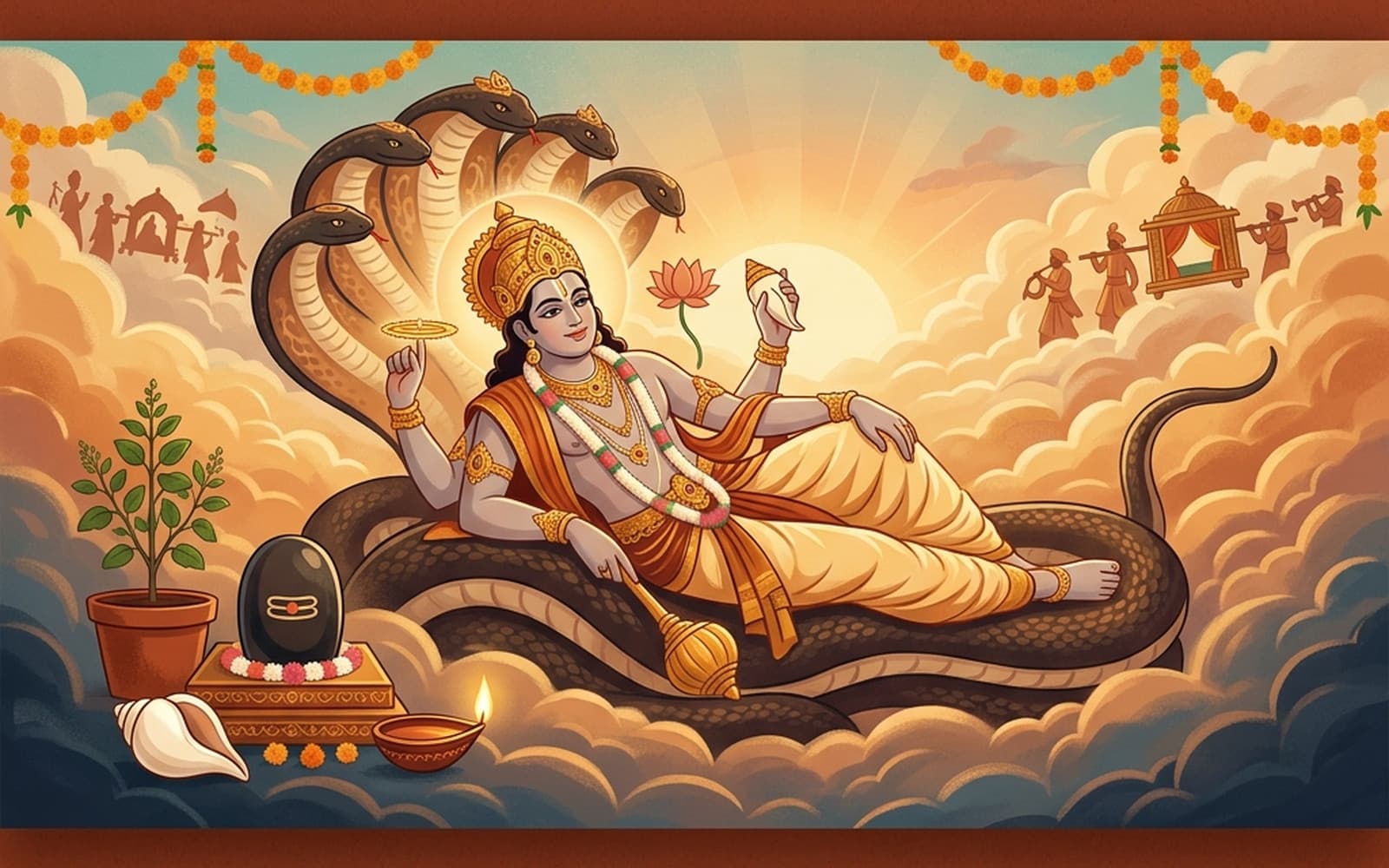
Dev Uthani Ekadashi is the mirror of Devshayani. It is the eleventh tithi of the bright fortnight of Kartika, and the morning Lord Vishnu is said to wake from yoga-nidra — the four-month cosmic sleep he entered back in Ashadha. The name Prabodhini means "the awakener", and that is exactly what the day does: it rouses the divine order back into motion.
When Vishnu wakes, the long pause of Chaturmas lifts. The mangal karya that families set aside — weddings, housewarmings, the first ventures of a new chapter — become possible again. Households greet the dawn with conch and bell, and it is on this day that Tulsi Vivah, the marriage of the Tulsi plant to Shaligram, is performed.
Date & tithi timing
Observance day and tithi window for your city
Dev Uthani Ekadashi 2026 falls on Friday, 20 November 2026. The Ekadashi tithi runs from 20 November 2026, 07:16 AM to 21 November 2026, 06:32 AM.
Tithi begins
20 November 2026, 07:16 AM
Tithi ends
21 November 2026, 06:32 AM
Smarta and Vaishnava dates differ
| Year | Observance day |
|---|---|
| 2026 | Friday, 20 November 2026 |
| 2027 | Wednesday, 10 November 2027 |
Times shown for New Delhi; pick your city on the Ekadashi calendar for local timings.
Dev Uthani Ekadashi at a glance
Date in 2026
Friday, 20 November 2026
Lunar month
Kartika · Shukla Paksha
Deity
Lord Vishnu
Marks
End of Chaturmas · Tulsi Vivah
Also called
Prabodhini · Devutthana · Dev Uthni Gyaras
Prabodhini — the awakening of Vishnu
Why the whole year turns on this morning
For four months, tradition holds, Lord Vishnu has reclined on Shesha, the cosmic serpent, adrift on the ocean of milk. Dev Uthani Ekadashi is the morning that stillness ends. Devotees do not simply worship him — they wake him, calling out "Utho Dev" with conch, bells and song at first light, the way a household rouses an honoured guest who has slept long under its roof.
The waking is more than a story. With the divine order alert again, the world is understood to return to its full working order, and the auspicious current that Chaturmas held back begins to flow. That is why Prabodhini — the awakener — is counted among the most important Ekadashis of the year, and kept with such care.
Sugarcane, water-chestnut (singhara), ber and the season's first fruits are offered — foods that ripen just as Kartika turns cool. The bhog is homely and seasonal, fitting a day that is less about grandeur than about welcoming the deity back into ordinary life.
Chaturmas ends and the wedding season returns
Why marriages and mangal karya resume from this day
Chaturmas — the four sacred months — runs from Devshayani Ekadashi in Ashadha to this day in Kartika. Through that span, because the divine order was at rest, families held back from new beginnings: weddings, griha pravesh, thread ceremonies and other mangal karya were traditionally paused.
Dev Uthani lifts that pause. From this morning the marriage muhurats reopen, and across much of northern India the days that follow fill with weddings that had waited out the four months. Housewarmings, the buying of a home, the start of a business — the whole class of auspicious beginnings becomes available again.
For many households this is the practical heart of the day: not only a fast, but the signal that the calendar of celebrations has turned back on. The vows taken at the start of Chaturmas are released now too, closing the season of restraint on the same note of devotion with which it began.
Tulsi Vivah — the marriage of Tulsi and Shaligram
The ceremony at the centre of the day
Central to Dev Uthani is Tulsi Vivah, the ceremonial marriage of the Tulsi plant — revered as Vrinda — to Shaligram, the sacred stone that represents Vishnu. It is performed on this day and in the days that follow, and in many homes it is the first wedding of the resumed season: a small rite that reopens the door for all the human weddings to come.
The Tulsi in its courtyard pot is dressed as a bride, the pot wrapped and adorned, a canopy raised above it. Shaligram is brought to her, the marriage rituals are carried out as they would be for any couple, and the household plays host to the union. Sugarcane is often stood around the plant to form a mandap.
The ceremony ties the day's threads together — it honours a newly woken Vishnu, inaugurates the wedding season it symbolically restarts, and carries the old story of Vrinda's devotion, the reason Tulsi is held so dear in the Vaishnava home.
Waking the god, keeping the fast
Fasting, the dawn waking and the day's worship
The observance is simple in outline. The day opens with a bath and a sankalp, the quiet resolve to keep the fast. Most keep it for the full day, setting grains aside and taking only fruit, milk and water; some keep it without water at all, as their strength allows.
What sets this Ekadashi apart is the waking itself. At dawn the deity is roused — conch blown, bells rung, the songs of "Utho Dev" sung — and offered sugarcane, singhara, ber and seasonal fruit. Through the day Vishnu is worshipped with tulsi leaves and a lamp, the Ekadashi katha is read or heard, and where Tulsi Vivah is kept, the marriage is performed in the evening.
The form varies by family, sampradaya and region. Keep to the practice your household follows and your health allows; what is written here is offered for understanding, not as prescription.
A word on fasting
Parana on Dwadashi, and the season ahead
The Dwadashi window that completes the vrat
Parana, the breaking of the fast, completes the vrat, and its timing matters as much as the fast itself. It is done the next morning on Dwadashi — after sunrise, before the Dwadashi tithi ends, and never during Hari Vasara, the first quarter of Dwadashi.
Breaking too early or too late is held to leave the vrat incomplete, which is why the next day's sunrise counts alongside the Ekadashi date. The window shifts with your city and its sunrise, so the exact minute is best read from that day's panchang rather than assumed.
Mind the parana window
See today's live panchang for your city
Tithi, nakshatra, sunrise and the day's muhurat — computed for wherever you are.
Dev Uthani Ekadashi — questions answered
Tulsi Vivah, the wedding season and parana