
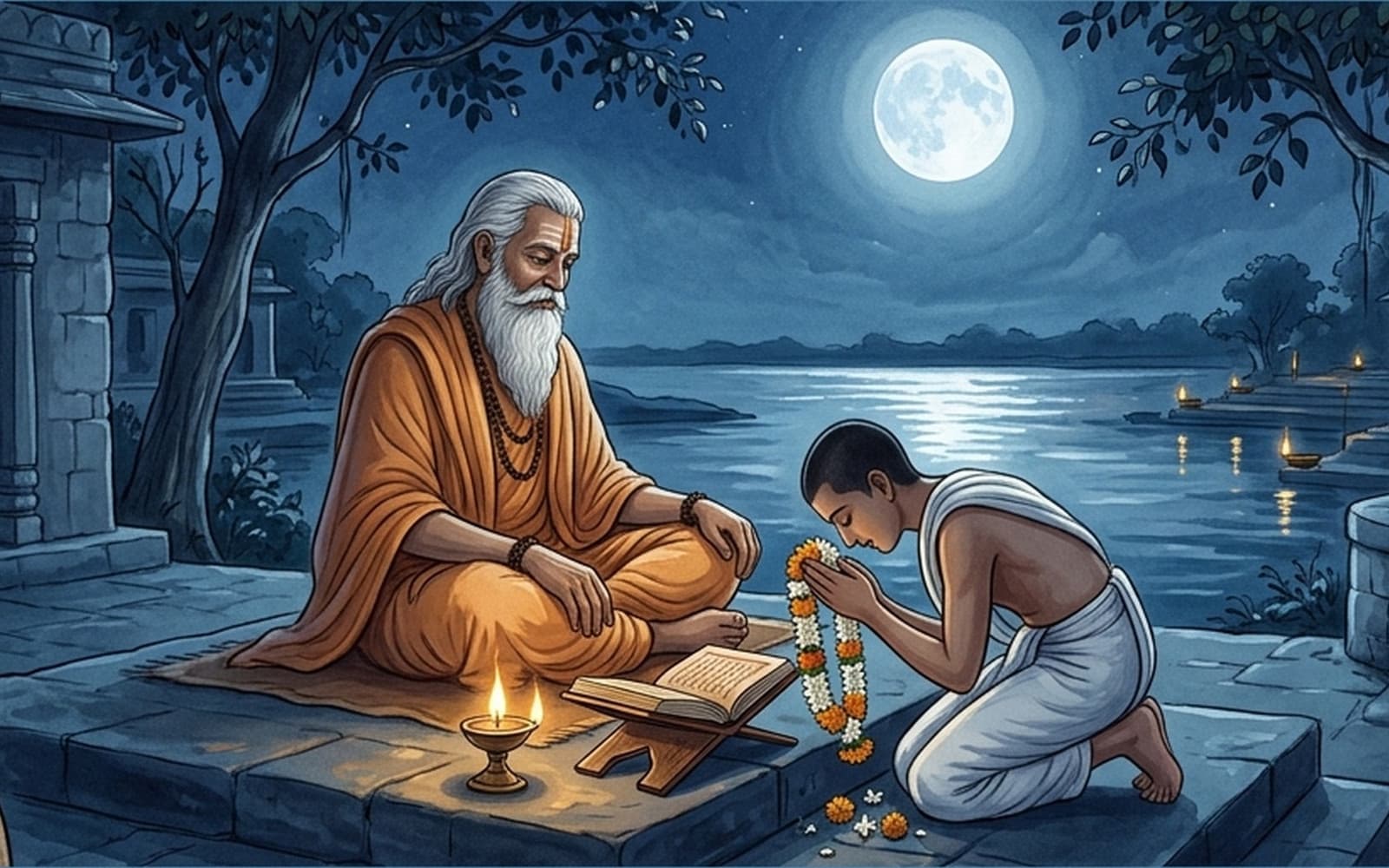
Guru Purnima 2027 is on Sunday, 18 July. In New Delhi the Purnima tithi runs from 6:49 PM on Saturday, 17 July to 9:15 PM on Sunday, 18 July.
Guru Purnima is the full moon of Ashadha, the day a shishya turns to the one who taught them and offers thanks. The word guru is read as the remover of darkness — gu, the dark, and ru, its dispelling — and on the brightest night of the month, when the moon stands full and lit, the disciple honours the source of that inner light. It is also called Vyasa Purnima, held as the birthday of Ved Vyasa, who gathered the scattered Veda into order and set down the Mahabharata and the Puranas.
The day is older than any one faith. Hindus honour Vyasa and their own guru; Buddhists mark the first sermon the Buddha gave at Sarnath; Jains recall the day Mahavira took his first disciple. For wandering ascetics it opens Chaturmas, the four months of the rains when they settle in one place and teach. Householder and monk alike keep it the same way — a bath at dawn, worship of the guru, a gift laid at the teacher's feet, and the resolve to carry what was learned a little further.
Vyasa Purnima and the meaning of guru
Why the day carries a sage's name
The full moon of Ashadha is called Vyasa Purnima because tradition keeps it as the day Ved Vyasa was born. He is the sage who divided the single Veda into four, so that it could be held and handed on, and who is credited with the Mahabharata, the eighteen Puranas and the Brahma Sutras — the frame on which much of later thought rests. In him the tradition sees the first teacher of the line, the guru from whom the long chain of teaching descends, and so the day of learning is set on his.
The word guru is itself read as a teaching. One old gloss takes gu for darkness and ru for its remover: the guru is the one who lifts the dark of not-knowing. On a night when the moon is at its fullest and borrows all its light from the sun, the image is exact — the disciple's mind, like the moon, shines only with light it has received. Guru Purnima is the day to name that debt, and to look toward the source of the light rather than take it for granted.
Guru Purnima at a glance
Date in 2027
Sunday, 18 July 2027
Tithi
Purnima — the full moon (15th)
Lunar month
Ashadha, Shukla Paksha (June–July)
Honoured
Ved Vyasa & one's Guru
Observance
Guru-puja, dakshina, snan & daan
Date & tithi timing
The Ashadha full moon and Purnima window for your city
Tithi begins
17 July 2027, 6:49 PM
Tithi ends
18 July 2027, 9:15 PM
| Upcoming dates | Day |
|---|---|
| 18 July 2027 | Sunday |
| 6 July 2028 | Thursday |
Times shown for New Delhi; pick your city on the Purnima calendar for local timings.
The guru-shishya parampara
How knowledge is passed from hand to hand
Indian learning has long moved not from book to reader but from guru to shishya — living voice to listening ear, tested over years of nearness. What the teacher carries is not only information but a way of holding it, and that cannot be printed; it has to be given in person and received in trust. The line of such givings is the parampara: each guru a link who took from one before and passes to one after, so that a teaching reaches the present unbroken.
Guru Purnima is the day that chain is honoured out loud. The shishya returns to the guru — in person where possible, in memory or before a photo and the guru's paduka where not — to say what is rarely said on ordinary days: that the debt is known and the seat still revered. It is why the day belongs not only to those with a spiritual master. Every first teacher counts — the one who taught the letters, the craft, the instrument, and the parent who was the earliest guru of all.
How Guru Purnima is observed
Snan, guru-puja, dakshina and the vow to learn
The day opens, like other Purnimas, with a bath before sunrise — in a holy river where one can reach it, and at home with the same intent where one cannot. Many then keep a light fast and give the freed hours to the guru. Where the teacher is present, the shishya offers pada-puja — the washing and honouring of the feet — a garland, and guru-dakshina, the gift by which a student answers what was given; in ashrams the guru takes the seat of Vyasa, the Vyasa-peetha, and the assembly worships the lineage through him.
Where no living guru can be reached, the day is kept before the guru's image or paduka, or turned toward Vyasa and the Vedas themselves. A reading of scripture, a round of the guru-mantra, and charity — food, clothing or books given to a student who lacks them — carry the same spirit. The truest offering is not the garland but the resolve that goes with it: to put the teaching to use and hand it on in turn.
An offering of gratitude, kept to your means
One full moon, many teachers
Buddhists, Jains, and the start of Chaturmas
The Ashadha full moon is honoured well beyond the Hindu fold. For Buddhists it is Asalha Puja, the day the Buddha, newly awakened, gave his first teaching at Sarnath — the turning of the wheel of dharma before his first five disciples, the moment a lone realisation became a guru's path. Jains keep it as the day Mahavira accepted Gautama Swami as his first ganadhara, and so became a teacher himself. Three traditions, one moon, the same subject: the passing of light from one who has it to one who seeks it.
The same full moon opens Chaturmas for the sadhus. Through the four months of the rains, when travel is hard and the earth teems with small life, wandering ascetics stop wandering and stay in one place — and a settled teacher means gathered students. So the year's calendar of learning has long begun here, on the night the moon is full and the master, for once, sits still. What starts on Guru Purnima is meant to run well past it: a season, and ideally a life, given to being taught.
See today's live panchang for your city
Tithi, nakshatra, sunrise and the day's muhurat — computed for wherever you are.
Guru Purnima — questions answered
The date, Vyasa, guru-puja and dakshina