
Sharad Purnima 2026 is on Sunday, 25 October. In New Delhi the Purnima tithi runs from 11:57 AM on Sunday, 25 October to 9:42 AM on Monday, 26 October.
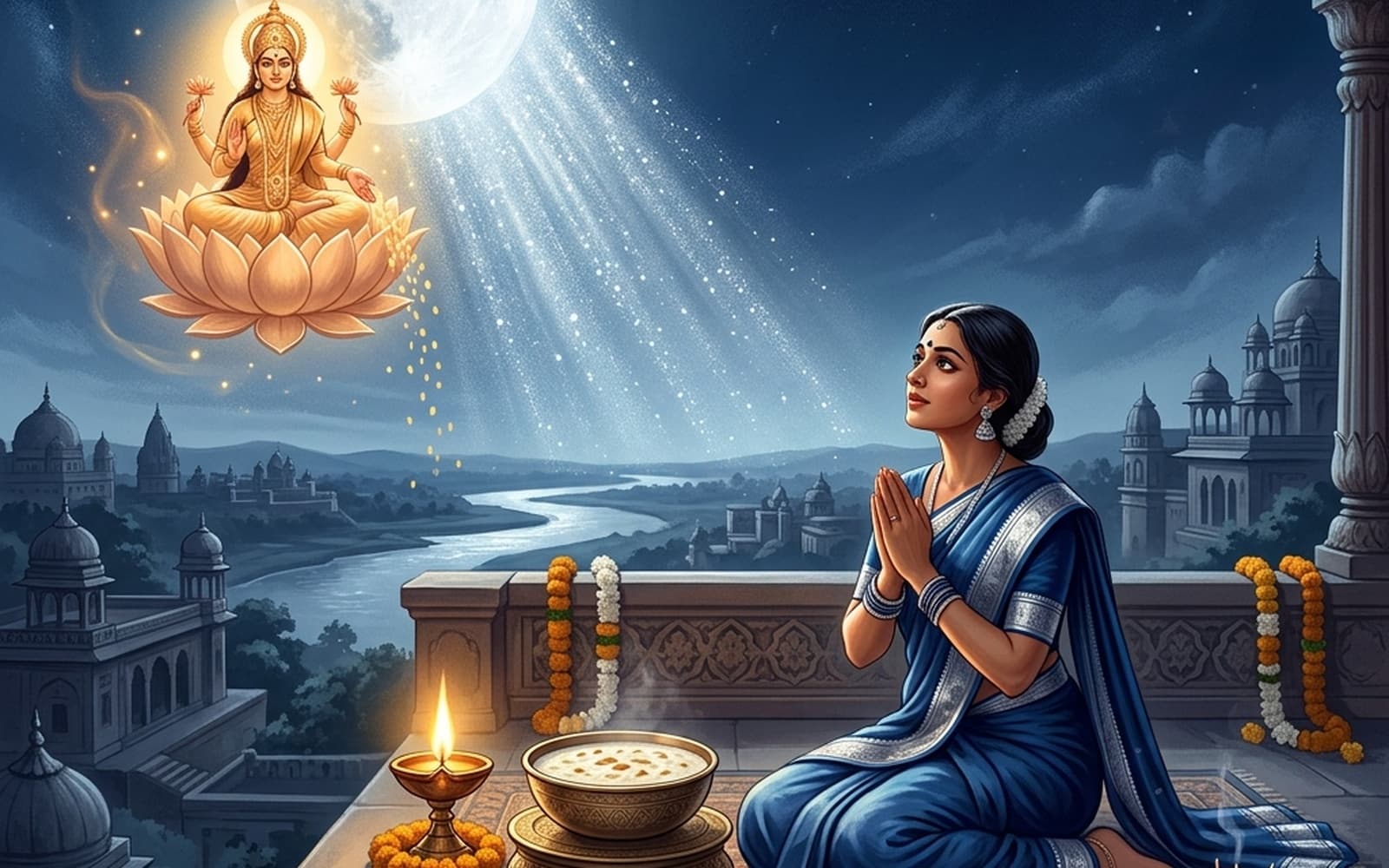
Sharad Purnima is the full moon of Ashwina, the first clear full moon after the rains, and by tradition the brightest of the year. The monsoon clouds have withdrawn, the night sky is washed clean, and the moon rises full and near — so bright that its light is said to fall like amrit, nectar. On this one night the moon is not merely watched but received: kheer is set out beneath it, a lamp is kept burning, and many stay awake until dawn.
The night carries several names and traditions at once. As Kojagari Purnima it belongs to Lakshmi, who is said to move through the world after dark asking ko jagarti — who is awake — and to bless those she finds keeping vigil. In Braj it is Raas Purnima, the night of Krishna's Maha Raas with the gopis. Through all of them runs the same full moon: a night for wakefulness, for prosperity sought and cooling nectar received, kept once a year at the turn from monsoon into autumn.
Sharad Purnima at a glance
Date in 2026
Sunday, 25 October 2026
Lunar month
Ashwina · Shukla Paksha (Purnima)
Deity & focus
Goddess Lakshmi · Krishna (Raas) · the full moon
Observance
Moonlit kheer, night vigil (jaagran) & dawn snan
Also called
Kojagari · Kojagiri · Raas Purnima · Kumar Purnima
Date & tithi timing
Full-moon day and Purnima window for your city
Tithi begins
25 October 2026, 11:57 AM
Tithi ends
26 October 2026, 9:42 AM
| Upcoming dates | Day |
|---|---|
| 25 October 2026 | Sunday |
| 14 October 2027 | Thursday |
| 2 October 2028 | Monday |
Times shown for New Delhi; pick your city on the Purnima calendar for local timings.
The brightest moon of the year
Sharad, the clear sky and the nectar rays
Ashwina's full moon opens the season of sharad, the short, luminous autumn that follows the monsoon. For months the sky has been thick with cloud; now it clears, and the first full moon to rise in that washed air seems larger and more brilliant than any other. Tradition reads this brightness as more than a trick of the season — it holds that on this night alone the moon's rays carry amrit, the nectar of immortality, and that whatever they touch is quietly blessed by it.
The moon has always been held the giver of coolness and of the healing sap that rises in plants, and Sharad Purnima is its highest night. The vaidyas of the old tradition read the sharad moonlight as medicinal, cooling a body that still carries the heat of the departed summer and rains. It is why the night's rituals reach upward, toward the moon, rather than toward any shrine — the light itself is the offering received, and the whole shape of the night is built to gather it.
Kheer left out in the moonlight
The moon-soaked prasad and its cooling amrit
The signature act of the night is simple. Kheer — rice simmered slow in milk and sugar — is cooked in the evening and set out in the open, in a vessel left where the full moon can reach it, and there it stays through the night. By morning it has drunk the moonlight, and with it, tradition says, a little of the nectar those rays are held to carry. It is eaten at dawn as prasad, shared through the household as the first food of the day.
The old texts and vaidyas give the practice a plainer reading too: the cool night air and the moon's calming light are said to change the kheer, making it a tonic that soothes the eyes and cools the body. Some cover the vessel with a thin muslin against the dew; some drop in a few tulsi leaves; some set it on a rooftop or in a courtyard open to the sky. The forms vary, but the intent is one — to let the food sit beneath the fullest moon of the year and carry its coolness into the body.
Kojagari: the goddess asks who is awake
The night vigil, Lakshmi, and Krishna's Raas
The night's other name is Kojagari, from ko jagarti — who is awake. On Sharad Purnima, the tradition holds, Lakshmi walks the earth after dark, looking in at every house to ask that question, and where she finds someone awake and at worship she stays, leaving prosperity behind. So the night is kept as a jaagran, a vigil: the household stays up, a lamp burns, Lakshmi and Kubera are worshipped, and dice or quiet games pass the hours until the moon rides high. In Bengal, Odisha and Mithila this is the principal Lakshmi night of the year, kept with as much care as Diwali is elsewhere.
In Braj the same full moon is Raas Purnima. It is remembered as the night Krishna played his flute on the banks of the Yamuna and danced the Maha Raas with the gopis — the night on which, the story says, he multiplied himself so that each gopi found him at her side, and the hours stretched out under a moon that would not set. Lakshmi in the east, Krishna in Braj: two traditions, one wakeful night, both asking the devotee to stay up and turned toward the divine while the brightest moon of the year rides overhead.
How Sharad Purnima is observed
The dawn bath, the fast, daan and the vigil
For those who keep it fully, the day begins with a bath before sunrise — in a holy river where one is near, or at home with the same intent. Many take a vrat: some fast through the day on fruit and milk, some simply eat light, and break it with the moon-soaked kheer at dawn. Vishnu, Lakshmi or Krishna is worshipped by name according to the household's tradition, and the evening is given to setting out the kheer and lighting the lamp that will burn through the vigil.
As the moon climbs, the family gathers under the open sky to take in its light, which is itself held to be the night's blessing. Charity belongs here too: kheer and food shared with neighbours and the poor, and daan given in the season's plenty. None of it need be elaborate. A bath taken with resolve, a few hours kept awake under the full moon, a bowl of kheer set out and shared at dawn — these carry the spirit of the night as fully as any longer observance.
Kept according to your means
See today's live panchang for your city
Tithi, nakshatra, sunrise and the day's muhurat — computed for wherever you are.
Sharad Purnima — questions answered
The nectar moon, the kheer and the Kojagari vigil