
If the eclipse is not visible where you are, no grahan precaution applies at all.
Visibility decides everything. When an eclipse is visible, tradition asks for rest and stillness — not fear, and never anything that would compromise your health or your doctor's advice.
Start with the only question that matters
Before any list of dos and don'ts, one thing settles most of the anxiety: is the eclipse even visible from your city? The tradition is unambiguous here. Sutak and every grahan observance attach to the dṛśya grahaṇa — the seen eclipse. An eclipse happening below your horizon, on the other side of the planet, carries no obligation for anyone, pregnant or otherwise.
Several eclipses each year are invisible from India entirely. On those days there is no Sutak, no restriction, and nothing a pregnant woman needs to do differently. Our Sutak Kaal Calculator answers this for your specific city in one step — it is worth checking before you read another forwarded message.
When the eclipse IS visible: what the tradition asks
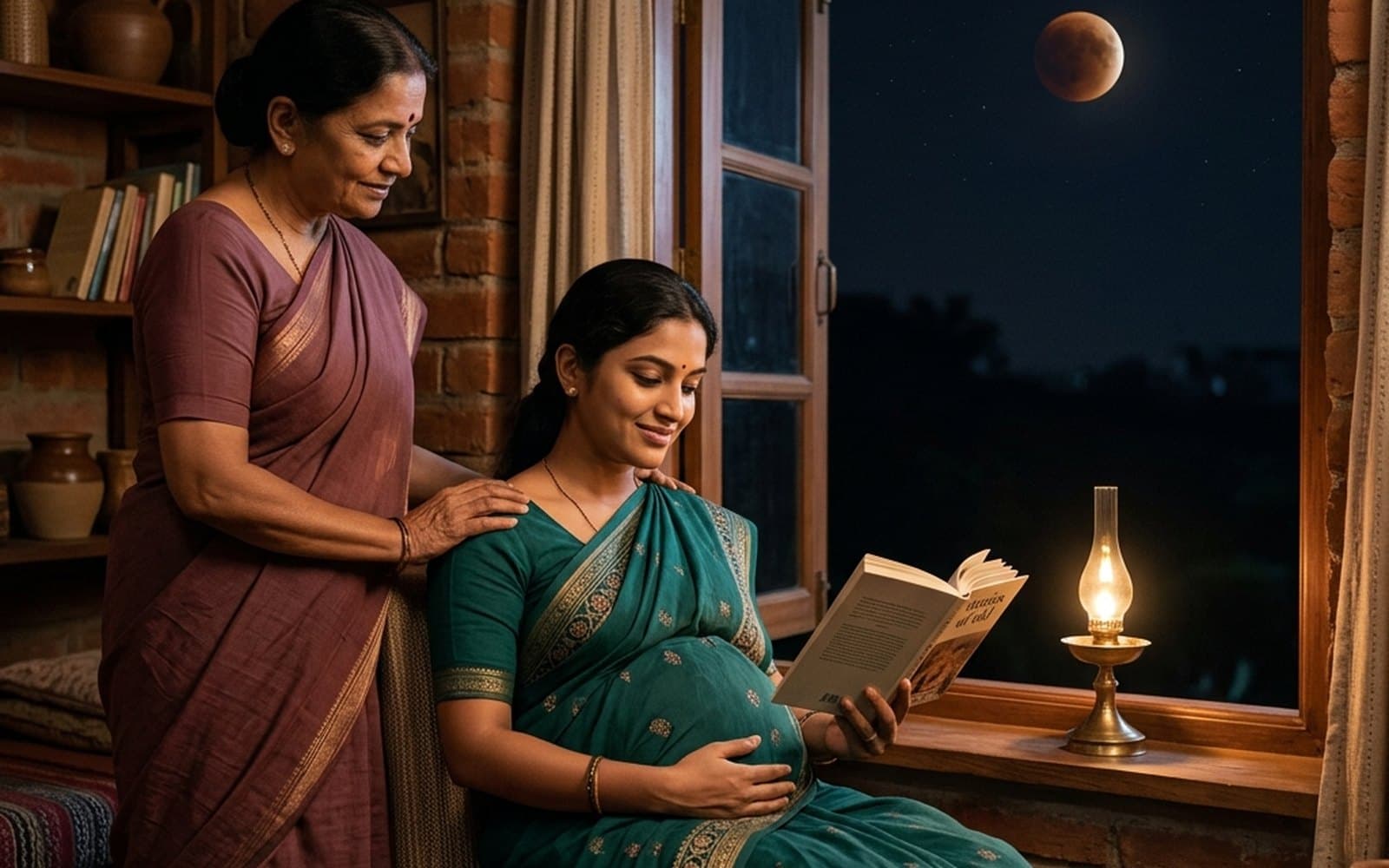
Where an eclipse is genuinely visible, the customs around pregnancy are, at their core, an instruction to rest. Stay indoors, avoid the direct sight of the eclipse, keep the hours quiet, and spend them in prayer, mantra or simply stillness. Many families ask the expectant mother to sit calmly rather than work through the Sutak window.
Read plainly, this is a prescription for rest during a period the tradition treats as unsettled — the same instinct behind asking anyone to pause cooking and travel. It is care, expressed in the vocabulary of an older time.
One practical note that is genuinely important and not superstition at all: never look at a solar eclipse directly. That applies to every person, pregnant or not, and it is the one precaution modern astronomy insists on just as firmly as the panchang does.
What the shastras never said
A great deal of what circulates before every eclipse has no classical basis whatsoever. There is no scriptural instruction that a pregnant woman must avoid holding scissors or knives, that cutting or stitching cloth harms the child, that she must lie in a particular direction, or that a birthmark will follow from any of it. These are folk accretions, repeated so often that they now sound authoritative.
Nor does any classical source suggest an eclipse causes harm to a developing child. The tradition treats grahan as an inauspicious period for beginnings and activity — a time to pause, not a time to fear. The distance between "pause" and "danger" is where most of the modern anxiety has grown.
Fasting, food and the exemptions that already exist
The Sutak fast is where the tradition itself makes room. Classical practice exempts children, the elderly, the unwell — and pregnant and nursing women — from the full Sutak fast. They observe only one Prahar, roughly three hours, and many households ask nothing at all of an expectant mother.
This exemption is old, explicit, and worth knowing, because families sometimes apply the strictest reading to precisely the person the tradition wanted to protect. Medicines, water, and food taken on medical advice are never restricted — not for anyone, and least of all here.
A calm way to keep the day
If the eclipse is visible where you live and you would like to observe something, the gentlest form is also the most traditional: stay in, rest, keep the room quiet, chant if it brings you peace, and take a bath after moksha when the eclipse ends. That is the whole of it.
And if a custom in your family goes beyond this, keeping it is entirely your choice — traditions carry meaning for the people who hold them. What no one should carry away from an eclipse is fear about their pregnancy.
The short version, if you take nothing else
Every point below follows the classical rules, in the order they actually matter.
- Check visibility first — if the eclipse cannot be seen from your city, nothing applies.
- If it is visible: rest indoors, keep the hours quiet, and never view a solar eclipse directly.
- Pregnant and nursing women are traditionally exempt from the full Sutak fast — one Prahar at most.
- Medicines, water and food on medical advice are never restricted.
- Scissors, knives, stitching and sleeping positions have no basis in the shastras.
- Bathe after moksha, and resume the day normally.
This page describes traditional beliefs and is provided for educational purposes only. It is not medical advice — for anything concerning your pregnancy or health, follow your doctor.
Pregnancy and grahan: the questions families ask
Is it harmful to be pregnant during an eclipse?
No classical source describes an eclipse as harmful to a developing child, and no medical evidence supports it either. The tradition treats grahan as a period to pause activity, not as a danger. Where an eclipse is not visible, even the pause does not apply.
Should a pregnant woman avoid using scissors or knives during a grahan?
This is a folk custom, not a scriptural rule. The shastras contain no such instruction, and nothing connects cutting, stitching or similar work to any effect on the child. Families who keep the custom may do so by choice, but it carries no traditional obligation.
Does a pregnant woman have to fast during Sutak?
No. Classical practice explicitly exempts pregnant and nursing women — along with children, the elderly and the unwell — from the full Sutak fast, limiting it to one Prahar (about three hours) if observed at all. Medicines, water and prescribed food are never restricted.
What should a pregnant woman actually do during a visible eclipse?
Rest indoors, keep the hours quiet, avoid looking directly at a solar eclipse (a rule for everyone), chant or pray if that brings calm, and take a bath after the eclipse ends. That is the substance of the tradition.
How do I know whether an eclipse is visible from my city?
Use the Sutak Kaal Calculator — pick the eclipse and your city, and it checks whether the Sun or Moon is above your horizon during the eclipse before telling you whether Sutak applies at all.
Do these rules differ for solar and lunar eclipses?
Only in timing. Sutak begins 12 hours before a solar eclipse and 9 hours before a lunar one, ending at moksha in both cases. The pregnancy-related customs and exemptions are the same, and both depend entirely on the eclipse being visible where you are.