
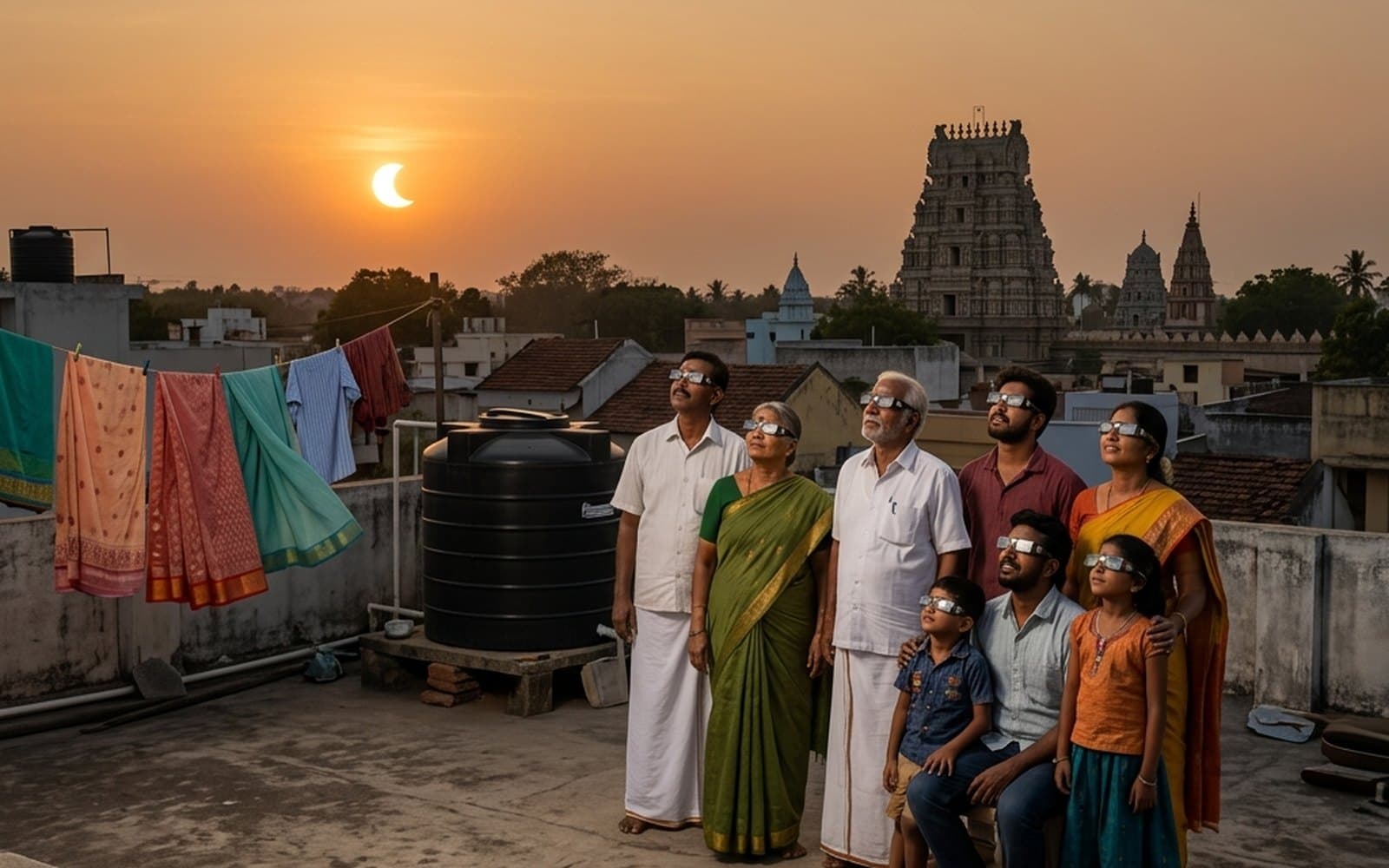
Visible from most of India as a partial eclipse — Sutak applies this time.
The eclipse runs through the afternoon into early evening, IST. Sutak begins 12 hours before first contact and ends at moksha. Check your city below.
Monday, 2 August 2027 · partial from India, total elsewhere
Why this one is different
Both August 2026 eclipses passed India by — one happened at midnight here, the other while the Moon sat below the horizon. Neither carried Sutak, and neither changed a single observance. That made them reassuring stories rather than practical ones.
2 August 2027 reverses that. This is a total solar eclipse whose path of totality crosses southern Europe, North Africa and the Middle East, with an exceptionally long totality of over six minutes near Luxor. India sits outside the path of totality but inside the penumbra, which means a genuine partial eclipse in the Indian sky — beginning in the early afternoon and ending in the early evening.
Because it is visible, the entire apparatus of the tradition switches on: Sutak, the pause in cooking, temple closures, and the post-moksha bath. This is the eclipse worth marking in the calendar.
Eclipse timings in Indian Standard Time
From first to last contact
| Partial begins (Sparsha) | 2 Aug, 01:00 pm IST |
| Maximum eclipse | 2 Aug, 03:37 pm IST |
| Partial ends (Moksha) | 2 Aug, 06:13 pm IST |
Clock times are the same across India; how much of the Sun is covered varies by location. Per-city verdicts below come from the same engine that powers our eclipse calendar.
How deep the eclipse goes, region by region
The eclipse deepens as you travel south and west. Around the southern tip — Kanyakumari and Nagercoil — roughly half the solar disc is covered at maximum, the best view in the country. Western cities including Bhuj, Jaisalmer and Mumbai also get a clearly visible bite out of the Sun.
Northern and eastern India see a much shallower eclipse — Delhi around a tenth of the disc — and in the far northeast the Moon barely grazes the Sun at all, with little or nothing to notice. The figures here are approximate; exact local circumstances for every city will be published closer to the date.
One rule holds everywhere, without exception: never look at any phase of a partial solar eclipse without certified solar filters. Ordinary sunglasses, smoked glass, exposed film and phone cameras are not protection. This is the single most important sentence on this page.
Sutak on 2 August 2027 — what actually changes
For a solar eclipse, Sutak begins 12 hours (4 Prahars) before first contact and ends at moksha, the last contact. Because first contact falls in the early afternoon, the Sutak window opens in the small hours of the same morning — meaning the entire day, from before dawn until the eclipse ends in the evening, sits inside it.
In practice that means the kitchen closes after an early meal, temples shut their doors for the window, and auspicious work is deferred. Children, the elderly, the unwell and pregnant women observe only one Prahar, as tradition has always allowed. Our Sutak Kaal Calculator gives the exact window for your city.
How to prepare — a year is a good head start
The one thing genuinely worth arranging in advance is eye protection: certified ISO 12312-2 eclipse glasses or a properly filtered telescope. These sell out in the weeks before any eclipse, and the counterfeit market is real. Buying early from a reputable source is the whole preparation.
Beyond that, note the date, decide as a family how you will keep the Sutak window, and find a spot with a clear view of the sky — a rooftop or open terrace makes the afternoon far easier to watch.
Observances for a visible grahan
Unlike the 2026 eclipses, the full traditional sequence applies this time.
- Eat before Sutak begins; keep the kitchen closed through the window.
- Spend the eclipse indoors in japa, meditation or quiet — or view it safely with certified filters.
- Bathe after moksha, then offer daan before resuming the day.
- Children, the elderly, the unwell and pregnant women observe one Prahar at most.
This information is based on traditional beliefs and is provided for educational purposes only.
Surya Grahan 2027: your questions, answered
Will the solar eclipse of 2 August 2027 be visible in India?
Yes, from most of the country — as a partial solar eclipse, where the Moon covers part of the Sun rather than all of it. It is deepest in the far south and west, noticeably shallower in the north, and barely grazes the far northeast. The eclipse runs through the afternoon into early evening.
Will Sutak apply in India for this eclipse?
Yes. Because the eclipse is genuinely visible from India, Sutak applies — beginning 12 hours before first contact and ending at moksha. This is the opposite of the August 2026 eclipses, which were invisible here and carried no Sutak.
Where in India will the eclipse be deepest?
Around the southern tip — Kanyakumari and Nagercoil — where roughly half the solar disc is covered at maximum. Western India also sees a substantial partial eclipse; the north and east see a shallower one. Exact city figures will be published closer to the date.
Is it safe to look at a partial solar eclipse?
Not without certified protection. A partial eclipse is never safe to view with the naked eye, and sunglasses, smoked glass, exposed film and phone cameras do not protect your eyes. Use ISO 12312-2 eclipse glasses or a properly filtered telescope.
Why is this eclipse called the longest of the century?
Along its path of totality — across southern Europe, North Africa and the Middle East — totality lasts over six minutes near Luxor in Egypt, exceptionally long for a total solar eclipse. India lies outside that path and sees the partial phases only.
What is the exact Sutak window for my city?
Use the Sutak Kaal Calculator, which checks visibility for your city first and then computes the exact Sutak start and moksha timings.