
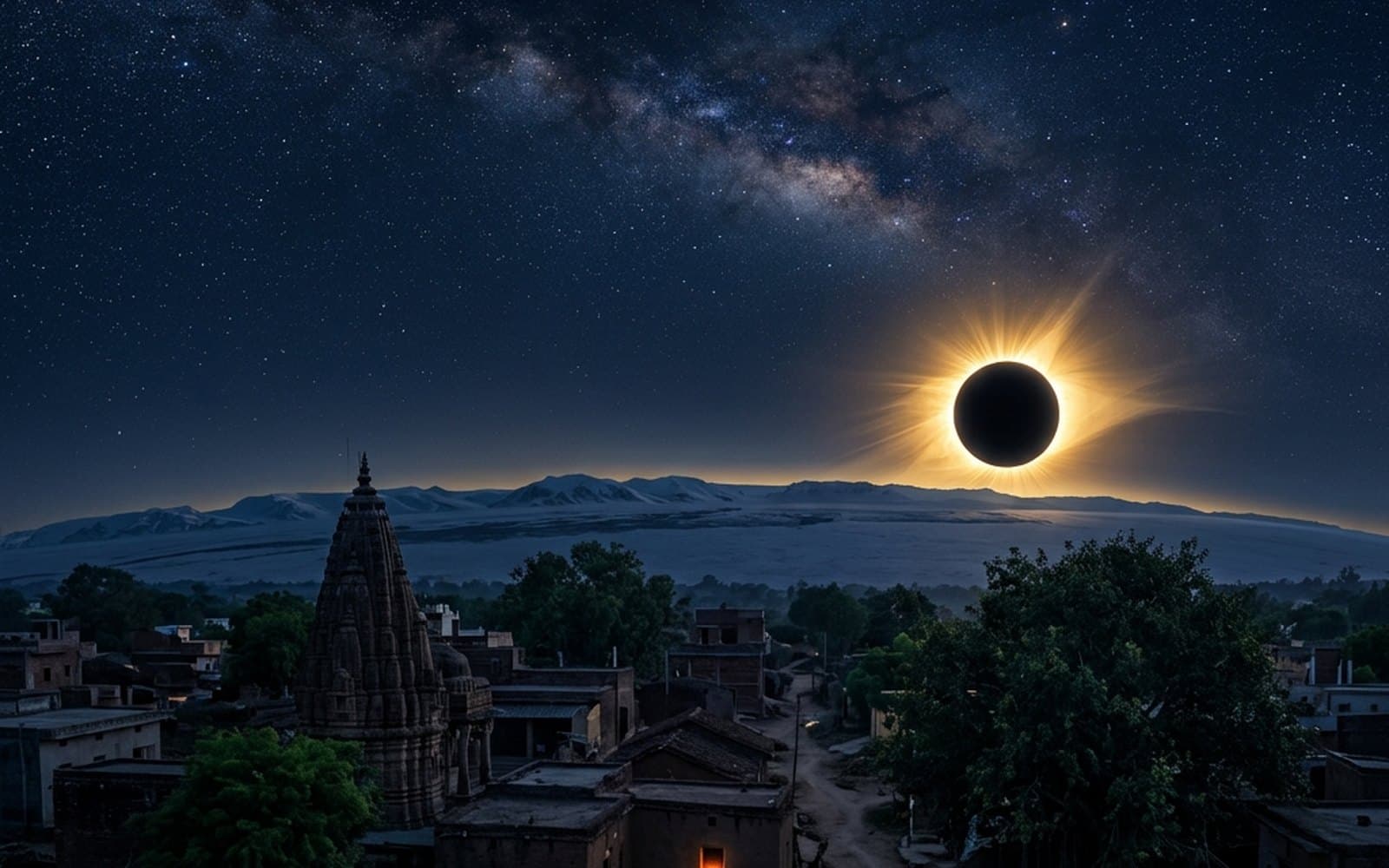
This eclipse has passed
The solar eclipse of 12 August 2026 is over. It was not visible from India and carried no Sutak here. The next grahan India will actually see is the partial solar eclipse of 2 August 2027 — and that one does carry Sutak.
Read about the 2 August 2027 eclipse →It was not visible from India — no Sutak applied.
The whole eclipse fell during night hours here, with the Sun below the horizon, so Hariyali Amavasya was observed exactly as usual.
Wednesday, 12 August 2026 · Hariyali Amavasya (Shravan Amavasya)
An eclipse at night? Why India misses this one
A solar eclipse can only be seen from the places where the Moon's shadow actually touches the Earth — and the shadow can only fall on the daylight side of the planet. On 12 August 2026 that shadow sweeps across Greenland, Iceland and northern Spain, where it will be afternoon and evening.
On Indian clocks, the same event runs from about 9:05 PM to 1:28 AM — the middle of the night. At the eclipse maximum the Sun sits more than 40 degrees below the horizon at Delhi, and deeper still further south. There is simply nothing in our sky to be eclipsed, which is why no Indian city sees any part of it.
Contact times in Indian Standard Time
From first to last contact
| Partial begins (Sparsha) | 12 Aug, 09:05 pm IST |
| Maximum eclipse | 12 Aug, 11:16 pm IST |
| Partial ends (Moksha) | 13 Aug, 01:28 am IST |
India uses one time zone, so these clock times hold nationwide. City verdicts below are computed with the same engine that powers our eclipse calendar.
Where the eclipse actually happens
The path of totality sweeps from the Arctic across eastern Greenland and western Iceland, then reaches northern Spain about an hour before sunset there. Totality lasts up to 2 minutes 18 seconds at its maximum, over the North Atlantic. Most of Europe and parts of North America see a partial eclipse.
From India, the only way to watch is a live stream — observatories in Iceland and Spain will broadcast the totality, which corresponds to late evening on Indian clocks.
Why NASA and the Panchang agree
The classical rule of the shastras ties Sutak and every grahan observance to the eclipse being visible at your place — the principle of the dṛśya grahaṇa, the seen eclipse. An eclipse that never rises over your horizon carries no ritual weight.
Modern astronomy computes the same answer from shadow geometry: the penumbra never touches India. Two very different roads — scripture and ephemeris — arrive at the same verdict for 12 August: not visible here, so the question of Sutak never even arises.
Hariyali Amavasya continues undisturbed
The same date is Hariyali Amavasya — the Shravan new moon kept with a sacred bath, charity, tarpan for ancestors, and the lovely monsoon tradition of planting trees. Had the eclipse been visible in India, Sutak would have pushed and reshaped these observances. It is not, so nothing moves.
The Amavasya snan, daan and tarpan were performed at their usual times, and the Sawan calendar around it — Somvar vrat, Mangala Gauri — ran unchanged.
Snan-daan for an eclipse you cannot see?
Tradition prescribes grahan-snan and grahan-daan only where the eclipse is visible. For India, the merit of this day flows from the Amavasya itself, not from the eclipse.
- Keep the Hariyali Amavasya bath, charity and tarpan at their normal times.
- Continue running Sawan observances (Somvar vrat, Mangala Gauri vrat) unchanged.
- No grahan-related restriction on food, temple visits or puja applies in India on this day.
This information is based on traditional beliefs and is provided for educational purposes only.
Surya Grahan 2026: your questions, answered
Will the solar eclipse of 12 August 2026 be visible in India?
No. The eclipse takes place between about 9:05 PM and 1:28 AM Indian time, when the Sun is below the horizon everywhere in India. No Indian city sees any phase of it.
Is there Sutak in India for this surya grahan?
No. Sutak applies only where an eclipse is actually visible. Since this eclipse cannot be seen from India, no Sutak period applies — temples stay open and no food or puja restrictions arise.
I am pregnant. Do I need to follow any eclipse precautions on 12 August?
The classical rule ties all eclipse precautions to visibility, and this eclipse is not visible from India — so no grahan-related precaution applies. Families who keep additional customs may of course follow their own tradition. This is traditional information, shared for educational purposes.
Does the eclipse change Hariyali Amavasya puja timings?
No. Amavasya snan, daan and tarpan follow their usual muhurat. Sutak — which is what reshapes ritual timings — does not apply in India for this eclipse.
Where can I watch the eclipse live?
The totality crosses Greenland, Iceland and northern Spain, with maximum totality of about 2 minutes 18 seconds. Major observatories will stream it live; on Indian clocks the peak falls at 11:16 PM.
When is the next eclipse actually visible from India?
The solar eclipse of 2 August 2027 will be visible across India as a partial eclipse — deeper in the south — and Sutak will genuinely apply that day. That is the one to prepare for.
Keep reading
Chandra Grahan on Raksha Bandhan
The 28 August lunar eclipse and why the rakhi muhurat survives
Grahan Calendar
Every eclipse of the year with city-wise visibility and timings
Sutak Kaal Guide
The rules, the timings and who is exempt
Grahan Guide
From Samudra Manthan to the Surya Siddhanta
Amavasya Dates
Every new moon of the year with tithi timings