
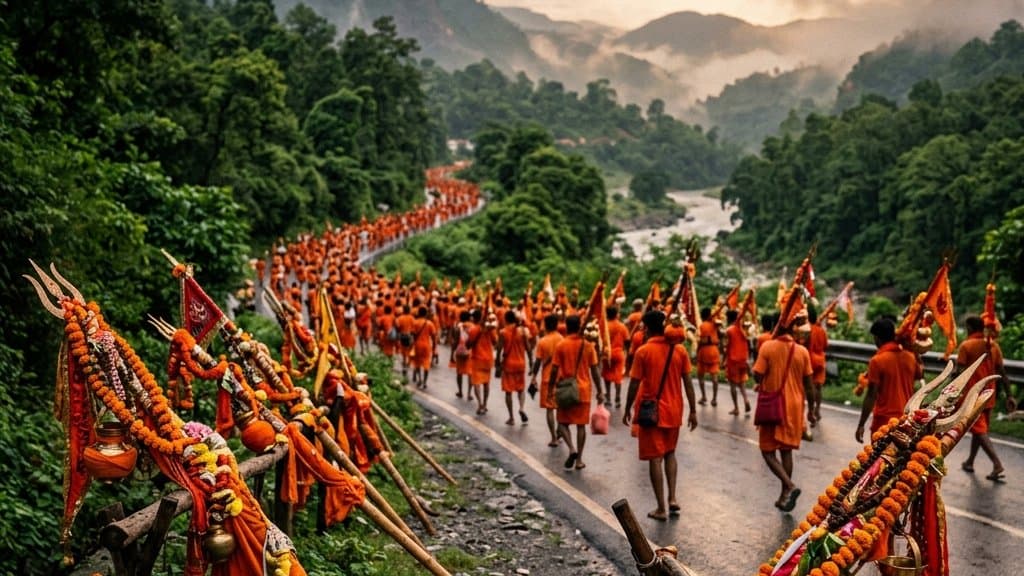
The Kanwar Yatra is one of the largest annual pilgrimages in the world — a river of saffron-clad devotees, the kanwariyas, who carry Ganga water on decorated poles across hundreds of kilometres to offer it to Lord Shiva. It is the living heart of Sawan on the roads of North India.
In 2026 the yatra begins with the Sawan month, on Thursday 30 July, and continues through Sawan, with the main jalabhishek on Sawan Shivratri, 11 August. This is a period of travel rather than a single muhurat. Below are the dates, the kanwariya niyam, the major routes, and the significance of the jalabhishek.
Kanwar Yatra 2026 at a glance
Yatra begins
Thursday, 30 July 2026
Main jalabhishek
Sawan Shivratri, 11 August
Held during
The Sawan (Shravan) month
Water offered to
Lord Shiva (Shivling)
Major sources
Haridwar, Gaumukh, Sultanganj
Undertaken by
Kanwariyas (Shiva devotees)
Kanwar Yatra 2026 dates
A period through Sawan, not a single day
Yatra begins
Thursday, 30 July 2026
Main jalabhishek
Sawan Shivratri, 11 August
The Kanwar Yatra is not a one-day festival but a stretch of the Sawan month. In 2026 it begins with Sawan, on Thursday 30 July, as kanwariyas set out for the source rivers. Water is offered to Shiva through the month, but the principal jalabhishek is on Sawan Shivratri, 11 August 2026 — the day most kanwariyas aim to complete their journey and offer the water. Plan travel for the full window, since the roads are at their busiest in the days leading up to Shivratri.
The kanwariya niyam — rules of the yatra
The discipline every kanwariya keeps
The kanwar (the water pots on a decorated pole) must not touch the ground once filled; it is rested on a stand or held by another during breaks.
Kanwariyas travel on foot, keep a sattvik diet, and abstain from alcohol, tobacco, meat, onion and garlic through the yatra.
Cleanliness is strict — a bath before touching the kanwar, and no wearing of leather or footwear near the pots.
The chant of "Bol Bam" is kept up along the way, and many walk barefoot as an act of devotion.
The major Kanwar Yatra routes
Where the Ganga water is filled
Haridwar
The most-travelled source — kanwariyas fill Ganga water at Har Ki Pauri and carry it across North India, most famously to temples in Delhi, Haryana and western Uttar Pradesh.
Gaumukh
The glacial source of the Ganga near Gangotri, from where the most devout carry water for the long journey down — a demanding, high-altitude route.
Sultanganj
In Bihar, kanwariyas lift Uttarvahini Ganga water and walk about 100 km to offer it at the Baidyanath Jyotirlinga in Deoghar (Jharkhand).
The jalabhishek and its significance
Offering the water to Shiva
Jalabhishek is the offering of the carried Ganga water over the Shivling. Sawan is the month most beloved of Shiva, and to bring water by hand over many kilometres — on foot, keeping the kanwar off the ground and following the niyam — is an act of intense devotion and surrender. The abhishek is believed to please Shiva greatly, bringing health, the removal of obstacles and the fulfilment of the devotee's vows. On Sawan Shivratri the temples fill through the night with the sound of Bol Bam.
Sawan Shivratri
Track the Sawan days and Shivratri timing
Plan your yatra around the Sawan Mondays and the Shivratri jalabhishek window. Use our live tools for the day's panchang and auspicious periods.
Frequently asked questions
Kanwar Yatra 2026 dates, rules and routes