
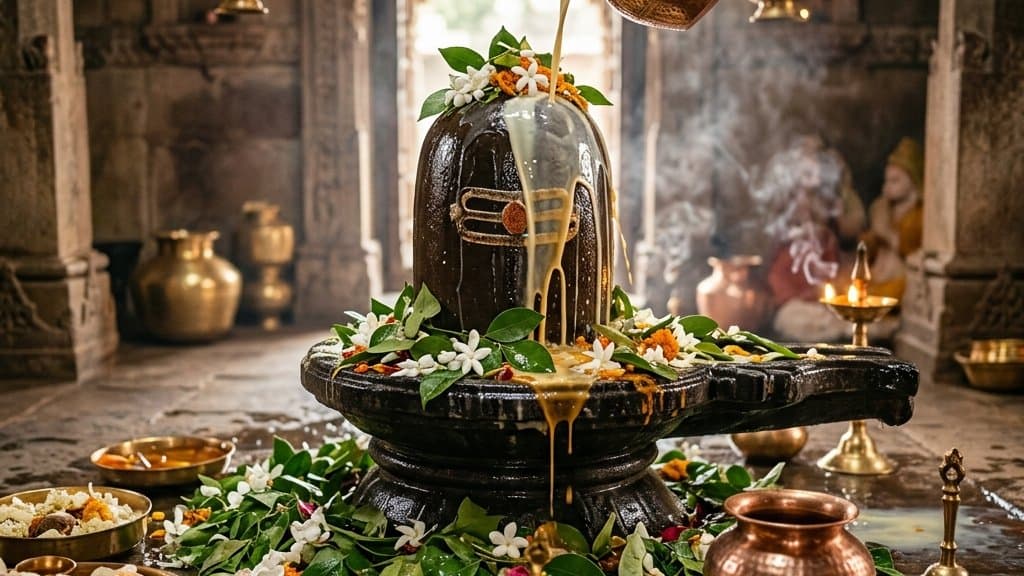
Rudrabhishek is the ritual bathing of the Shivling in the form of Rudra — regarded as one of the most complete and powerful of all Shiva worships. The Shivling is bathed with water and sacred substances while the Rudri (Namakam and Chamakam) or the mantra "Om Namah Shivaya" is recited.
This guide gives the samagri checklist, the vidhi in order, and the abhishek dravya — water, milk, curd, honey, ghee, sugarcane juice and panchamrit — with the fruit each is traditionally said to bestow, followed by the benefits and the best days to perform it in Sawan.
The abhishek dravya and their fruits
What each liquid offered on the Shivling is said to grant
Water (Jal)
Peace of mind and relief from fever and heat
Milk (Dugdh)
Good health, long life and freedom from illness
Curd (Dahi)
Progeny, prosperity and harmony at home
Honey (Shahad)
Freedom from debt and a sweet, melodious voice
Ghee (Ghrit)
Strength, vitality and continuity of the lineage
Sugarcane juice (Ikshu)
Wealth, abundance and sweetness in life
Sugar (Sharkara)
Removal of illness and fulfilment of wishes
Panchamrit
All-round blessings — the five together give complete grace
Rudrabhishek samagri checklist
Everything to keep ready before you begin
- A Shivling (or a clean, consecrated image) and a broad thali to catch the abhishek
- Gangajal and clean water; a conch (shankh) or small vessel to pour with
- Milk, curd, ghee, honey and sugar for the panchamrit; sugarcane juice if available
- Bilva (bel) leaves, white flowers, dhatura, aak flowers and bhang (as offered locally)
- Akshat (unbroken rice), chandan (sandal paste), roli, a sacred thread (janeu)
- A ghee lamp, incense, camphor, and fruit or sweets for the bhog
Rudrabhishek vidhi
How to perform the abhishek, step by step
Purification & sankalp
Bathe, wear clean clothes, purify the seat and take the sankalp — stating your name, the day and the purpose of the abhishek.
Establish & invoke
Place the Shivling on the thali facing north, light the lamp, and invoke Lord Shiva along with Ganesha and the Navagraha.
Jalabhishek
Begin the abhishek with Gangajal and pure water, letting a thin, steady stream fall on the Shivling while chanting "Om Namah Shivaya".
Abhishek with the dravya
Perform the abhishek in order — milk, curd, ghee, honey, sugar (or panchamrit and sugarcane juice) — washing with water after each. The traditional recitation is the Rudri (Namakam–Chamakam); where that is not known, "Om Namah Shivaya" is kept throughout.
Offerings
Wash the Shivling with clean water a final time, then offer bilva leaves, white flowers, chandan, akshat, dhatura and the sacred thread.
Aarti & prasad
Offer the bhog, wave camphor and perform the Shiva aarti, then distribute the panchamrit and prasad to all present.
Best days for Rudrabhishek in Sawan
Mondays, Pradosh and Shivratri
Every day of Sawan is auspicious for Shiva worship, but three occasions are held most fruitful for Rudrabhishek. The Sawan Mondays (Sawan Somwar) are Shiva’s own day. The Pradosh tithi — the thirteenth of each fortnight — carries a special evening window (pradosh kaal) prized for the abhishek. And Sawan Shivratri, worshipped through the night, is the most powerful occasion of all. If you can keep only one, choose a Monday, a Pradosh evening or the Shivratri night.
Sawan Mondays & Pradosh
Benefits of Rudrabhishek
What the worship is kept for
Rudrabhishek is kept for health and long life, for the removal of doshas and obstacles, and for peace of mind. Devotees also perform it for prosperity, progeny and the fulfilment of long-held wishes, and to pacify graha (planetary) afflictions and bring wellbeing to the family. In the devotional view its deepest benefit is simply the grace and nearness of Lord Shiva, who is Ashutosh — easily pleased by sincere, simple devotion.
Find the right window for the abhishek
The Pradosh evening and the Monday puja windows shift with your city's sunset and sunrise. Check today's tithi and auspicious periods before you begin.
Frequently asked questions
Rudrabhishek vidhi, samagri and benefits