
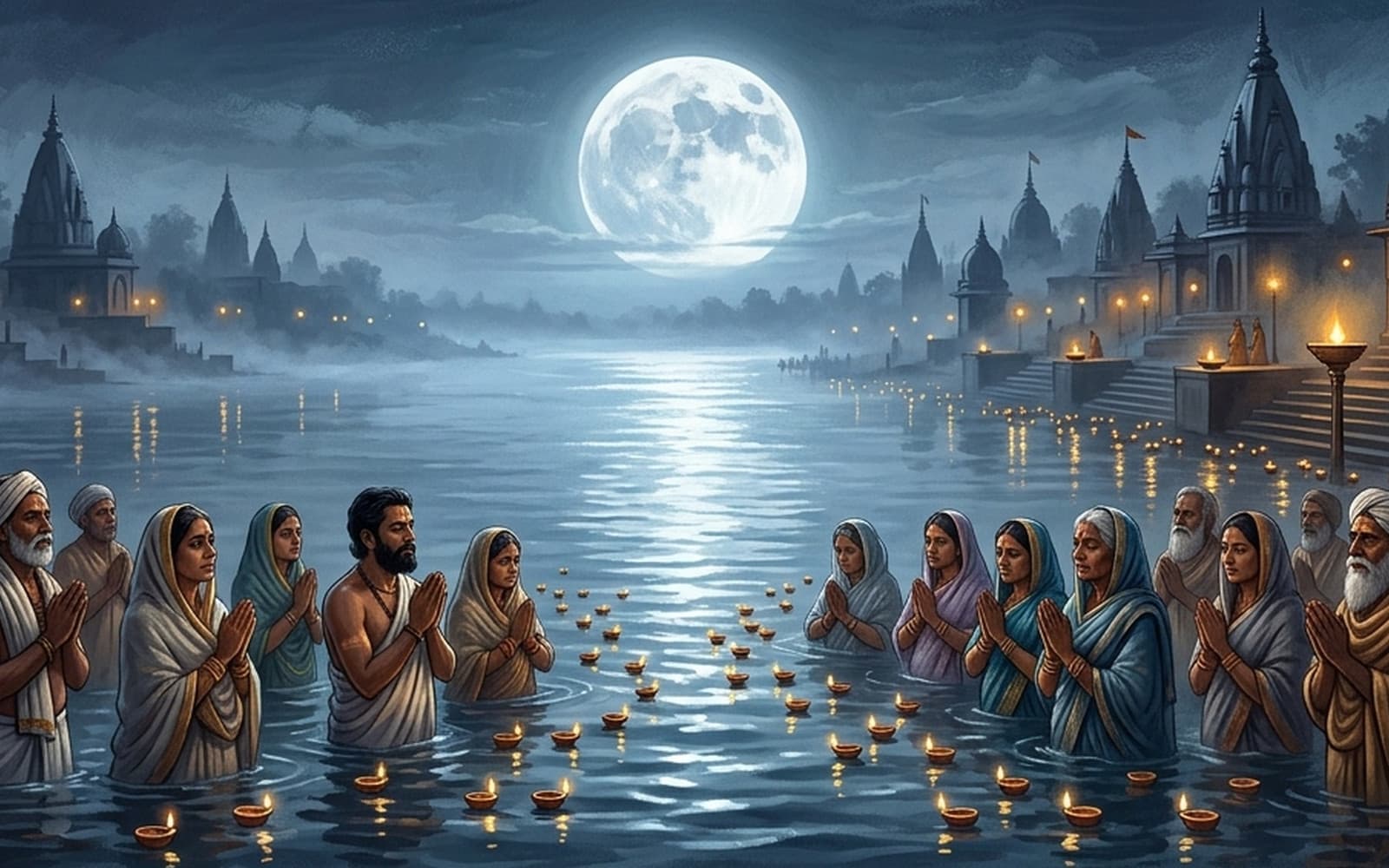
Magha Purnima 2027 is on Saturday, 20 February. In New Delhi the Purnima tithi runs from 8:00 AM on Saturday, 20 February to 4:54 AM on Sunday, 21 February.
Magha Purnima is the full moon of Magha, and the day that closes the month's long devotion to bathing. Through the weeks of Magha the faithful rise before dawn to stand in cold river water — above all at the Sangam in Prayagraj — and this full moon is where that discipline reaches its end and its height. The month of Magha-snan opens on the previous full moon and shuts on this one; what Paush Purnima began, Magha Purnima completes.
It falls once a year, in the deep of the northern winter. For those who have kept Kalpavas — the month-long vow of living simply on the riverbank, one bath, one meal, and the hours given to prayer — this is the last and most cherished snan, the morning the vow is laid down. For everyone else it is a great day of river bathing, of charity to those the cold presses hardest, and of the Satyanarayan puja, kept in the light of a moon at its fullest.
Date & tithi timing
Observance day and full-moon window for your city
Tithi begins
20 February 2027, 8:00 AM
Tithi ends
21 February 2027, 4:54 AM
| Upcoming dates | Day |
|---|---|
| 20 February 2027 | Saturday |
| 10 February 2028 | Thursday |
Times shown for New Delhi; pick your city on the Purnima calendar for local timings.
Magha Purnima at a glance
Date in 2027
Saturday, 20 February 2027
Tithi & month
Purnima (full moon) of Magha
Deity & focus
Lord Vishnu (Satyanarayan) · the Moon
Observance
Maghi snan, Satyanarayan puja & daan
Also called
Maghi Purnima · the closing Magha-snan
The full moon that closes the month of bathing
Magha-snan, and the vow of Kalpavas
Magha is the month the shastras single out for bathing. The old texts hold that a dip in a holy river through this month — and above all where the rivers meet at Prayag — washes away wrong carried across years, and that the gods themselves come down to the water in that season, unseen among the pilgrims. The devotion runs the length of the month, dawn after dawn, and two full moons stand at its gates: it opens on Paush Purnima and closes on Magha Purnima, the night this page is named for.
Between those full moons some keep Kalpavas — the vow to live for the month on the sands of the Sangam, in a tent and a single change of cloth, taking one bath and one meal a day, giving the hours to japa, katha and satsang. It is austerity chosen, not imposed, and Magha Purnima is the morning it is set down. The last bath is taken, the sankalp completed, and the kalpavasi returns to ordinary life carrying, it is believed, the merit of the whole month held in that final dip under the full moon.
The concluding bath at the Sangam
Prayagraj, and the merit of the Maghi snan
Prayagraj is the heart of the Maghi snan. There the Ganga and the Yamuna meet the unseen Saraswati at the Triveni Sangam, and for the weeks of the Magh Mela the sands fill with those who have come to bathe. If Mauni Amavasya, the dark moon earlier in the month, draws the single largest crowd, Magha Purnima is its counterpart at the other end — the bath that seals the month, quieter in number but held to close the account of merit the season has been building.
The belief behind the crowd is plain and old: that to bathe here on this full moon is to be washed clean, the body in the cold water and the record of one's wrongs along with it. Those who cannot reach the Sangam bathe in the Ganga at Haridwar or Kashi, or in whatever holy river runs near, and those who cannot travel at all add a little Ganga water to a bath at home and take it with the same resolve. Tradition asks for the intent and the pre-dawn hour more than for any one riverbank.
How Magha Purnima is observed
Snan, arghya to the moon, and the winter gift
The day turns on its bath. Those who can reach a holy river bathe there before sunrise; those who cannot add a little Ganga water to the bath at home and take it with the same intent, making a sankalp — the quiet resolve to keep the day — before stepping into the water. Arghya is offered to the rising sun, and because this is a full moon, many also worship Chandra at its brightest and offer arghya to the moon as the night comes on.
From the bath the day gives itself to worship and to giving. The hours go to the Satyanarayan puja and its katha, to the recitation of Vishnu's names, and to daan that answers the season's cold — sesame and the sweets made from it, warm clothing and blankets, and anna-daan, a gift of food, to the poor and to brahmins. The giving is not a price paid for merit but the outward face of the same devotion the bath practises in the water.
Kept according to your means
The Satyanarayan vrat, and what the month leaves behind
Vishnu's katha, and the fruit of Kalpavas
The worship at the centre of Magha Purnima is the Satyanarayan vrat — the honouring of Vishnu as Satyanarayan, the lord who is truth. A small puja is set, the katha is read or heard in five parts, and the prasad, the well-known sheera of semolina, is shared among all who are present. Kept on this full moon, it is held to bring peace to the household and steadiness to what the family has undertaken; many keep it to mark a wish fulfilled or a new beginning made.
What the month leaves behind is quiet. The kalpavasi folds the tent and carries home the calm of thirty dawns at the water; the pilgrim who came only for the last bath carries the sense of a slate wiped clean. In some communities the same full moon is kept as the birth-anniversary of Sant Ravidas, and the day gathers his songs and his memory into it as well. However it is held, Magha Purnima closes the coldest, most devout stretch of the year on a note of light — a full moon over water that has been prayed in for a month.
See today's live panchang for your city
Tithi, nakshatra, sunrise and the day's muhurat — computed for wherever you are.
Magha Purnima — questions answered
The Maghi snan, Kalpavas and the Satyanarayan puja