
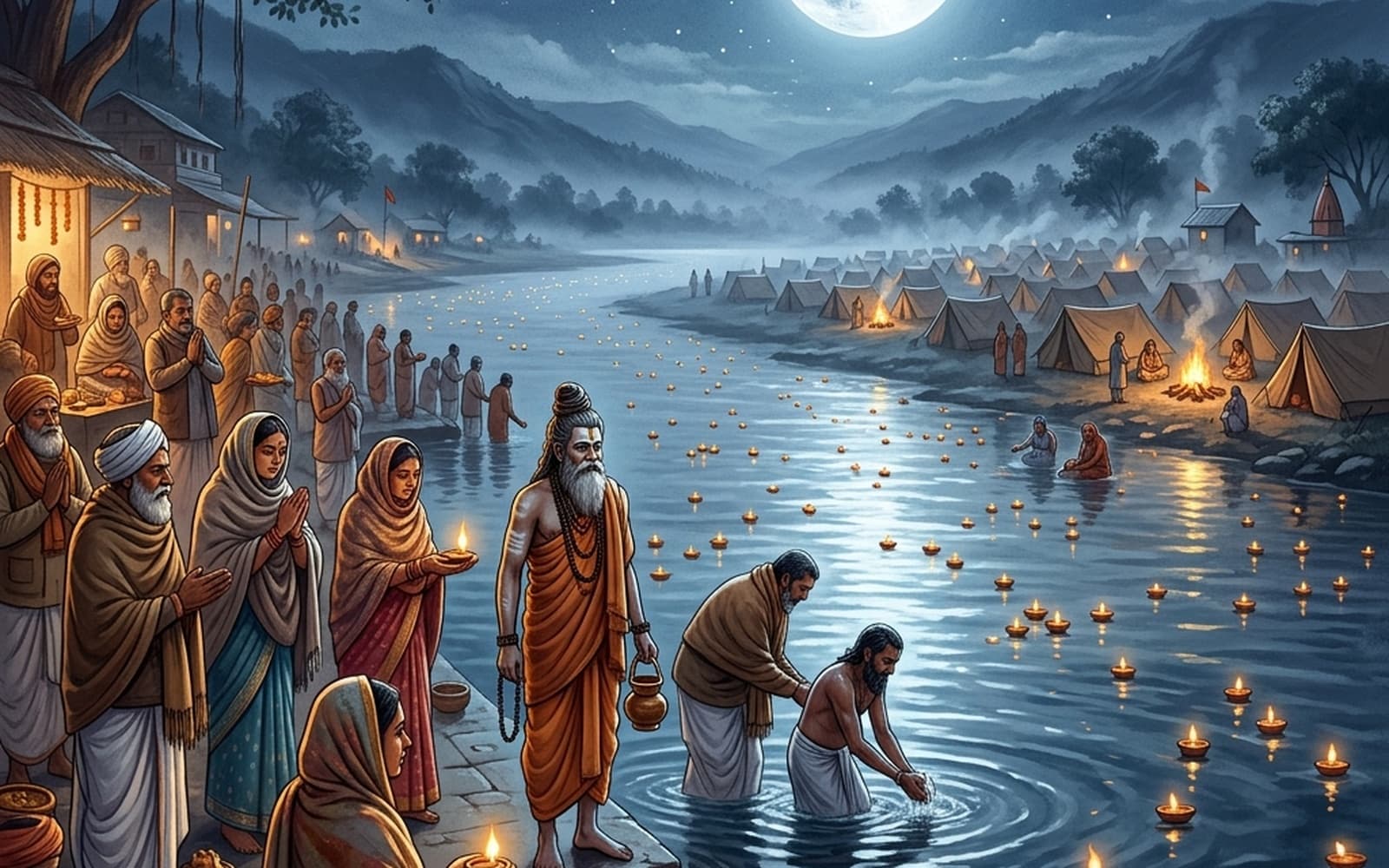
Paush Purnima 2027 is on Friday, 22 January. In New Delhi the Purnima tithi runs from 9:31 PM on Thursday, 21 January to 5:47 PM on Friday, 22 January.
Paush Purnima is the full moon of Pausha, the winter month of the Hindu calendar, and one of the most important bathing days of the year. It opens the sacred season of Magha snan: on this full moon the great pilgrimage to Prayag begins, the first holy dip is taken in the cold rivers before dawn, and the month-long vow of Kalpavas is entered upon the banks of the Sangam.
The same full moon is Shakambhari Jayanti, sacred to the goddess who once fed the world with greens and fruit, and a day given everywhere to bathing, charity and fasting. Where other Purnimas are kept mainly at home, this one draws pilgrims in their millions to the rivers — a full moon of cold water, open sky, and vows made for the year to come.
Paush Purnima at a glance
Date in 2027
Friday, 22 January 2027
Tithi
Purnima (full moon)
Lunar month
Pausha · Shukla Paksha
The day marks
First Magh snan · Kalpavas begins at Prayag
Also honoured
Shakambhari Jayanti · snan, daan & vows
Date & tithi timing
The full-moon day and tithi window for your city
Tithi begins
21 January 2027, 9:31 PM
Tithi ends
22 January 2027, 5:47 PM
| Upcoming dates | Day |
|---|---|
| 22 January 2027 | Friday |
| 12 January 2028 | Wednesday |
| 31 December 2028 | Sunday |
Times shown for New Delhi; pick your city on the Purnima calendar for local timings.
The full moon that opens the bathing month
Why Pausha's full moon begins the Magha snan
Paush Purnima is the full moon of Pausha, the tenth lunar month, and it arrives in the depth of winter. It closes the bright fortnight of a cold, quiet month — yet it is remembered less for what it ends than for what it begins. On this full moon the great bathing month of Magha opens, and the first of its holy dips is taken at first light on the banks of the sacred rivers.
The heart of it is Prayag, the confluence of the Ganga, the Yamuna and the unseen Sarasvati at Prayagraj. Paush Purnima is the opening snan parva of the Magh Mela — the first of the season's great bathing days — and it is also the day the month-long Kalpavas begins: the vow by which pilgrims leave home to live plainly on the riverbank through all of Magha, bathing each dawn until the next full moon releases them.
So this is a threshold tithi. The full moon of Pausha stands at the mouth of the most concentrated season of pilgrimage in the Hindu year, and everything the month will hold — the bathing, the charity, the austerity, the vows — is entered through it. For countless families it is the day the journey to the Sangam is timed to.
Part of the Magha bathing season
The pre-dawn snan, daan and the month's vows
How the day is traditionally kept
The day turns on the snan, the holy bath taken before sunrise. Pilgrims step into the cold river in the dark and dip as the eastern sky lightens, offering water to the rising Sun and to the Moon that has just set, and reciting the name of the sacred waters. A bath at Prayag, at Haridwar, at Pushkar's lake or in any holy river is held to carry the full merit of the day; where no river is near, water drawn at home with a few drops of Ganga is used in its place.
Daan, charity, is the bath's companion, and Pausha's charity is shaped by the cold. Sesame and jaggery, warm blankets and clothing, ghee, and cooked food such as khichdi are given to brahmins and to the needy — the winter gifts that ease the season for another. Many keep a fast through the day, break it after sighting the moon, and read or hear the Satyanarayan Katha in the evening, the observance common to every Purnima.
For those who take the fuller vow, the day is the start of Kalpavas — a month of austere residence at the Sangam on a single sattvik meal, three baths a day, and hours given to prayer, the reading of scripture, and the darshan of Venimadhava, the presiding Vishnu of the confluence. The vow is made on this full moon and carried, unbroken, to the full moon of Magha.
Kept in the spirit of faith
Shakambhari Jayanti, the goddess of green
The full moon that closes Shakambhari Navratri
Paush Purnima is also Shakambhari Jayanti, the day sacred to the goddess Shakambhari — a form of the Adi Shakti whose name means she who bears the greens. The story told of her is of a famine that lasted a hundred years, when the earth cracked and nothing grew; moved by the hunger of her creatures, the goddess brought forth vegetables, fruit and herbs from her own body and fed the world until the rains returned.
The nine nights of Shakambhari Navratri, kept in the bright fortnight of Pausha, come to their close on this full moon. At her shrines — the Shakti Peeth near Saharanpur, Banashankari in the south, Shakambhari at Sambhar — she is worshipped on this day with offerings of fresh greens, vegetables and fruit rather than the usual sweets, in memory of how she once nourished the living.
Read together with the bathing month it opens, the day carries a single thread: nourishment and renewal at the turn of deep winter. The rivers are entered for the cleansing of the year, and the goddess who feeds the world is honoured on the same full moon — the pilgrimage of the body and the pilgrimage of gratitude kept as one.
What tradition attaches to the day
Merit of the Magh snan and vows for the year
The Magh snan rests on an old and simple faith: that a bath taken in the sacred rivers in this season, begun on Paush Purnima, washes away the accumulated faults of the past and readies the bather for the year ahead. The colder and harder the dip, the greater the merit is held to be — the austerity freely undertaken being the point of it.
The full moon lends the day its own character. Purnima is counted among the auspicious tithis, favoured for worship, charity and the making of vows, and the bright moon over the river is taken as a sign of fullness and grace. Many use the day to fix a sankalpa — a resolution or a discipline — to be held through Magha or through the year, the vow made under a full and witnessing moon.
Set beside the loud festivals of the calendar, this is a grave and hopeful observance, turned toward purification rather than celebration. Its promised fruit is not fortune so much as a clean beginning — a year entered from cold water and open sky, with the month of Magha's austerities still ahead.
See today's live panchang for your city
Tithi, nakshatra, sunrise and the day's timings — computed for wherever you are.
Paush Purnima — questions answered
The full moon, the Magh snan, Kalpavas and Shakambhari Jayanti