
Mokshada Ekadashi carries its meaning in its name — moksha-da, the giver of liberation. It falls on the eleventh tithi of the bright fortnight of Margashirsha, the month also called Agahan, in the cool as the year turns toward winter, and it is kept as a fast for Vishnu in his Damodara form. Among the year's Ekadashis it is the one asked for grace not only for oneself but for the dead — for the release of ancestors who have not yet found rest.
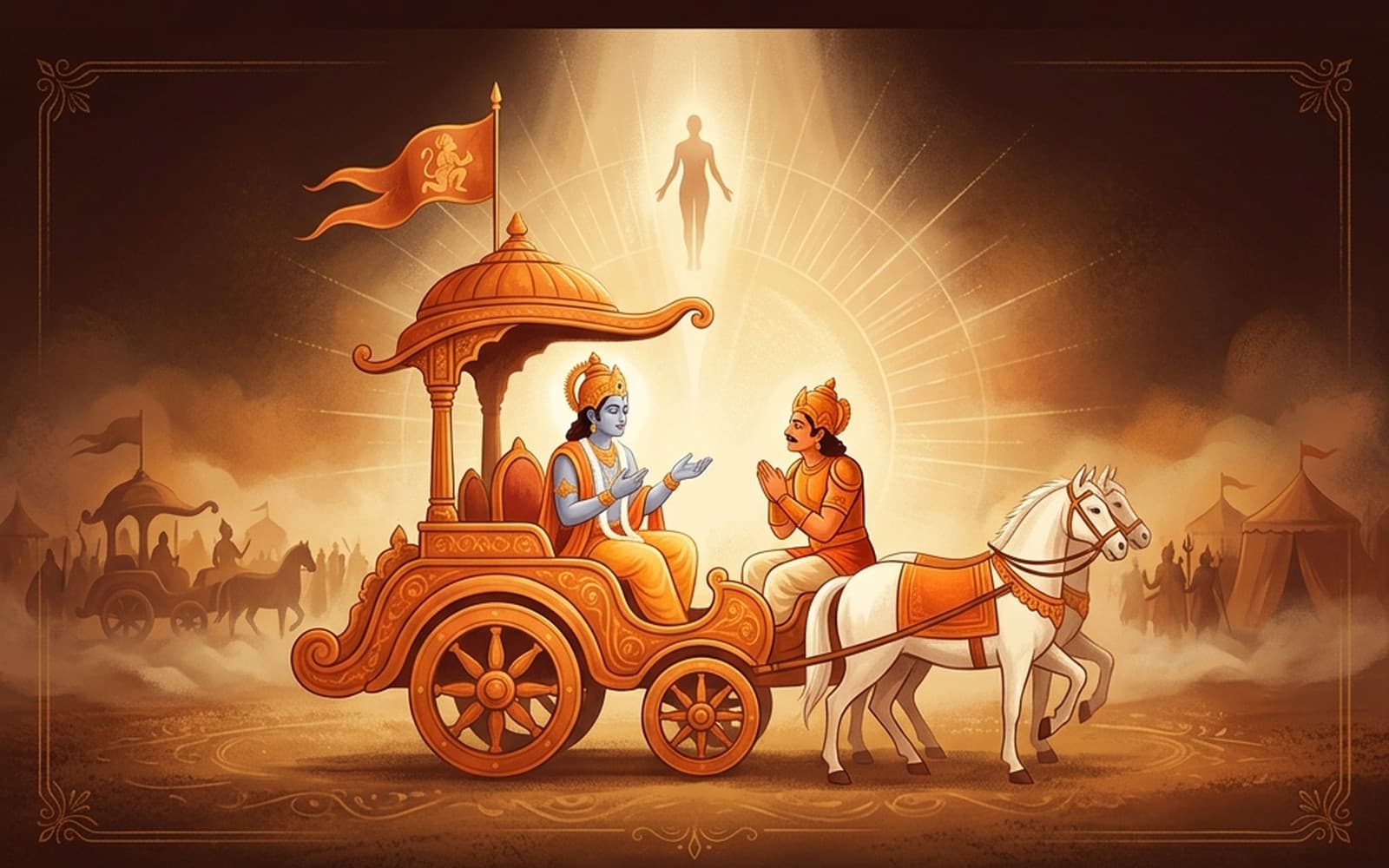
The same tithi holds a second, greater weight: it is Gita Jayanti, the day the Bhagavad Gita is said to have been spoken. On the field of Kurukshetra, with the two armies drawn up and Arjuna's courage failing, his charioteer Krishna gave the counsel that became the Gita. To fast on Mokshada Ekadashi and to read or hear those verses is to keep both observances in a single day.
The giver of liberation
Moksha for oneself — and for the departed
The name is a compound of two words — moksha, liberation, and da, the one who grants it. Among the twenty-four Ekadashis of the year, this is the one turned most openly toward release: freedom from the long round of birth and death, and from the weight of karma carried over from before.
What sets the day apart is the direction of its prayer. Many who keep this fast ask its grace not for themselves but for their forefathers. The old story tied to the day tells of a king who learned, to his grief, that his late father was suffering for a wrong done long ago; a sage counselled him to keep Mokshada Ekadashi and to make a gift of its merit to his father, and by that offering the father was set free. To earn grace and then hand it on to the dead — that gesture is the heart of the observance.
The form of Vishnu worshipped here is Damodara, and the fruit sought is not comfort or gain but, in the end, liberation itself — for the living who keep the vow and for the departed in whose name it is kept.
Mokshada Ekadashi at a glance
Date in 2026
Sunday, 20 December 2026
Lunar month
Margashirsha (Agahan) · Shukla Paksha
Deity
Lord Vishnu (Damodara)
The day marks
Fast for moksha · Gita Jayanti
Also called
Vaikuntha · Mukkoti (South)
Date & tithi timing
Observance day and tithi window for your city
In 2026, Mokshada Ekadashi is kept on Sunday, 20 December 2026 — the Ekadashi tithi opens 19 December 2026, 10:10 PM and closes 20 December 2026, 08:15 PM.
Tithi begins
19 December 2026, 10:10 PM
Tithi ends
20 December 2026, 08:15 PM
| Year | Observance day |
|---|---|
| 2026 | Sunday, 20 December 2026 |
| 2027 | Thursday, 9 December 2027 |
Times shown for New Delhi; pick your city on the Ekadashi calendar for local timings.
Gita Jayanti — the day the Gita was spoken
Krishna's counsel to Arjuna on Kurukshetra
Mokshada Ekadashi is also Gita Jayanti, the anniversary of the Bhagavad Gita, and tradition places the discourse on this very tithi. When Arjuna looked across the field of Kurukshetra at his own teachers and kinsmen arrayed for battle, his resolve broke and his bow slipped from his hand. His charioteer, Krishna, answered that despair with the seven hundred verses that became the Gita.
On this day households keep the Gita open — some read a single chapter, some the whole of it, and many simply sit and listen as it is recited; in some homes the book itself is worshipped. The pairing is not by chance. The Gita's own subject is moksha — how to act in the world without being bound by action — so the scripture of liberation and the fast for liberation come to rest on the same day.
Vaikuntha Ekadashi — the same day in the South
When the gates of Vaikuntha are said to open
In the temples of the South, and above all in the Tamil tradition, this is the season of Vaikuntha Ekadashi, also called Mukkoti Ekadashi. It is counted in the solar month of Dhanur, and in many years it falls on the same tithi as Mokshada Ekadashi in the North, so the two are often kept as a single festival.
On this day the great Vishnu temples — Srirangam most famously — open the Vaikuntha Dwaram, the northern “gate of Vaikuntha.” Devotees pass through it in the belief that those who do so on this day are drawn toward the Lord's own abode, and the name Mukkoti recalls the tradition that a great host of the gods gathers for the occasion.
One Ekadashi, two reckonings
How the fast is kept
The vow, the Gita, and remembrance of ancestors
The day begins at dawn with a bath and a sankalp, the quiet resolve to keep the vow, followed by the worship of Vishnu with tulsi leaves, a lamp, incense and the Ekadashi katha. Grain and pulses are set aside for the day; some keep a complete fast, while others take fruit and milk — a phalahara fast — according to their strength.
Two threads run through the day beyond the fasting itself. The first is the Gita: to read it, or to sit with its recitation, is treated as the central act of worship. The second is remembrance of the dead. Because the day leans toward liberation for ancestors, many offer tarpan — water given in their name — and dedicate the merit of the fast to forefathers who have passed, that they too may find release.
Faith within your strength
Parana — closing the fast on Dwadashi
The window that completes the vow
Parana is the breaking of the fast, done the next morning on Dwadashi — after sunrise, before the Dwadashi tithi ends, and never during Hari Vasara, the first quarter of Dwadashi. It is usually broken gently, with tulsi water and simple sattvik food.
Breaking too early or too late is held to diminish the fast, which is why the next morning's window matters as much as the Ekadashi date itself. The exact time shifts with your city; check that day's panchang for the precise parana window.
Mind the parana window
See today's live panchang for your city
Tithi, nakshatra, sunrise and the day's muhurat — computed for wherever you are.
Mokshada Ekadashi — questions answered
Liberation, Gita Jayanti, Vaikuntha Ekadashi and parana