
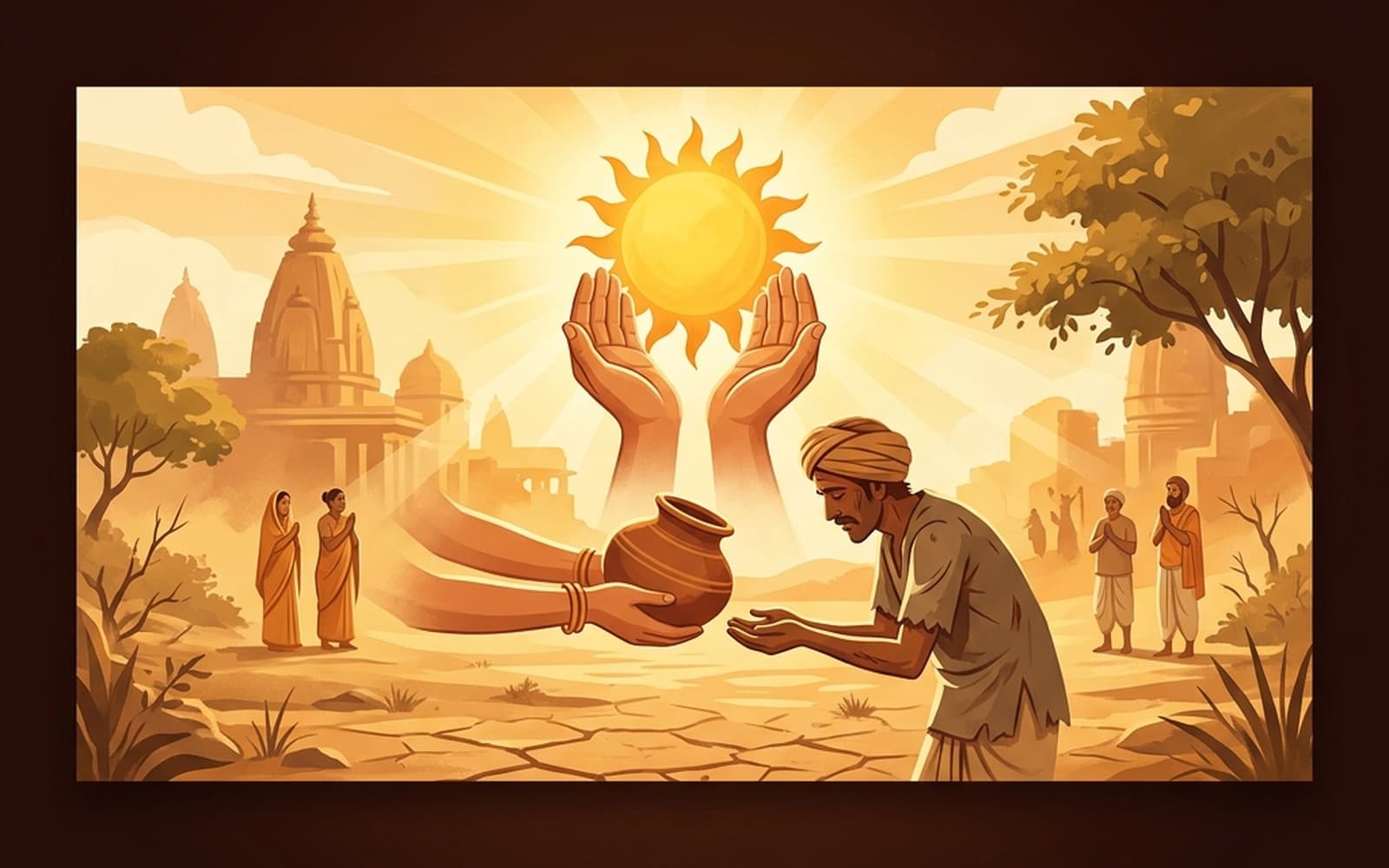
Nirjala Ekadashi is the hardest and the most prized of the year's Ekadashis. The name says what it asks — nir-jala, without water. From sunrise on Ekadashi to the moment of parana the next morning, those who keep it take neither food nor a drop of water, and they do it in the deep heat of Jyeshtha, when June is at its most unforgiving.
Its reward is meant to match its difficulty. Tradition holds that a single Nirjala fast, kept properly, gives the merit of all twenty-four Ekadashis of the year — which is why so many who cannot fast every fortnight keep this one. It is also called Bhimseni or Pandava Ekadashi, after the story of Bhima, who found his own way to the same grace.
Nirjala Ekadashi at a glance
Date in 2027
Monday, 14 June 2027
Lunar month
Jyeshtha · Shukla Paksha
Deity
Lord Vishnu
Observance
Waterless (Nirjala) fast
Also called
Bhimseni · Pandava
Date & tithi timing
Observance day and tithi window for your city
In 2027, Nirjala Ekadashi is observed on Monday, 14 June 2027. The Ekadashi tithi begins 14 June 2027, 02:13 AM and ends 15 June 2027, 02:09 AM.
Tithi begins
14 June 2027, 02:13 AM
Tithi ends
15 June 2027, 02:09 AM
Smarta and Vaishnava dates differ
| Year | Observance day |
|---|---|
| 2026 | Thursday, 25 June 2026 |
| 2027 | Monday, 14 June 2027 |
Times shown for New Delhi; pick your city on the Ekadashi calendar for local timings.
Why this Ekadashi outweighs the rest
One fast, the merit of twenty-four
There are twenty-four Ekadashis in an ordinary year, and the devout keep every one of them. But few households can hold a fast twice a month, year after year, and the tradition made room for that human limit. The Padma and Brahmavaivarta Puranas hold that a person who keeps Nirjala Ekadashi with full discipline — no food, no water, the day given to Vishnu — earns the fruit of all the others together.
That is not a licence to skip the rest so much as a mercy for those who must. The waterless vow is severe by design: what is given up is not just grain but the one thing the summer body craves most. In that surrender the day finds its weight, and its promise of liberation from past wrongs.
The story of Bhima
Why it is called Bhimseni Ekadashi
The name Bhimseni comes from the second of the Pandavas. Bhima loved his food and could not bring himself to fast, yet it pained him that his mother, his brothers and Draupadi all kept every Ekadashi while he could not. He went to the sage Vyasa with his trouble.
Vyasa's answer was kind and exact: if a full fortnightly fast was beyond him, let Bhima keep this one Ekadashi in Jyeshtha without water, and he would gain the merit of them all. Bhima did — and by tradition it nearly undid him in the heat, which is why the day also carries his name. His story is the reassurance folded into the vow: sincerity on this single day is counted as though you had kept the whole year.
How the waterless fast is kept
The vow, the worship, and the day's discipline
The observance runs from sunrise on Ekadashi to the parana the next morning, and within it neither food nor water is taken — some do not so much as rinse the mouth. The day opens with a bath and a sankalp, the resolve to keep the vow, and turns to the worship of Vishnu with tulsi, a lamp and the Ekadashi katha. Many pass the day in his names rather than in errands.
Because the fast is so demanding, the tradition itself sets a limit: it is for those whose health allows it. Elders, children, the unwell, expectant mothers and anyone for whom going without water is a risk are meant to keep a lighter fast — fruit and water, or a partial vow — without any sense of failure. The vow is an offering, not an ordeal.
A word on health
Charity in the summer heat
Giving water to those who thirst
Nirjala Ekadashi falls at the peak of the hot season, and its charity answers the heat directly. Where the fast withholds water from oneself, the day's giving offers it freely to others. It is traditional to donate earthen pots filled with water, and with them hand-fans, umbrellas, footwear, sherbet, seasonal fruit and cooling foods — the small mercies of a Jyeshtha afternoon.
Many set up a piau, a roadside stall of drinking water, or give to those who work through the heat. The idea is simple and of a piece with the vow: to feel thirst yourself for a day, and to make sure no one near you goes thirsty.
Breaking the fast — parana
The window that completes the vow
Parana is the breaking of the fast, and its timing is part of the observance. It is done the next morning on Dwadashi — after sunrise, before the Dwadashi tithi ends, and never during Hari Vasara, the first quarter of Dwadashi. The fast is usually broken gently, with water first and then simple food, so the body is not shocked after a full day without.
Breaking too early or too late is held to lessen the fast, which is why the next day's sunrise matters as much as the Ekadashi date itself. The exact window shifts with your city; check that day's panchang for the precise time.
Mind the parana window
See today's live panchang for your city
Tithi, nakshatra, sunrise and the day's muhurat — computed for wherever you are.
Nirjala Ekadashi — questions answered
The waterless fast, the Bhima story and parana