
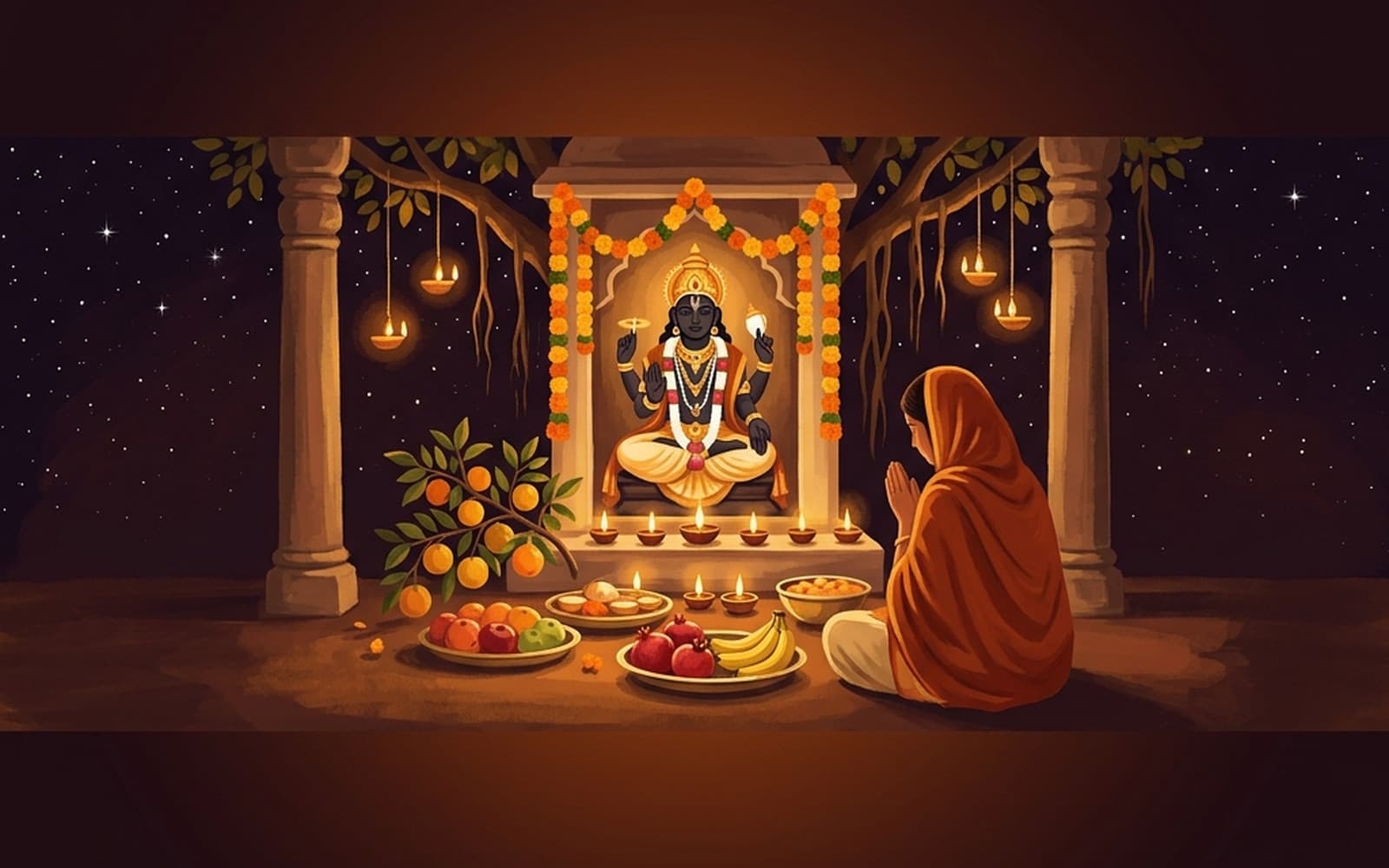
Saphala Ekadashi is the fast whose name is its promise. Sa-phala means 'with fruit' — fruitful, success-bearing — and the day is kept in the belief that effort offered here will not be wasted, that even a small, sincere act of worship will bear great merit. It is the eleventh tithi of the dark fortnight of Pausha, kept for Lord Vishnu in the short, cold days at the heart of winter.
The day is remembered above all for the story of Lumpaka — a wayward prince, banished to the forest, who kept this fast one bitter night without meaning to, and found his life turned by it. Because grains are set aside, the day belongs to seasonal fruit and to a night vigil in Vishnu's names, closing with parana the next morning on Dwadashi.
The fast that bears fruit
What 'Saphala' means, and why it matters
Saphala means, quite simply, 'with fruit' — fruitful, success-bearing. Where many of the year's Ekadashis take their name from a deity or a turn of the season, this one is named for its promise: that effort offered on this day does not go to waste. It is the eleventh tithi of the dark fortnight of Pausha, kept as a fast for Lord Vishnu — Narayana — in the short, cold days at the heart of winter.
What sets the day apart is the weight it gives to sincerity over scale. The tradition, drawn from the Bhavishya Purana, holds that even a small and honest act of worship on Saphala Ekadashi carries great merit. It is a promise made plain in the story the day is remembered by — the story of a prince who kept the fast without meaning to, and was changed by it.
Saphala Ekadashi at a glance
Date in 2027
Sunday, 3 January 2027
Lunar month
Pausha · Krishna Paksha
Deity
Lord Vishnu (Narayana)
Observance
Fast, fruit offering & night vigil
Name means
Fruitful, success-bearing
Date & tithi timing
Observance day and tithi window for your city
Saphala Ekadashi 2027 falls on Sunday, 3 January 2027. The Ekadashi tithi runs from 02 January 2027, 02:25 PM to 03 January 2027, 04:09 PM.
Tithi begins
02 January 2027, 02:25 PM
Tithi ends
03 January 2027, 04:09 PM
| Year | Observance day |
|---|---|
| 2027 | Sunday, 3 January 2027 |
| 2027 | Thursday, 23 December 2027 |
Times shown for New Delhi; pick your city on the Ekadashi calendar for local timings.
The story of Lumpaka
How a banished prince was redeemed
King Mahishmat ruled Champavati and had four sons. The eldest, Lumpaka, was the trouble of his life — wasteful, irreligious, contemptuous of holy men, a drain on the treasury and the kingdom's good name. The king counselled him, and when nothing took, he did the hard thing a father can do: he banished his own son to the forest.
There Lumpaka lived rough, and on the night of Saphala Ekadashi the cold and the hunger were at their worst. He could find nothing to eat, and he lay awake through the long winter night, shivering — and so, without intending any of it, he kept the fast and the vigil the day asks for. By that unmeant observance he drew Vishnu's grace. His heart turned; he was reconciled with his father, restored to the kingdom, and in the fullness of time reached Vishnu's own abode.
The point of the tale is not lost on anyone who hears it. If a fast kept by accident, out of sheer hardship, could bear such fruit, how much more a fast kept with intention and love. That is the reassurance folded into the day.
The night vigil and the fruit offering
How the vrat is kept
In form the observance is gentle. The day opens with a bath and a sankalp, the resolve to keep the vow, and turns to the worship of Vishnu with tulsi leaves, a lamp and the Ekadashi katha. Because grains are set aside for the day, both the offering and what little is eaten lean on seasonal fruit — the very fruit that gives the day part of its name and its meaning.
After dark comes the jagran, the night vigil. To stay awake through the winter night in Vishnu's names — as Lumpaka once stayed awake without knowing why — is the heart of this vrat. The hours are given to bhajan, to the katha, and to remembrance, and the vigil is held to be as much a part of the fast as the abstinence itself.
Keep to your capacity
A small deed, a great fruit
Why sincerity outweighs grandeur
The promise of Saphala is not that only elaborate rituals count — it is nearly the opposite. Tradition holds that a small, sincere act of devotion on this day yields great merit. The katha is the proof of it: Lumpaka had no priest, no offering, no ritual to his name — only a sleepless, hungry night — and it was enough to change the course of his life.
The measure, in other words, is the heart. A single fruit offered with faith, a lamp lit, a night honestly kept — each is counted. For the household that cannot manage grand worship, that is the day's quiet reassurance: give what you can give, give it sincerely, and it bears fruit.
The parana that seals the fast
The window that completes the vrat
Parana is the breaking of the fast, and its timing is part of the observance, not an afterthought. It is done the next morning on Dwadashi — after sunrise, before the Dwadashi tithi ends, and never during Hari Vasara, the first quarter of Dwadashi. After a day of fruit and a night without sleep, the fast is broken gently.
Breaking it too early or too late is held to lessen the vrat, which is why the next day's sunrise matters as much as the Ekadashi date itself. The exact window shifts with your city; check that day's panchang for the precise time.
Mind the parana window
See today's live panchang for your city
Tithi, nakshatra, sunrise and the day's muhurat — computed for wherever you are.
Saphala Ekadashi — questions answered
The vrat that bears fruit, the Lumpaka story and parana