
Vat Purnima 2027 is on Friday, 18 June. In New Delhi the Purnima tithi runs from 4:35 AM on Friday, 18 June to 6:15 AM on Saturday, 19 June.
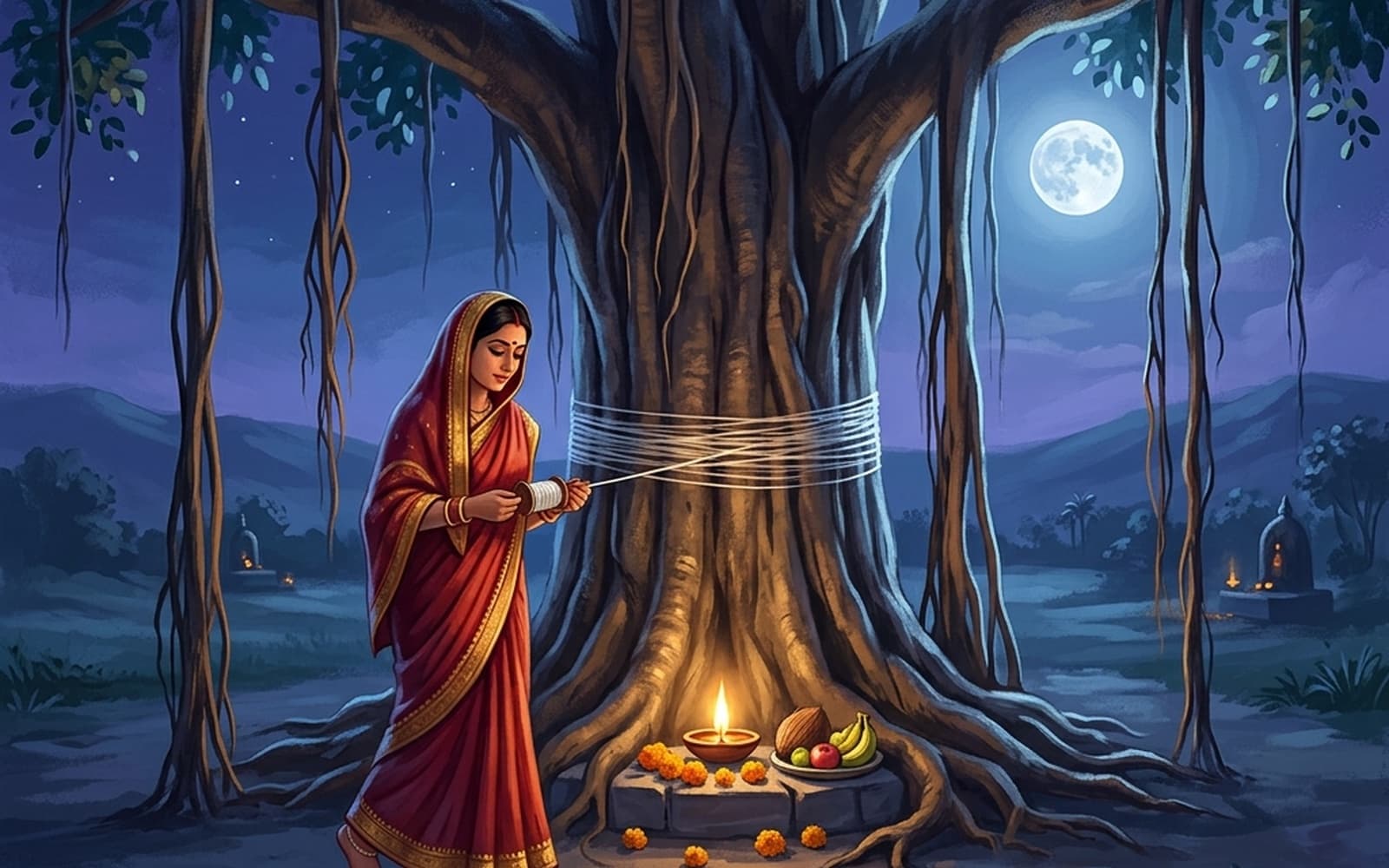
Vat Purnima is the full moon of the month of Jyeshtha, kept by married women for the long life and wellbeing of their husbands. On this day they gather at a banyan tree — the vat — pour water at its roots, wind a raw cotton thread around its great trunk and walk around it, praying that their marriage may stand as long and unbroken as the tree itself.
The vow reaches back to Savitri, who followed Yama into the shadows and argued her husband Satyavan back to life. Because she is said to have revived him beneath a banyan, that tree carries the vrat's memory. One honest complication travels with the day: in Gujarat, Maharashtra and much of the south the vrat falls on this Jyeshtha full moon, while across the north the very same fast is kept a fortnight earlier, on the Jyeshtha new moon, Amavasya. Both are Vat Savitri; only the tithi differs.
The full moon of Jyeshtha, and why a tree
Jyeshtha Purnima, the banyan, and a vow measured in longevity
Purnima is the tithi of the full moon, the night the Moon stands complete. Falling in Jyeshtha, the hot month that closes the Indian summer, this particular full moon carries the Vat Savitri vrat, one of the oldest of the vows a married woman keeps. Where many full moons are given to a god — Guru Purnima to the teacher, Sharad Purnima to Lakshmi — this one is given to a tree, and to the woman who once bent death around it.
The tree is the vat, the banyan. Little in the Indian landscape lives as long or spreads as wide; its aerial roots drop, take hold and become trunks of their own, so that a single tree can outlast the generations that sit beneath it. That longevity is the whole point. A woman who ties her thread to the banyan and asks that her marriage endure is asking for exactly what the tree already is: something rooted, unhurried and hard to end. The full moon overhead, round and unbroken, says the same thing in the sky.
Vat Purnima at a glance
Date in 2027
Friday, 18 June 2027
Tithi
Purnima (full moon)
Lunar month
Jyeshtha
The vow
Banyan (vat) parikrama, cotton thread
Tradition
Vat Savitri; kept by married women
Date & the full-moon tithi
The Jyeshtha Purnima and its tithi times for your city
Tithi begins
18 June 2027, 4:35 AM
Tithi ends
19 June 2027, 6:15 AM
| Upcoming dates | Day |
|---|---|
| 18 June 2027 | Friday |
| 7 June 2028 | Wednesday |
Times shown for New Delhi; pick your city on the Purnima calendar for local timings.
How the vrat is kept
The dawn bath, the cotton thread, and seven turns of the banyan
The day begins early, with a bath and a sankalp — the quiet resolve to keep the fast. Many women keep it nirjala, without even water, through the daylight; others take fruit and milk. Dressed as a bride, in the red and the bangles of a married woman, they carry a plate of offerings to a banyan tree, in a courtyard, a temple yard or by the roadside where one grows.
At the tree they pour water at the roots and offer roli, rice, flowers, soaked gram and fruit. A length of raw cotton thread is wound around the broad trunk as they circle it — seven turns is the common count, one for each round — while the Savitri katha is read or recalled. Some fan the trunk gently with a hand fan, as Savitri is said to have watched over Satyavan in the forest. When the rounds are done the thread stays on the tree, and the fast is broken later, often with the soaked gram that was offered.
On the rituals here
Savitri, Satyavan and the argument with Yama
The katha the banyan remembers
The vow's story is one of the most admired in the tradition. Savitri, daughter of King Ashvapati, was allowed to choose her own husband and chose Satyavan, a prince living in forest exile with his blind, dethroned father. The sage Narada warned her that Satyavan was fated to die exactly one year from that day. She married him all the same, and told no one.
As the year turned, Savitri fasted and kept vigil. On the appointed day she followed her husband into the forest where he went to cut wood. When he faltered and lay down, Yama himself came for his life. Savitri walked behind the lord of death as he carried Satyavan's soul away, and would not turn back. Moved by her constancy and her speech, Yama offered her boon after boon — everything but her husband's life. She asked for her father-in-law's sight and kingdom restored, for sons for her own father, and then, carefully, for sons of her own; and since sons could not be born of a dead husband, Yama, bound by his own word, had to return Satyavan.
She revived him, the story says, beneath a banyan. That is why the banyan — and this vow of a wife who walked after death and won — are remembered together on Vat Purnima.
Purnima in the west, Amavasya in the north — and who keeps the day
One vrat, two tithis, and the women who observe it
The same Vat Savitri vrat is kept on two different tithis, a fortnight apart, and it is worth saying so plainly. In Gujarat, Maharashtra and much of southern and western India, women keep it on this Jyeshtha Purnima, the full moon. Across the north — Uttar Pradesh, Bihar, Rajasthan and neighbouring states — the same fast is kept on Jyeshtha Amavasya, the new moon that falls two weeks earlier. The vow, the tree, the thread and the katha are identical; only the tithi differs, according to which calendar tradition a family follows. Some households, with roots in both, keep both.
It is married women who observe the day, for the long life and wellbeing of their husbands, and in many families newly married women keep it with particular care. None of it is a matter of compulsion: where a full nirjala fast or a visit to a banyan is not possible, tradition allows a simpler keeping — a bath, a thread offered at whatever tree can be reached, and the Savitri katha read with a sincere heart.
See today's live panchang for your city
Tithi, nakshatra, sunrise and the day's muhurat, computed for wherever you are.
Vat Purnima — questions answered
The Jyeshtha full moon, the banyan vow and the two dates