
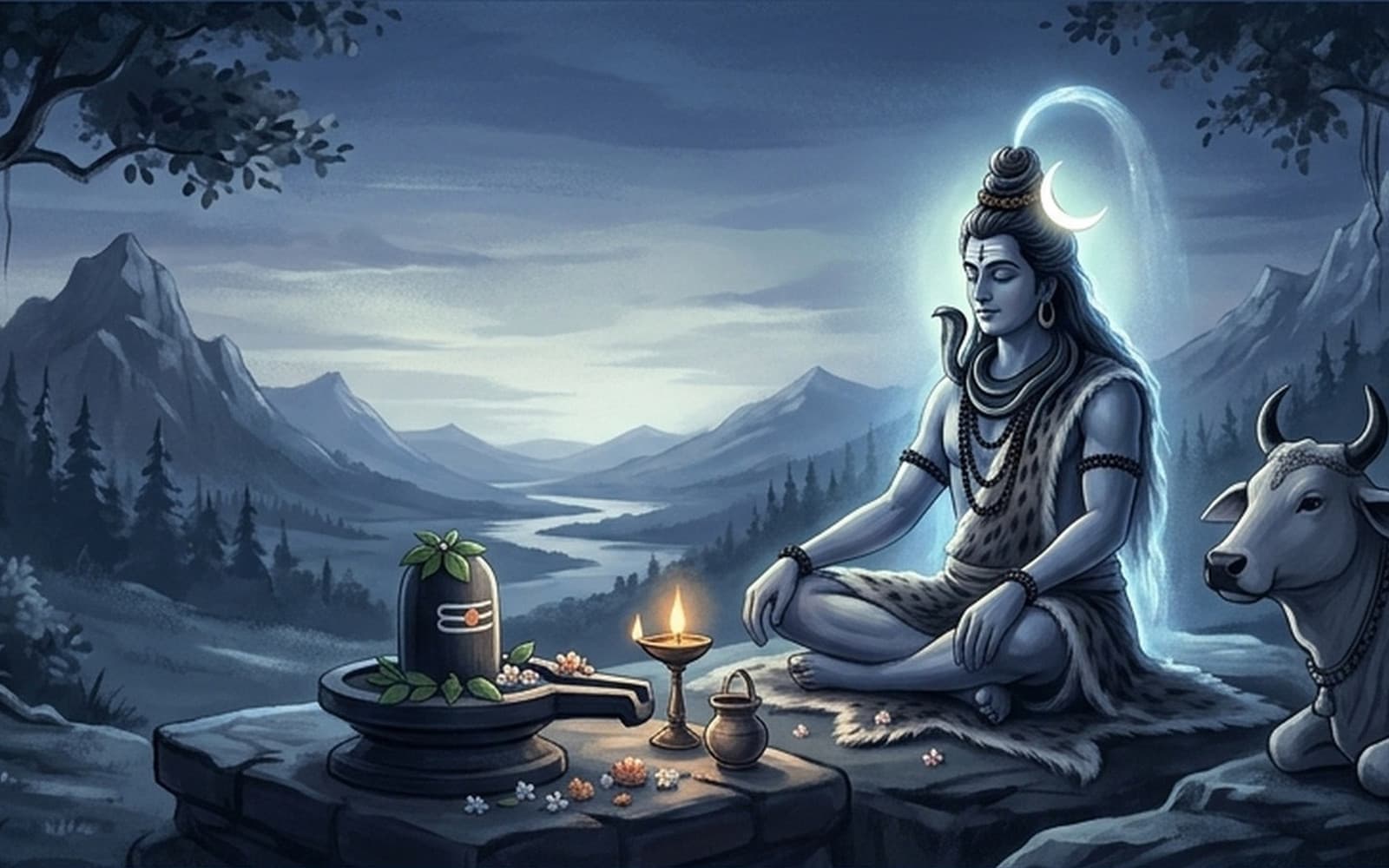
The next Som Pradosh Vrat is on Monday, 21 December 2026. In New Delhi the Trayodashi begins at 5:37 PM, after sunset, so do the Shiva puja between then and 7:52 PM.
Som Pradosh is the Pradosh Vrat that falls on a Monday. A Trayodashi, the thirteenth tithi, comes twice each lunar month, but only sometimes does one land on Somvar, the day of the Moon and of Lord Shiva. That coincidence is what names the day and gives it its standing. Some months bring a Som Pradosh; many do not.
A Pradosh Vrat is a fast for Lord Shiva, observed not in the morning but at dusk, in the short Pradosh-kaal that opens around sunset on a Trayodashi. Because Monday is already Shiva's own weekday, Som Pradosh joins the day to the deity as no other weekday Pradosh does, which is why tradition counts it the most auspicious of them, kept above all for peace of mind and wellbeing at home.
The twilight hour that belongs to Shiva
Trayodashi's dusk, the Pradosh-kaal, and an old story of poison and dance
Every Trayodashi, the thirteenth tithi of the waxing and the waning moon, carries a short window of worship at dusk, the hour when day has not quite ended and night has not quite begun. This is the Pradosh-kaal, the roughly hour-and-a-half around sunset, and by long tradition it belongs to Lord Shiva.
An old story explains why. When the gods and asuras churned the cosmic ocean, the first thing to rise was not nectar but halahala, a poison fierce enough to end all creation. It was Shiva who gathered it and drank it, holding it in his throat until it turned blue, the reason he is called Neelkanth. The gods, watching him take the world's death into himself, gathered at the twilight of a Trayodashi to praise and worship him. Another telling holds that in this same twilight hour Shiva dances the tandava between the horns of Nandi, and the whole assembly of gods draws near to witness it.
Whichever story a family keeps, the meaning is the same: the Pradosh-kaal is Shiva's hour, and the Trayodashi is his tithi. A Pradosh Vrat is simply the fast that honours that hour, kept through the day and completed with Shiva puja as the sun goes down.
Som Pradosh Vrat at a glance
Date in 2026
Monday, 21 December 2026
Tithi
Trayodashi (13th tithi)
Deity
Lord Shiva
Weekday
Monday (Somvar) · Moon
Observance
Pradosh-kaal Shiva puja
Date & Pradosh-kaal window
The Monday Pradosh and its twilight puja window for your city
Pradosh-kaal begins
21 December 2026, 05:28 PM
Pradosh-kaal ends
21 December 2026, 07:52 PM
| Upcoming dates | Day |
|---|---|
| 21 December 2026 | Monday |
| 3 May 2027 | Monday |
| 17 May 2027 | Monday |
Times shown for New Delhi; pick your city on the Pradosh Vrat calendar for local timings.
What makes it Som Pradosh
The weekday names the vrat, and Monday doubles the Shiva connection
A Pradosh Vrat takes its full name from the weekday on which the Trayodashi lands. Fall on a Saturday and it is Shani Pradosh; on a Thursday, Guru Pradosh. When the Trayodashi falls on a Monday, Somvar, it is Som Pradosh, also called Soma Pradosh. Monday is the Moon's own weekday, and soma is an old name for the Moon, so the two names point to the same thing.
What sets Som Pradosh apart is that Monday is already Lord Shiva's day. On every other weekday, the Pradosh worship brings Shiva into a day ruled by another planet; on a Monday, the day and the deity are one. The Shiva puja of the Pradosh-kaal and the Shiva of Somvar align, and tradition holds this the most auspicious of the seven weekday Pradoshas.
The Moon lends the day its themes. The Moon governs the mind and the emotions, so Som Pradosh is kept above all for peace of mind, for relief from restlessness and worry, and for harmony in marriage and family life. Many keep it as well for a heartfelt wish long carried. Because a Monday Trayodashi comes only in some months and not others, Som Pradosh has no fixed place in the calendar; check the panchang for when it next arrives.
How Som Pradosh is kept
The daylong fast, the Pradosh-kaal abhishek, and breaking the vrat
The day begins before sunrise with a bath and a sankalp, the quiet resolve to keep the vow. From there the fast runs through the daylight hours; kept strictly it is nirjala, without food or water, though many observe a lighter phalahar fast of fruit and milk according to their strength and health.
The worship itself waits for the Pradosh-kaal. As the sun nears setting, the devotee bathes again, cleans the place of puja, and offers Shiva an abhishek, water first, then milk, honey, curd and again water, followed by bilva (bel) leaves, white flowers, dhatura, sandal paste and akshat, with a ghee lamp and incense lit before the lingam. 'Om Namah Shivaya' is chanted, and where it is known, the Mahamrityunjaya mantra; the Pradosh Vrat katha is read or heard, and the observance closes with aarti. The fast is broken after the puja, once the Pradosh-kaal has passed.
About the vidhi and the offerings
Who keeps it, and the good it is said to bring
Peace of mind, harmony at home, and a heartfelt wish
Som Pradosh is kept by more than one kind of devotee. Those seeking calm, anyone weighed down by anxiety, restlessness or a troubled mind, turn to it because the Moon, whose day this is, is held to govern the emotions. Married couples and families keep it for harmony and marital wellbeing. Devotees of Shiva mark it simply because the Monday and the Trayodashi are both his. And many keep it carrying a single heartfelt wish, trusting the day's alignment to carry it further.
How much one does is a matter of capacity, not compulsion. Where a full nirjala fast is not possible, a lighter fast, a bath, a ghee lamp, a few bilva leaves and a sincere prayer offered in the Pradosh-kaal are enough. The tradition treats the vrat as an offering made in good faith, and asks only sincerity, not severity.
See today's live panchang for your city
Tithi, nakshatra, sunrise and the day's muhurat, computed for wherever you are.
Som Pradosh Vrat — questions answered
The Monday Pradosh, the twilight window and how to observe it