
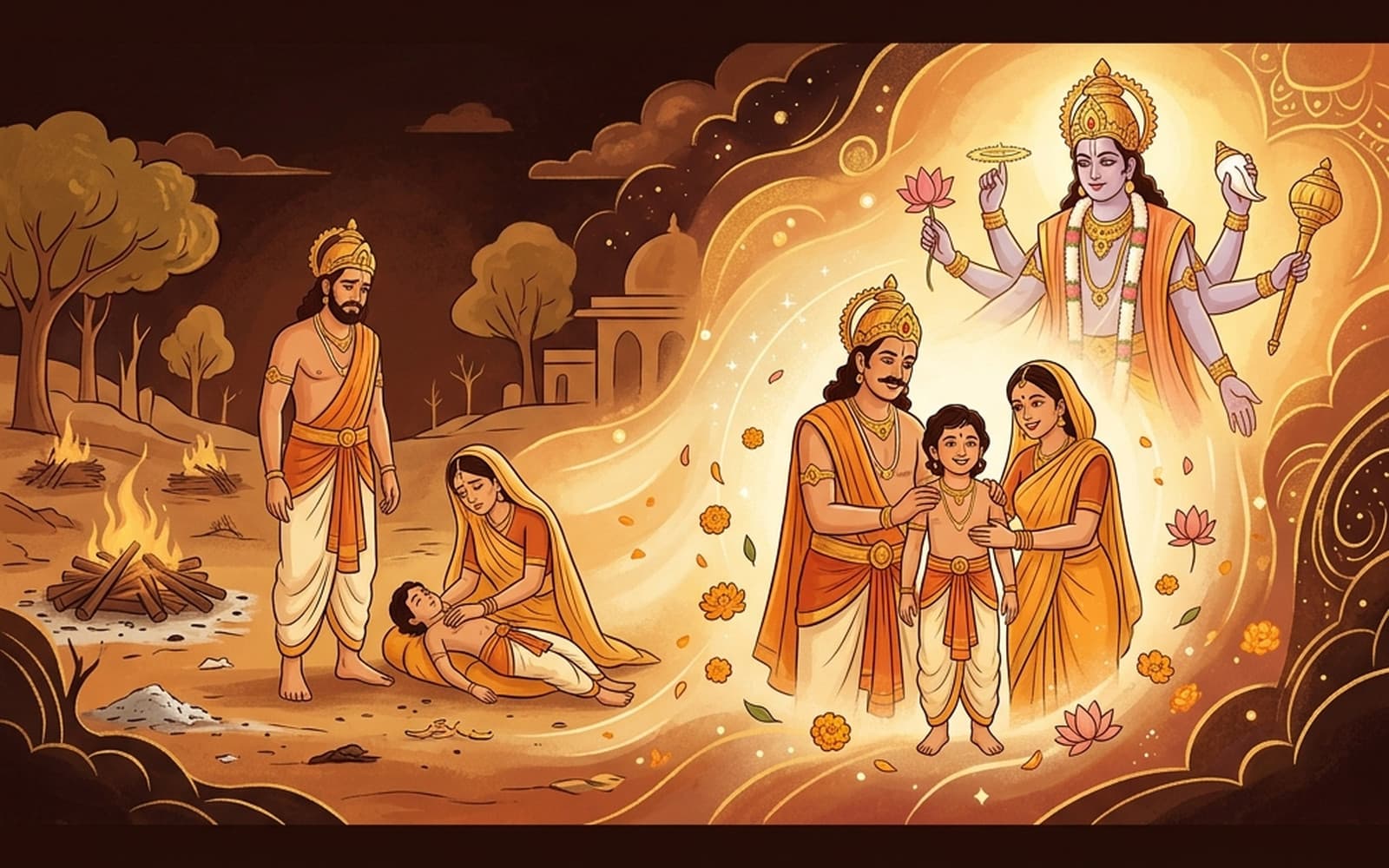
Among the Ekadashis of the year, Aja is the one carried by a story of ruin and return. It falls in the waning fortnight of Bhadrapada, deep in Chaturmas, and it is dedicated to Vishnu under one of his oldest names — Aja, the unborn. The tradition promises that the fast can lift the weight of past wrongs; to show what that means, it tells of a king who lost everything and got it back.
This guide opens with that story — the fall of the truthful King Harishchandra and his restoration through the vrat — and then turns to what the name Aja means, how the day is kept, and how the fast is completed the next morning on Dwadashi. For the exact date and timing where you live, use the live panchang linked below.
Harishchandra, the truth-bound king
The story Krishna told Yudhishthira
When Yudhishthira asked which observance in the dark fortnight of Bhadrapada could lift the weight of past wrongs, Krishna answered with the story of Harishchandra — a king remembered less for his throne than for the price he paid to keep his word. To honour a single promise he surrendered his kingdom, his wealth, and at last himself, until the sovereign of a great realm stood as a servant at a cremation ground, tending the fires of the dead.
Everything that had once defined him was gone. He was parted from his queen, and his young son had died. A ruler who had given alms all his life now had nothing left to give but his own labour, and no comfort except the one fact that he had never lied. Into that grief came the sage Gautama, who saw a way out that had nothing to do with armies or gold.
Gautama told him to keep the fast of Aja Ekadashi, and Harishchandra observed it exactly, without a word of complaint. By the merit of that single day his son was returned to life, his queen and his kingdom were restored to him, and the truth he had guarded through every humiliation was vindicated before gods and men. The story is the reason the day endures: it holds that no fall is so complete that this vrat cannot answer it.
The essentials, before the story
Date in 2027
Saturday, 28 August 2027
Lunar timing
Ekadashi of Krishna Paksha, Bhadrapada — within Chaturmas
Deity
Lord Vishnu, worshipped as Aja, the unborn
The day marks
A fast for liberation, with the katha of King Harishchandra
Also known as
Aja / Ajaa Ekadashi; Annada Ekadashi in some regions
When Aja Ekadashi falls, and when to keep it
The observance day and tithi window, computed for your city
In 2027, Aja Ekadashi is observed on Saturday, 28 August 2027. The Ekadashi tithi begins 27 August 2027, 03:26 PM and ends 28 August 2027, 12:43 PM.
Tithi begins
27 August 2027, 03:26 PM
Tithi ends
28 August 2027, 12:43 PM
| Year | Observance day |
|---|---|
| 2026 | Monday, 7 September 2026 |
| 2027 | Saturday, 28 August 2027 |
Times shown for New Delhi; pick your city on the Ekadashi calendar for local timings.
Aja — a name for the unborn
Why the day carries one of Vishnu's names
Aja is one of the names of Vishnu, and it means the unborn, the eternal — that which was never brought into being and so can never end. The fast is dedicated to Vishnu under this name. Placed in the Krishna Paksha of Bhadrapada, it falls within Chaturmas, the four months in which Vishnu is said to rest and devotional observance is held especially close.
The merit the tradition assigns it is large and plainly stated: the vrat absolves accumulated sins and opens the way to liberation. Harishchandra's story is offered as the measure of that claim — if the fast could restore a man who had lost everything, its reach is not small. In some regions the same tithi is kept under the name Annada Ekadashi.
One tithi, two names
A day turned toward Vishnu
Fasting, worship, and the telling of the story
The observance itself is unelaborate. Devotees keep a fast from the Ekadashi tithi — some take nothing at all, others a single sattvic meal without grains, according to their strength and health. The day is given to the worship of Vishnu: a lamp, tulsi, and the remembrance of his names.
The katha of Harishchandra is read or heard, and this is not decoration but the centre of the day, since the tradition holds that hearing the story carries its own merit. Restraint in speech and conduct matters as much as restraint in food; the fast is understood as a turning of attention, not only an emptying of the plate.
Keep the fast to your capacity
Parana — the first meal on Dwadashi
Completing the vow within the right window
The fast is not simply set aside; it is completed. On the next morning, Dwadashi, within the prescribed window after sunrise, the devotee eats for the first time — the act called parana. Timing matters here: the parana should fall on Dwadashi and not be delayed past it, and it is not done during the hours the tradition marks off.
Many break the fast with something simple after offering food to Vishnu and, where they can, sharing a meal with a guest or with those in need. The gesture keeps the day's spirit intact to its close: the vrat ends not in indulgence but in giving. The exact parana window shifts with your city, so check that day's panchang for the precise time.
See today's live panchang for your city
Tithi, nakshatra, sunrise and the day's muhurat — computed for wherever you are.
Aja Ekadashi — questions answered
The story, the name, and how the day is kept