
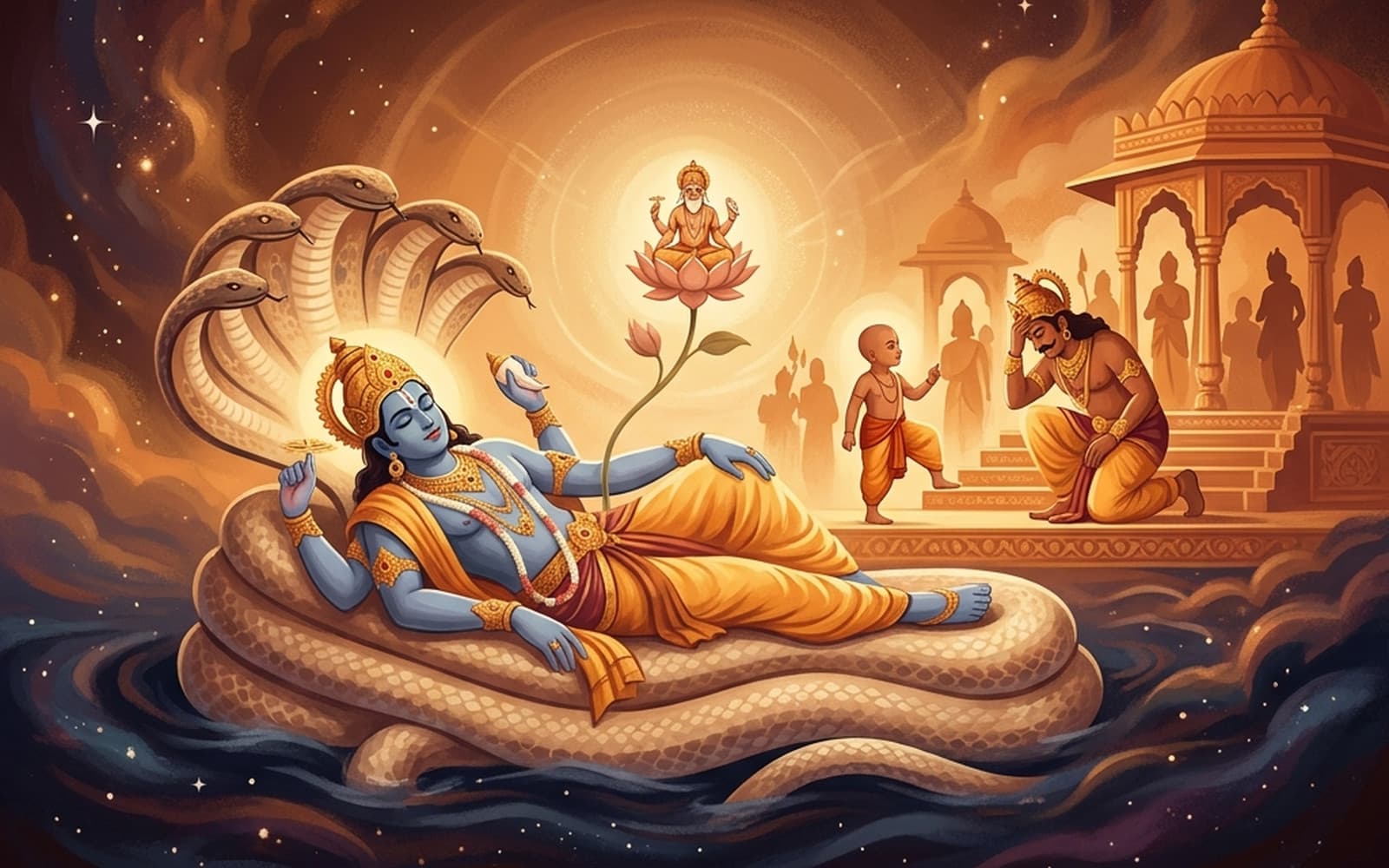
Since Devshayani Ekadashi in Ashadha, Vishnu has lain in yoga-nidra on the cosmic ocean, and the world keeps the quieter observances of Chaturmas around his rest. Parivartini Ekadashi falls at the exact centre of that long sleep — the eleventh tithi of the bright fortnight of Bhadrapada, around the turn into September. On this day, tradition holds, the sleeping god stirs just enough to turn from one side to the other. Parivartana, a turning-over: the day is named for that single movement.
The turning gives the Ekadashi its quiet drama, but the day belongs to a more famous act of Vishnu's — the Vamana avatar, the dwarf who asked a proud king for three small paces of land and then crossed the three worlds in them. Curd, rice and sesame are offered, the fast is kept, and the story of King Bali is retold. Two images of the same god sit side by side here: the one who lies still and turns, and the one who strides across everything there is.
The night the sleeping god turns over
Parivartana, and the centre of Vishnu's four-month rest
From Devshayani Ekadashi in Ashadha to Dev Uthani in Kartik, Vishnu is said to sleep — four months of yoga-nidra on the serpent Shesha, afloat on the milk-ocean, while the earth passes through the rains. Parivartini Ekadashi arrives at the halfway mark of that long rest. On this Bhadrapada bright eleventh, the story goes, the god does not wake, but he turns: he shifts from one side onto the other, and settles again into sleep. That small movement, parivartana, is the whole meaning of the day, and its name.
There is a gentle logic in marking a turn at the exact middle of the sleep. Half the four months has passed; half remains. The year has reached its still, waterlogged centre, and the turning reads almost as reassurance — a sign that the rest has crested and now leans, slowly, toward waking. Devotees keep the day to honour that quiet motion in the divine, and to stay close to Vishnu through the deepest stretch of his repose.
The change of side has left its mark on the day's other names. It is widely called Parsva Ekadashi — parsva meaning the side or flank, the very part that turns. In some regions it is Padma Ekadashi, and in others Jayanti Ekadashi. And because of the avatar remembered above all others on this day, it answers to one more name — Vamana Ekadashi.
What Parivartini Ekadashi marks
Date in 2027
Saturday, 11 September 2027
Lunar month
Bhadrapada · Shukla Paksha
Deity
Lord Vishnu (Vamana avatar)
What it marks
Chaturmas midpoint — Vishnu turns in his sleep
Also called
Vamana · Parsva · Padma · Jayanti
Date & tithi timing
When the turning falls, and the tithi window for your city
In 2027, Parivartini Ekadashi is kept on Saturday, 11 September 2027 — the Ekadashi tithi opens 10 September 2027, 05:01 PM and closes 11 September 2027, 07:37 PM.
Tithi begins
10 September 2027, 05:01 PM
Tithi ends
11 September 2027, 07:37 PM
| Year | Observance day |
|---|---|
| 2026 | Tuesday, 22 September 2026 |
| 2027 | Saturday, 11 September 2027 |
Times shown for New Delhi; pick your city on the Ekadashi calendar for local timings.
Three paces of earth, and a king's pride
Why the day belongs to the Vamana avatar and King Bali
The fifth of Vishnu's descents came as Vamana, a small brahmin boy, dwarf-statured and mild. He appeared at a moment when the demon-king Bali — grandson of the devotee Prahlada, generous to a fault and mighty in arms — had won lordship over all three worlds and stood unrivalled. Bali was holding a great sacrifice, open-handed with gifts, and it was there that the dwarf came to ask.
Vamana asked for almost nothing: three paces of land, no more than his own short steps could measure. Bali's guru, Shukracharya, saw through the request and warned him against it, but the king had given his word and would not take it back. The moment the grant was made, the dwarf grew. In one stride Vamana covered the earth, in a second the heavens, and finding no ground left for the third, Bali bowed his head and offered it for the final step.
The pride was humbled, but the generosity was honoured. Vishnu did not destroy Bali; he pressed him gently down and gave him the netherworld to rule, along with a boon for the openness of his heart. That is the story retold on Parivartini Ekadashi, and it holds the day's second image — the god who measured every boundary in three steps, remembered on the day the same god lies still and turns in his sleep.
The king who was not cast down
Curd, rice and sesame at Vishnu's feet
Observing the day for Vamana Vishnu
The day opens before sunrise with a bath and a sankalp, the spoken resolve to keep the vow. Vishnu is worshipped in his Vamana form with tulsi leaves, a lamp, incense and flowers, and the story of the three strides is read or heard. What sets this Ekadashi apart at the altar is a particular set of offerings — curd, rice and sesame, dahi, chawal and til — placed before the god or, just as often, given away to someone in need.
Some keep a complete fast for the whole tithi; others take a phalahara fast of fruit, milk and water, according to their strength. Because the day turns so plainly on giving — Vamana who asked, Bali who gave — charity carries a special weight here, and many pair the fast with a gift of grain or cloth and the recitation of Vishnu's names. Some sit up through the night in jagran, keeping the lamp and the reading alight until dawn.
Keep it within your strength
Rising on Dwadashi to close the vow
The parana that completes the Parivartini fast
The vow is completed the next morning on Dwadashi, in the stretch called parana. It is broken after sunrise, before the Dwadashi tithi runs out, and never during Hari Vasara — the first quarter of Dwadashi, held to belong to Vishnu himself. Most break it gently: tulsi water first, then simple sattvik food, and often a gift of grain to a brahmin or to someone in need.
Breaking the fast too early, or letting the window slip by unbroken, is said to lessen what the vow earns — which is why the morning after weighs as much as the Ekadashi itself. The window turns on your local sunrise and the tithi's end, so the exact parana time is best read from that day's panchang for your city.
Watch the window
See today's live panchang for your city
Tithi, nakshatra, sunrise and the day's muhurat — computed for wherever you are.
Parivartini Ekadashi — your questions answered
The turning, the Vamana story, its other names and the parana