
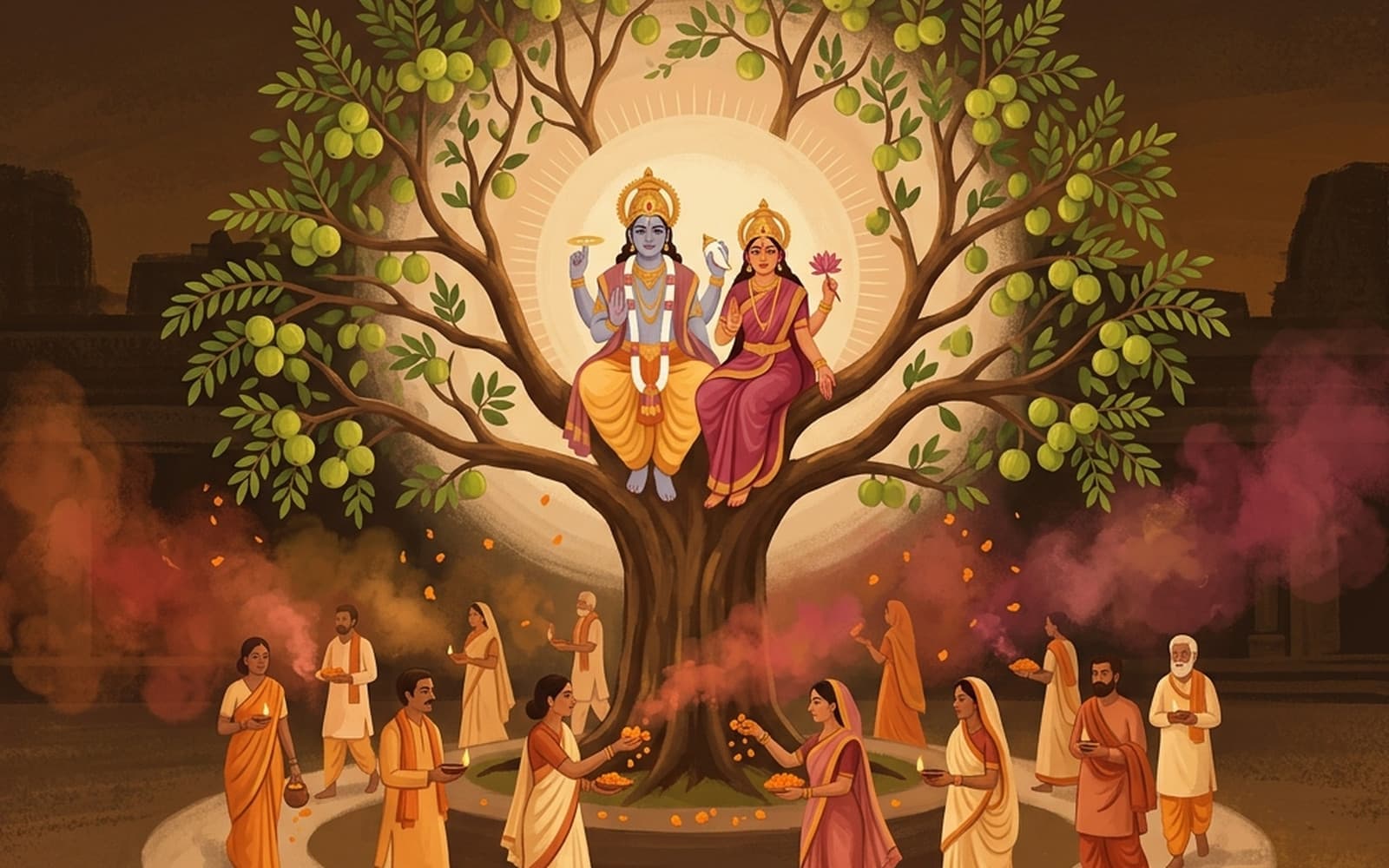
Amalaki Ekadashi is the eleventh tithi of the bright fortnight of Phalguna, and it arrives two days before Holi. Its name comes from the amalaki — the amla, or Indian gooseberry — whose tree stands at the centre of the day's worship. Here Vishnu is honoured not before a carved image but at the foot of a living tree, one that tradition holds him to inhabit.
The same date carries a second life. In Kashi it is kept as Rangbhari Ekadashi, the day Shiva is said to bring his newly-wed Parvati home to the city, and the first gulal of the season is thrown at Kashi Vishwanath. So a single tithi holds two devotions — Vishnu in the amla and Shiva with Parvati in Varanasi — and the day belongs honestly to both.
Vishnu in a living tree
Why the amla is watered, circled and revered
The heart of Amalaki Ekadashi is not an idol but a tree. The amla is held to be dear to Vishnu, and tradition places both Vishnu and Lakshmi within it, so that to honour the tree is to honour them. On this one day the amla itself becomes the shrine.
The worship is plain and physical. Devotees pour water at the root, walk the pradakshina in slow circles, and offer lamp, kumkum, flowers and sometimes a thread wound around the trunk. Many spread their meal beneath its branches and eat in its shade, so that fast, puja and food all happen at the foot of the same tree. It is a rare shape of devotion — not to a carved form of the god, but to a thing that grows, gives fruit and is believed to hold him.
The day in short
Date in 2027
Thursday, 18 March 2027
Lunar month
Phalguna · Shukla Paksha
Deity
Vishnu, through the amla tree
Observance
Amla-tree worship & fast
Also called
Rangbhari Ekadashi (Kashi)
Date & tithi timing
The observance day and tithi window for your city
Amalaki Ekadashi 2027 falls on Thursday, 18 March 2027. The Ekadashi tithi runs from 18 March 2027, 04:22 AM to 19 March 2027, 01:52 AM.
Tithi begins
18 March 2027, 04:22 AM
Tithi ends
19 March 2027, 01:52 AM
Smarta and Vaishnava dates differ
| Year | Observance day |
|---|---|
| 2026 | Friday, 27 February 2026 |
| 2027 | Thursday, 18 March 2027 |
Times shown for New Delhi; pick your city on the Ekadashi calendar for local timings.
Kashi's Rangbhari day
Shiva brings Parvati home, and the colours begin
In Varanasi the same Ekadashi wears a different name — Rangbhari, "filled with colour." By the city's tradition this is the day Shiva brings his bride Parvati to Kashi for the first time after their marriage, and the city receives her as its own. At the Kashi Vishwanath temple gulal is thrown in celebration, and with it the season of Holi is thrown open, days ahead of the full moon.
The image is tender rather than riotous: a husband walking his new wife through the lanes of the oldest of cities, and a whole town showering the two of them in colour. It is why, in Kashi, Holi is said to begin not on the day of the bonfire but here, on Rangbhari Ekadashi, with the first handful of gulal at Vishwanath.
One tithi, two traditions
Vishnu and Shiva on a single day
It is easy to assume a Hindu observance belongs to one deity, but Amalaki Ekadashi quietly refuses that. Across much of India it is a Vaishnava day, given to Vishnu through the amla tree; in Kashi it is a Shaiva day, given to Shiva and Parvati and the coming of colour. Neither reading cancels the other.
That doubling is not a contradiction to be solved. It is how a living calendar works — the same turn of the moon means the amla tree in one town and gulal at Vishwanath in the next. If you keep the day, keep whichever face of it your family and region hold, and know the other is being kept somewhere too.
Keeping the vow at the tree
The fast, the amla puja and the night's watch
Those who keep the vrat begin at dawn with a bath and a sankalp, the quiet resolve to hold the fast for Vishnu. Through the day they take no grain — some keep a full fast, others a phalahar of fruit, milk and permitted foods — and turn to worship at the amla tree, offering water, lamp and tulsi and reading or hearing the Ekadashi katha. Where a tree is at hand the puja is done there; where it is not, Vishnu is worshipped at home with the same intent.
The night is meant to be passed in jagran, a vigil of bhajan and the names of Vishnu rather than sleep, carrying the vow through to the next morning. As with every Ekadashi, the fast asks for restraint of speech and temper as much as of food; the discipline is itself the offering.
Keep it within your capacity
Completing the fast on Dwadashi
The morning-after window that seals the vow
The vrat is not finished at nightfall. It is completed the next morning on Dwadashi, when the fast is broken within the parana window — after sunrise, before the Dwadashi tithi ends, and not during Hari Vasara, its first quarter. Many break it with food offered first to Vishnu, and often with amla, before eating simply.
Breaking too early or too late is held to lessen the merit of the fast, which is why the next day's sunrise matters as much as the Ekadashi date itself. The exact window shifts with your city and the year; check that day's panchang for the precise time before you break the vow.
Mind the parana window
See today's live panchang for your city
Tithi, nakshatra, sunrise and the day's muhurat — computed for wherever you are.
Amalaki Ekadashi — questions answered
The amla tree, Rangbhari in Kashi, and the vrat