
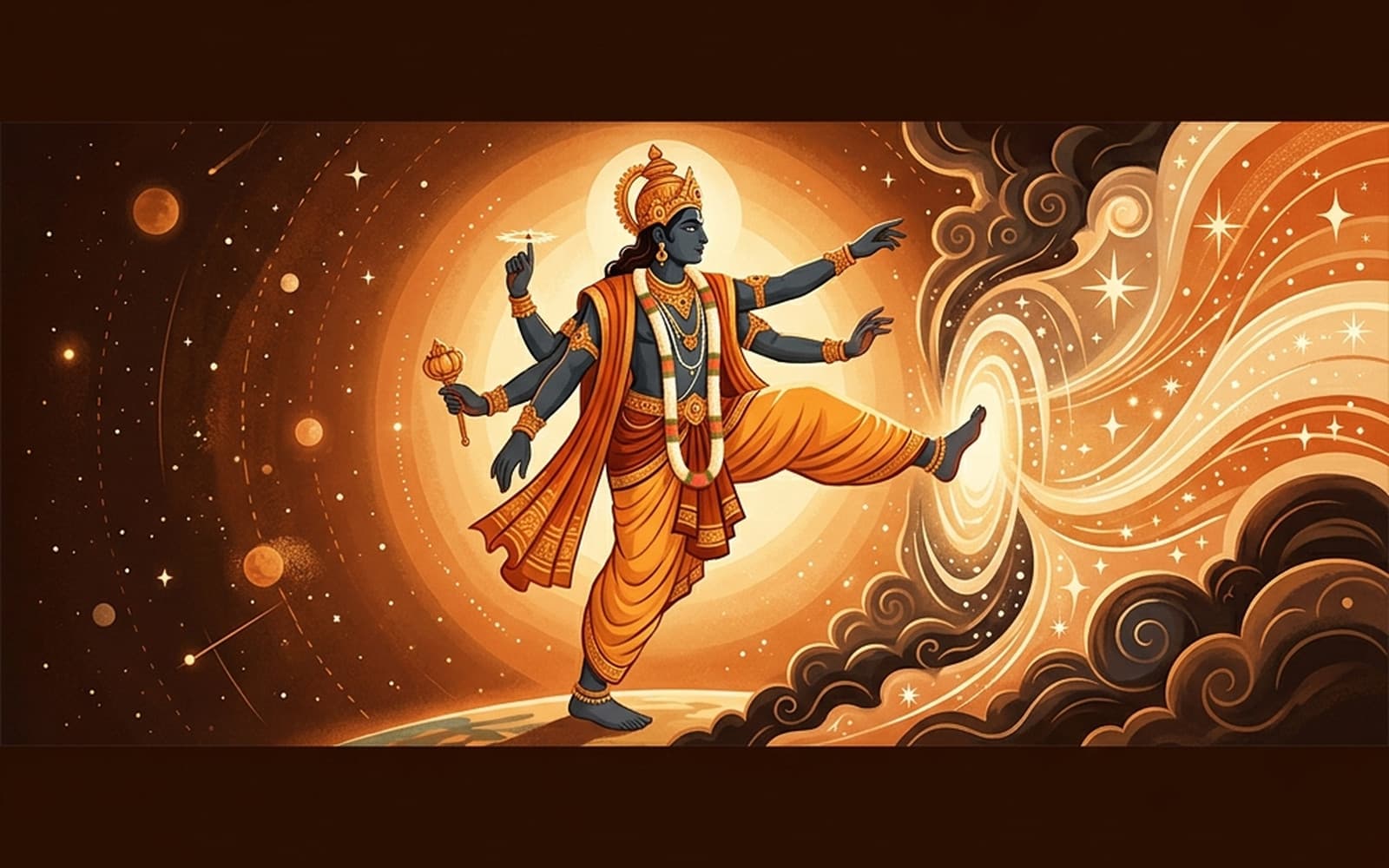
Apara Ekadashi keeps its promise in its name. Para is the far shore, the limit; a-para is what has none — and the merit of this fast is described in exactly that way, boundless, beyond counting. It falls on the eleventh tithi of the dark fortnight of Jyeshtha, when the summer heat stands at its height and the year leans toward the rains, a little before the great waterless fast of Nirjala Ekadashi. The Vishnu worshipped on this day is Trivikrama — the form that crossed the three worlds in three strides.
What has always drawn people to this particular Ekadashi is the weight of what it is said to wash away. Not the small lapses of an ordinary week, but grave wrongs — the taking of life, slander, false witness, acts done in bad faith — are held to be dissolved by the fast kept in faith. And its grace is not only for the one who keeps it: the oldest story of the day turns on merit earned by a devotee and given away, to free a soul that could find no rest.
The essentials of Apara Ekadashi
Date in 2027
Tuesday, 1 June 2027
Lunar month
Jyeshtha · Krishna Paksha
Deity
Lord Vishnu (Trivikrama)
Known for
Boundless merit · absolves grave sins
Also called
Achala · Jalakrida · Bhadrakali
Date & tithi timing
The observance day and tithi window for your city
In 2027, Apara Ekadashi is kept on Tuesday, 1 June 2027 — the Ekadashi tithi opens 31 May 2027, 10:03 AM and closes 01 June 2027, 09:40 AM.
Tithi begins
31 May 2027, 10:03 AM
Tithi ends
01 June 2027, 09:40 AM
| Year | Observance day |
|---|---|
| 2026 | Wednesday, 13 May 2026 |
| 2027 | Tuesday, 1 June 2027 |
Times shown for New Delhi; pick your city on the Ekadashi calendar for local timings.
A merit without a far shore
The grave sins the fast is said to wash away
The name is a small teaching in itself. Para is the far bank of a river, the edge, the measurable end of a thing; apara negates it — without shore, without end. The fruit promised to one who keeps this fast is described in exactly those terms: apara punya, merit that can be neither counted nor used up.
Texts single the day out for the weight of what it can lift. Where lighter observances speak to the small faults of an ordinary week, Apara Ekadashi is named against the heaviest — the shedding of blood, the ruin of a name by slander, false testimony given under oath, wrongs done knowingly for gain. The claim is not that the deed is undone, but that a fast kept in sincerity, turned toward Vishnu, can loosen the karmic debt a person would otherwise carry for lifetimes.
That the day belongs to Trivikrama sits well with all of this. In three strides the dwarf who became a giant measured the earth, the sky and the world beyond, leaving nothing outside his reach. A fast whose reward is called boundless is placed, fittingly, at the feet of the god who stepped across every bound.
Achala, Jalakrida, Bhadrakali — and the king who found no rest
The other names, and the katha from the Brahmavaivarta Purana
The same Ekadashi answers to more than one name. It is widely called Achala Ekadashi — achala meaning unmoved, immovable — for the steadfast merit it is believed to confer. In some regions it is Jalakrida, 'water-play', a name suited to a fast that falls in the fierce heat just before the monsoon; in others it is kept as Bhadrakali Ekadashi, where the goddess is honoured alongside Vishnu.
Its story, told in the Brahmavaivarta Purana, is not of a fast rewarded but of a fast given away. A just king named Mahidhwaja was killed by his own younger brother, Vajradhwaja, who envied him, and the body was buried in secret beneath a peepal tree. Denied his last rites, the king's spirit could not move on. It lingered as a restless ghost, and the country around the tree grew fearful and troubled.
A sage named Dhaumya, passing that way, saw with his inner sight what had happened. He counselled a devotee to keep the Apara Ekadashi fast and to dedicate its merit not to himself but to the wronged king. The offering was made, and by that transferred merit the trapped spirit was freed from its suffering and raised to a higher state. The lesson the day carries lives in that gesture — that the boundless merit of this fast can be earned by one and handed to another who cannot earn it for himself.
Merit meant to be shared
From dawn to nightfall: keeping the vow
The fast, and the worship of Trivikrama Vishnu
The day opens before sunrise with a bath and a sankalp, the spoken resolve to keep the vow. Vishnu is worshipped in his Trivikrama form with tulsi leaves, a lamp, incense and yellow flowers, and the Apara Ekadashi katha is read or heard. Grain and pulses are set aside from the evening before, and the household settles into a quieter, lighter routine.
Some keep a complete fast for the whole tithi; others take a phalahara fast of fruit, milk and water, according to their strength. Because the day turns so closely on the clearing of wrongs, many pair the fast with daan — a gift of food, water or cloth to someone in need — and with the recitation of Vishnu's names. Some sit up through the night in jagran, keeping the lamp and the reading alight until dawn.
Keep it within your strength
Sealing the fast on Dwadashi morning
The parana window that completes the vow
The vow is completed the next morning on Dwadashi, in the stretch called parana. It is broken after sunrise, before the Dwadashi tithi runs out, and never during Hari Vasara — the first quarter of Dwadashi, held to belong to Vishnu himself. Most break it gently: tulsi water first, then simple sattvik food, and often a gift of grain to a brahmin or to someone in need.
Breaking the fast too early, or letting the window slip by unbroken, is held to lessen what the vow earns — which is why the morning after weighs as much as the Ekadashi itself. The window turns on your local sunrise and the tithi's end, so the exact parana time is best read from that day's panchang for your city.
Watch the window
See today's live panchang for your city
Tithi, nakshatra, sunrise and the day's muhurat — computed for wherever you are.
Apara Ekadashi — your questions answered
Its meaning, its other names, the katha and the parana