
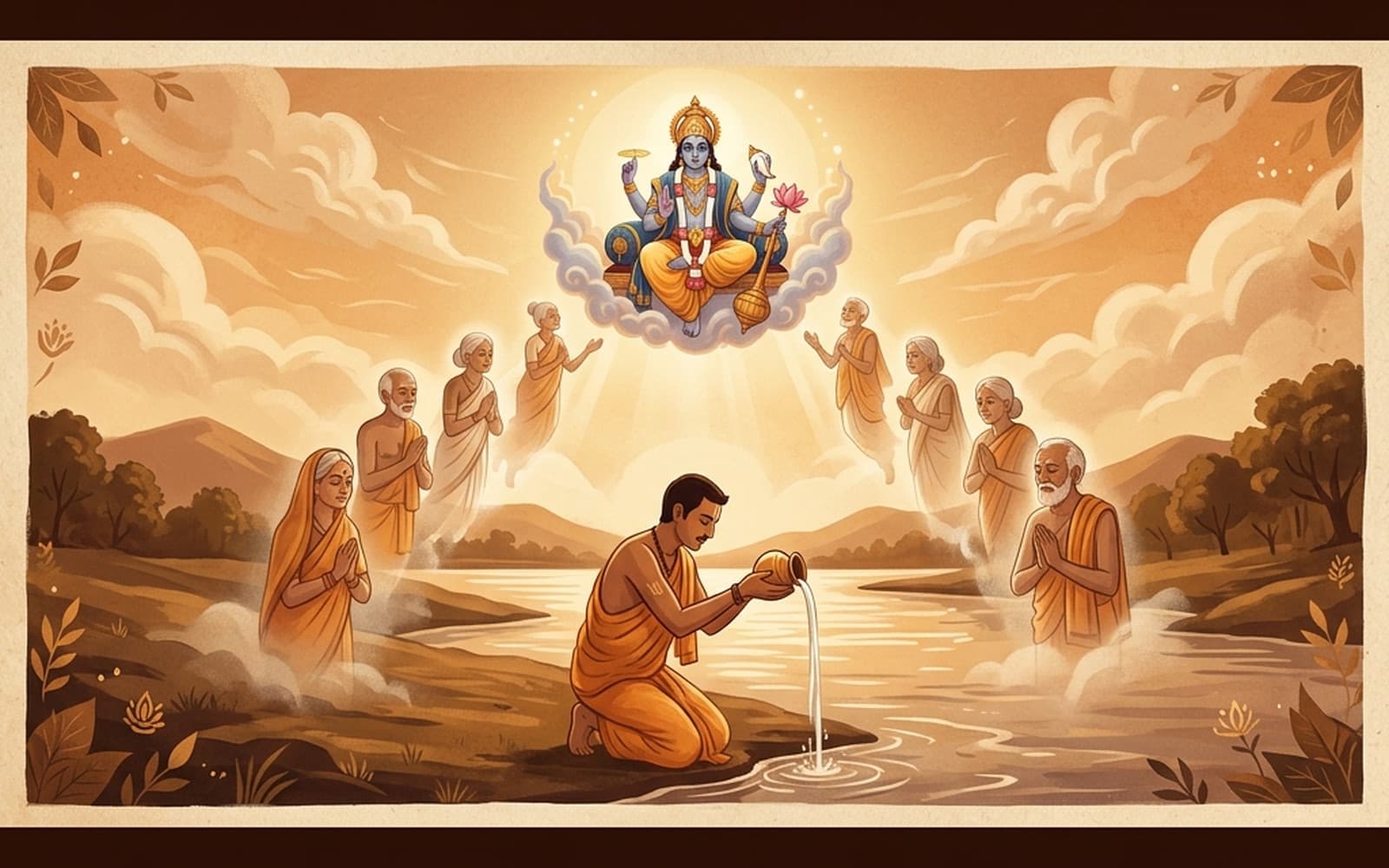
Indira Ekadashi falls on the eleventh tithi of the dark fortnight of Ashwina, and where it falls is the whole of its meaning. This waning fortnight is Pitru Paksha — the fortnight of the ancestors — when households turn from their own concerns to the memory of the dead, offering shraddha and tarpan to the forefathers. The one Ekadashi that lands inside it is kept as a fast for Lord Vishnu, but its grace is asked less for the living than for those who have gone before.
That is what sets this fast apart. Its merit is not held for oneself; it is made over to the departed — offered on their behalf to lift forefathers who have fallen to the lower realms and to draw them toward a higher state. To fast, and then to give the fruit of the fasting away to the dead, is the quiet purpose of the day.
Date & tithi timing
The observance day and tithi window, computed for your city
In 2027, Indira Ekadashi is observed on Sunday, 26 September 2027. The Ekadashi tithi begins 25 September 2027, 10:31 PM and ends 26 September 2027, 07:50 PM.
Tithi begins
25 September 2027, 10:31 PM
Tithi ends
26 September 2027, 07:50 PM
| Year | Observance day |
|---|---|
| 2026 | Tuesday, 6 October 2026 |
| 2027 | Sunday, 26 September 2027 |
Times shown for New Delhi; pick your city on the Ekadashi calendar for local timings.
Where Indira Ekadashi falls, and why it matters
Date in 2027
Sunday, 26 September 2027
Lunar month
Ashwina · Krishna Paksha
Deity
Lord Vishnu
The day marks
Fast for the liberation of ancestors
Falls within
Pitru Paksha (Shraddha Paksha)
A fast held inside the fortnight of the ancestors
Pitru Paksha, and the one Ekadashi within it
For a fortnight each year, in the dark half of Ashwina, tradition sets aside its usual round of festivals and turns wholly toward the dead. This is Pitru Paksha, sometimes called Shraddha Paksha — the season in which families remember their forefathers by name, pour tarpan of water and sesame, and feed the pitr through the rites of shraddha. It is a grave, inward fortnight, kept less for celebration than for a debt repaid.
Into this fortnight falls a single Ekadashi, and it takes its colour from the days around it. Like every Ekadashi it belongs to Lord Vishnu, and the fast is kept in his honour; but here the prayer is bent toward the ancestors. Where most Ekadashis ask grace for the one who keeps them, Indira Ekadashi asks it for the departed.
The belief attached to the day is specific. A forefather who has slipped to the lower realms — held there by some unfinished karma — can be lifted from that state when a living descendant keeps this fast and offers its merit in his name. The fasting is the living son's, but the freedom it buys is the dead father's.
The king who raised his father from Yama's realm
Krishna's telling of Indira Ekadashi to Yudhishthira
The origin of the day comes down as a conversation. Krishna recounts it to Yudhishthira: in the city of Mahishmati there ruled a king named Indrasena — devout, just, settled in the worship of Vishnu, with no visible sorrow in his life.
One day the sage Narada descended into his court. He brought word the king had not looked for: Indrasena's late father had fallen to the realm of Yama, and there, unfree, he had asked the sage to carry a message to his son. Keep Indira Ekadashi, the father had said, and give me the merit of it, that I may be released.
The king did as he was counselled. With his household he kept the fast in the dark fortnight of Ashwina, performed the shraddha rites for his father, and made over the whole merit of the vow to him. By that gift the father was lifted from Yama's keeping and raised to the abode of Vishnu — the story that fixes, once and for all, what the day is for.
The fast, the tarpan, and the merit given to the pitr
How the day is kept for the forefathers
The day opens as other Ekadashis do — a bath at dawn, a sankalp to hold the vow, and the worship of Vishnu with tulsi, a lamp and incense, the Ekadashi katha read or heard. Grain and pulses are set aside; some keep a full fast, others take fruit and milk as their strength allows.
What weights this particular day is everything offered to the dead. Because it stands within Pitru Paksha, the keeper turns to the forefathers: tarpan is poured in their names, the shraddha due to them is performed, and — the act at the centre of it all — the merit earned by the fasting is dedicated to the pitr, given away rather than kept.
Faith within your strength
Closing the vow on the morning after
The parana window on Dwadashi
The vow is completed at parana, the breaking of the fast, which is done the next morning on Dwadashi — after sunrise, before the Dwadashi tithi runs out, and never within Hari Vasara, the first quarter of Dwadashi. It is broken gently, with tulsi water and plain sattvik food.
Breaking too soon or too late is held to lessen the fruit of the fast, so the morning window carries as much weight as the Ekadashi itself. The exact time shifts from city to city; check that day's panchang for the parana window where you are.
Mind the parana window
See today's live panchang for your city
Tithi, nakshatra, sunrise and the day's muhurat — computed for wherever you are.
Indira Ekadashi — questions answered
Pitru Paksha, the fast for ancestors, the katha, and parana