
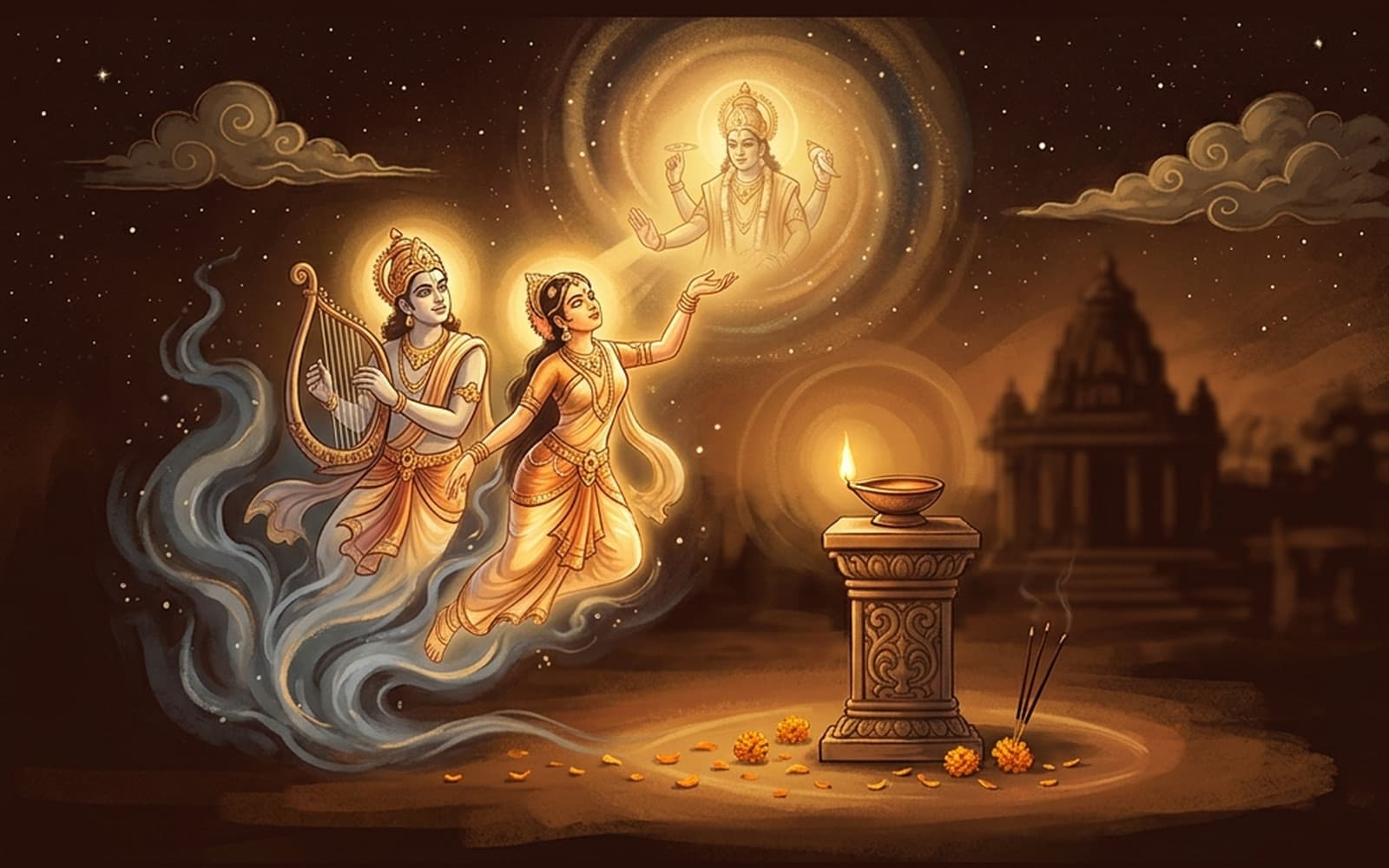
Of the fasting days sacred to Vishnu, Jaya Ekadashi carries one of the boldest promises. Its name means victory, and the victory it offers is release from the pret yoni — the ghost-state in which, the old texts say, a soul can be caught between births, denied both rebirth and liberation.
It falls in the bright half of Magha and is remembered above all through a single story: two heavenly performers, cursed to wander as ghosts, freed by a fast they kept without even knowing its name. This guide walks through that meaning, the katha, and how the day is observed.
The fast in brief
Date in 2027
Wednesday, 17 February 2027
Lunar month & fortnight
Magha, Shukla Paksha (waxing moon)
Presiding deity
Lord Vishnu
How it is kept
Day-long fast, Vishnu worship, night vigil
Also known as
Bhaimi Ekadashi
When Jaya Ekadashi falls this year
The date tracks the moon, so it moves each year. Here is the window computed for your city.
Jaya Ekadashi 2027 falls on Wednesday, 17 February 2027. The Ekadashi tithi runs from 16 February 2027, 08:20 PM to 17 February 2027, 05:32 PM.
Tithi begins
16 February 2027, 08:20 PM
Tithi ends
17 February 2027, 05:32 PM
| Year | Observance day |
|---|---|
| 2026 | Thursday, 29 January 2026 |
| 2027 | Wednesday, 17 February 2027 |
Times shown for New Delhi; pick your city on the Ekadashi calendar for local timings.
The victory hidden in the name
Why this Magha fast is called Jaya
The word jaya means victory, and of all the Ekadashis this is the one that names its prize outright. The victory it promises is not over an enemy or a rival but over a fate the old texts treat as worse than death: the pret or pishacha yoni, the restless ghost-state in which a soul wanders without rest or release. Falling in the bright fortnight of Magha, when the cold begins to loosen in the north, the fast is offered to Lord Vishnu, the preserver, who is asked to lift the observer clear of that shadow existence.
To a modern reader the "ghost-realm" can sound like folklore, but the tradition reads it as a spiritual condition — a soul held between lives, denied the forward motion of rebirth or liberation. Jaya Ekadashi is the appointed day to cut that knot. Its merit is spoken of as a clean release: not comfort within the ghost-state, but an end to it.
Malyavan, Pushpavati, and a dance that broke
Krishna's answer to Yudhishthira
The story comes down through the Mahabharata's frame, told by Krishna to Yudhishthira when the eldest Pandava asked what fast could undo so grim a fate. Long ago, Krishna said, in the court of Indra a gandharva named Malyavan sang while an apsara named Pushpavati danced. The two were meant to be performing for the king of the gods, but they had fallen for each other, and the longing showed — their voices wavered, their steps lost the beat, the performance came apart.
Offended by the lapse, Indra cursed the pair to fall to earth and live as pishachas, ghosts stripped of their heavenly beauty and bound to a cold, joyless existence. In that wretched form they suffered, without ceremony or comfort. Then, as it happened, on a single day they took no food and stayed awake through the night — not knowing they had kept the fast and vigil of Jaya Ekadashi. That unwitting observance was enough. Its power lifted the curse, returned them their forms, and restored them to the heavens.
The point Krishna draws is plain: if the fast could free two cursed spirits who kept it by accident, its merit for one who keeps it knowingly is greater still.
A day of restraint, a night kept awake
The fast, the worship, and the vigil that carries the merit
The observance turns on two things done together: the fast and the vigil. From sunrise the day is kept without grain, and in its stricter form without food or water at all, though many adapt this to their strength. The hours are given to Vishnu — his name repeated, his image honoured with a lamp, tulsi and a simple offering rather than elaborate display.
What sets this Ekadashi apart is the night. Where many fasts end at dusk, here the observer stays awake through the dark hours, keeping a jagaran of chanting, reading and remembrance. In the katha it is precisely the wakeful night, not the daytime abstinence alone, that turns the curse. The night is treated as the working half of the vow, and it is where the fast earns its name.
Keep the fast to your strength
Closing the vow at first light on Dwadashi
The parana, and why its timing matters
The fast is not broken at will. It is completed the next morning, on Dwadashi, the twelfth lunar day, within the window the panchang marks after sunrise — and before that window closes. The first food is taken simply, and it is customary to give something in charity, or feed another, before eating oneself.
Completing the fast at the right time matters to the tradition as much as keeping it; a vow ended carelessly is held to lose part of its fruit. This is why observers watch the local sunrise and Dwadashi timing rather than a fixed clock — the correct moment shifts with place and year.
See today's live panchang for your city
Tithi, nakshatra, sunrise and the day's muhurat — computed for wherever you are.
Jaya Ekadashi: common questions
The story, the fast, and what it is said to free you from.