
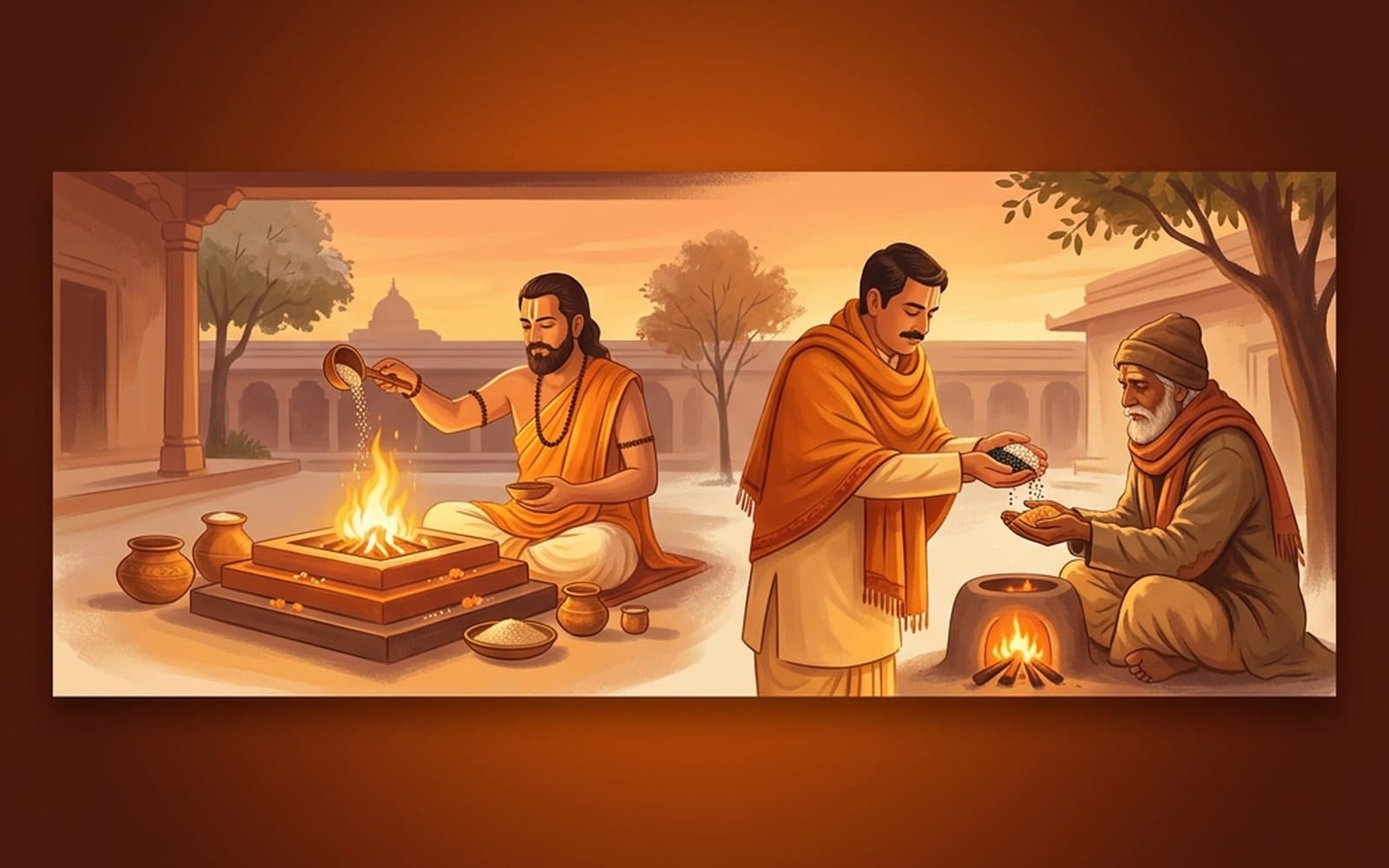
Shattila Ekadashi wears its meaning in its name. Shat-tila — 'six sesame' — for the six ways til is used across a single day: bathing in til-water, anointing the body with til paste, offering it into the sacred fire, giving it to the ancestors, eating it, and giving it away. It is the eleventh tithi of the dark fortnight of Magha, kept for Lord Vishnu in the depth of winter, when a warming, oil-rich seed is exactly what the season asks for.
Behind the ritual sits a sharp little story — of a devout woman who fasted and worshipped without fail, yet could not bring herself to give, and of the lesson Vishnu came in person to teach her. That story is why, of all six uses, til-daan — the giving of sesame — is the one the day is remembered for. The fast closes the next morning on Dwadashi, at parana.
The vrat in brief
Date in 2027
Tuesday, 2 February 2027
Lunar month
Magha · Krishna Paksha
Deity
Lord Vishnu (Narayana)
Observance
Fast, worship & six uses of sesame
Name means
‘Six uses of sesame’ (Shat-Tila)
Date & tithi timing
The observance day and tithi window for your city
In 2027, Shattila Ekadashi is kept on Tuesday, 2 February 2027 — the Ekadashi tithi opens 01 February 2027, 08:42 AM and closes 02 February 2027, 11:11 AM.
Tithi begins
01 February 2027, 08:42 AM
Tithi ends
02 February 2027, 11:11 AM
| Year | Observance day |
|---|---|
| 2026 | Wednesday, 14 January 2026 |
| 2027 | Tuesday, 2 February 2027 |
Times shown for New Delhi; pick your city on the Ekadashi calendar for local timings.
The six offerings of sesame
Why til runs through every part of the day
Shat-tila means 'six sesame,' and the number is exact: on this one Ekadashi, til is put to six different uses, each folding the little black-and-white seed deeper into the day. First, one bathes in water mixed with til, so the seed touches the body before the sun is fully up. Second, til paste is rubbed onto the skin — an anointing as much as a cleansing. Third, sesame is offered into the sacred fire, the til-homa or havan, its smoke carrying the offering upward.
The fourth use turns to the departed: til-water is offered to the ancestors as tarpan, the seed a traditional medium of remembrance. Fifth, the food of the day — what little is taken — is prepared with til, so that even the fast is flavoured by it. And sixth, sesame is given away: til-daan, the donation of the seed to those who need it. Bath, paste, fire, ancestors, food, gift — six turns of a single seed, and the reason the day carries its name.
The choice of sesame is not arbitrary. Magha falls in the sharpest cold of the year, and til is a warming, nourishing, oil-rich seed — the very thing the season calls for. What the body needs in winter, tradition lifts into an act of worship.
The woman who would not give
A miser, a beggar, and the worth of charity
The story the day is remembered by comes from the Bhavishyottara Purana. There was once a brahmin woman, devout in every visible way — she fasted, she worshipped Vishnu, she kept the observances faithfully. In one thing alone she failed: she could not give. Charity was beyond her; the hands that folded so easily in prayer would not open to another.
To reach her, Vishnu himself came to her door in the guise of a beggar, asking for alms. She had nothing to offer but a lump of clay, and that is what she placed in his hands. The lesson was gentle but unmistakable — a fast without giving is a hand closed on empty air, and worship that returns nothing to the world around it stays incomplete. When she understood, she kept Shattila Ekadashi as it is meant to be kept, with til-daan among its six uses, and in place of her want she was granted health and abundance.
The moral sits at the centre of the vrat. Devotion turned only inward, however sincere, is unfinished; it is the giving that makes it whole. On Shattila, the sesame offered into the fire and to the gods is the same sesame pressed into another's hands — worship and charity made from one seed.
Keeping the fast, seed by seed
Bath, worship and the day's observances
In shape the day follows the pattern of every Ekadashi, with sesame threaded through it. It opens with the til-bath and a sankalp, the quiet resolve to keep the vow, and turns to the worship of Vishnu — a lamp, tulsi, the recitation of his names. Grains are set aside, as on all Ekadashis, so what little is eaten leans on the sesame-touched food the day allows.
Through the day the six uses find their place: the paste, the offering into the fire, the til-water for the ancestors. But if one of the six is to be singled out, it is til-daan — the giving away of sesame, and with it food or warmth to whoever needs it. That is the act the katha exists to press home, and many keep the day for that reason above all. A vigil in Vishnu's names may close the evening before parana the next morning.
Keep it to your capacity
The morning that closes the vow
When and how parana is done
The fast is completed the next morning, on Dwadashi, at parana. The timing is not loose: parana is taken after sunrise, before the Dwadashi tithi runs out, and never during Hari Vasara, the first quarter of Dwadashi. To break the fast too early, or to let the window slip past, is each held to weaken the vrat — which is why the following sunrise matters as much as the Ekadashi date itself.
By custom the fast is broken gently, and many complete the day's giving here too, sharing til or food before taking their own. The exact window shifts from city to city with the local sunrise; check that morning's panchang for the precise time where you are.
Mind the parana window
See today's live panchang for your city
Tithi, nakshatra, sunrise and the day's muhurat — computed for wherever you are.
Shattila Ekadashi — questions answered
The six uses of sesame, til-daan and the parana window