
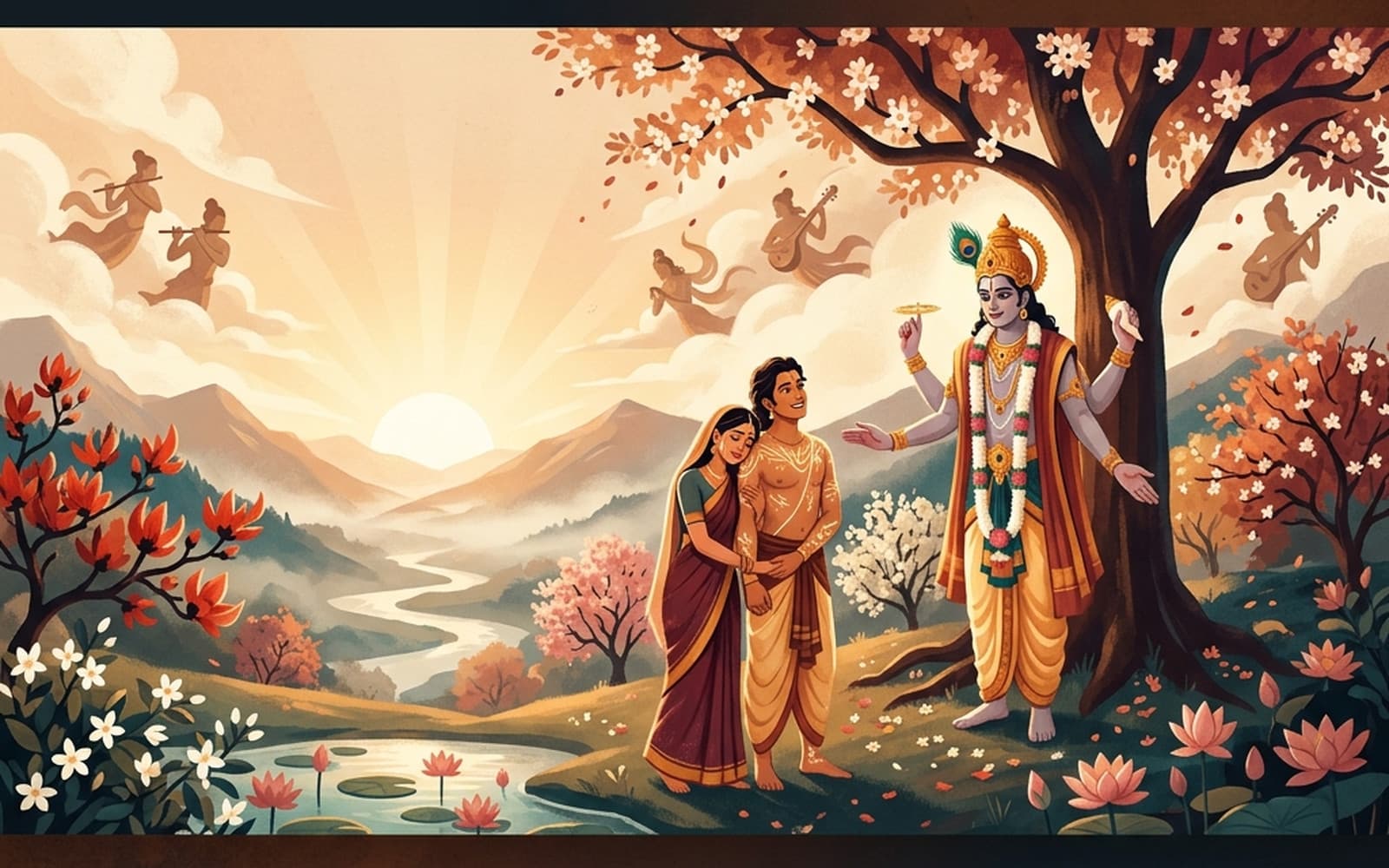
Kamada Ekadashi is the eleventh tithi of the bright fortnight of Chaitra, and it is the first Ekadashi to fall after the Hindu lunar year turns. It follows close behind Ugadi and Gudi Padwa and the nine nights of Chaitra Navratri, so the year is only days old when it arrives. The name says plainly what the day offers: kama is desire, and Kamada is the one that grants it.
One power is fixed to this Ekadashi above the promise of merit — it is said to lift curses. That claim rests on a story from the Varaha Purana about a gandharva turned into a monster and the wife whose fast turned him back. We begin there.
The gandharva who became a monster
Lalit's curse, and the fast that undid it
The Varaha Purana carries this story, told by the sage Vasishtha to King Dilipa when he asked which vow could wash away the heaviest of sins. There was once a city called Ratnapura, ruled by a king named Pundarika, and among the gandharvas of his court lived a singer named Lalit and his wife Lalita. They loved each other plainly and well, and Lalit's voice was the pride of the court.
One day, singing before the king, his mind wandered to Lalita, and his voice broke and lost its measure. Pundarika took the fault as an insult and, in a flash of anger, cursed him — let the gandharva become a rakshasa, a cannibal thing, huge and hideous, and let him wander the forest in that shape. The curse took at once. The singer who had faltered over a single note now roamed the wilds as a monster, and Lalita followed at a distance, watching what her husband had become and unable to reach him.
Her grief turned to resolve. A wise soul told her of Kamada Ekadashi — the eleventh tithi of Chaitra's bright half — and of its power over curses. Lalita kept the fast with a whole heart, and when it was done she stood before Vishnu and gave away its entire merit for one thing only: her husband's release. The curse loosened and fell away. The monstrous form dissolved, and Lalit stood before her a gandharva again, restored by a fast she had kept for him and not for herself.
The year's first fast, in brief
Date in 2027
Friday, 16 April 2027
Lunar month
Chaitra · Shukla Paksha
Deity
Lord Vishnu
Marks
First Ekadashi of the Hindu lunar year
Name means
The fulfiller of desires (kama)
When Kamada Ekadashi falls
The observance day and tithi window for your city
In 2027, Kamada Ekadashi is observed on Friday, 16 April 2027. The Ekadashi tithi begins 16 April 2027, 11:22 AM and ends 17 April 2027, 09:28 AM.
Tithi begins
16 April 2027, 11:22 AM
Tithi ends
17 April 2027, 09:28 AM
Smarta and Vaishnava dates differ
| Year | Observance day |
|---|---|
| 2026 | Sunday, 29 March 2026 |
| 2027 | Friday, 16 April 2027 |
Times shown for New Delhi; pick your city on the Ekadashi calendar for local timings.
The first wish of a new year
Why the year's opening Ekadashi is the one that grants desires
Every Ekadashi belongs to Vishnu, but their places in the year give each a different character. Kamada's place is the front of the line. It is the first Ekadashi to fall after the Hindu lunar year begins — arriving in Chaitra's bright fortnight, only days behind Ugadi and Gudi Padwa and the nine nights of Chaitra Navratri. The year is newly born, and this is its first fast.
That timing shapes what the day is for. Its name is Kamada, the giver of desires, and it is kept above all as a day to place a sincere wish before Vishnu — not a whim, but the thing the heart has settled on for the year ahead. Tradition holds that the fast fulfils such wishes, dissolves accumulated sin, and, as Lalita's story shows, reaches where few observances claim to: it can lift a curse. To open a new year with the one Ekadashi named for the granting of desires is no accident of the calendar; it is the point of it.
Sitting the fast, from dawn to jagran
Bath, sankalp, Vishnu puja and the night's vigil
Those who keep the vrat begin before sunrise with a bath and a sankalp — the spoken resolve to hold the fast for Vishnu, and, on this day more than others, to name the wish it is being kept for. Through the daylight hours they take no grain: some keep a full fast, others a phalahar of fruit, milk and permitted foods. The hours are turned toward Vishnu with tulsi, lamp and incense, and with the reading or hearing of the Kamada Ekadashi katha, so that Lalita's fast is remembered while one's own is kept.
The night is meant for jagran, a vigil of bhajan and the names of Vishnu rather than sleep. As with every Ekadashi, the vow asks for restraint of tongue and temper as much as of the stomach — the discipline is itself the offering, and a wish placed on a day of quarrel or complaint is held to lose its weight.
Keep it within your capacity
Sealing the wish on Dwadashi morning
The parana window that completes the vow
The vow is not sealed at nightfall. It is completed the next morning on Dwadashi, when the fast is broken within the parana window — after sunrise, before the Dwadashi tithi ends, and not during Hari Vasara, its first quarter. Many break it with food first offered to Vishnu, taking tulsi water before eating simply.
Breaking too early, or letting the window pass, is held to lessen the fast's merit — which is why, on a day kept to carry a wish through, the next morning's timing matters as much as the Ekadashi itself. The exact window shifts with your city and the year; check that day's panchang for the precise time before you break the fast.
Mind the parana window
See today's live panchang for your city
Tithi, nakshatra, sunrise and the day's muhurat — computed for wherever you are.
Kamada Ekadashi — questions answered
The name, the curse-lifting story, and the vrat