
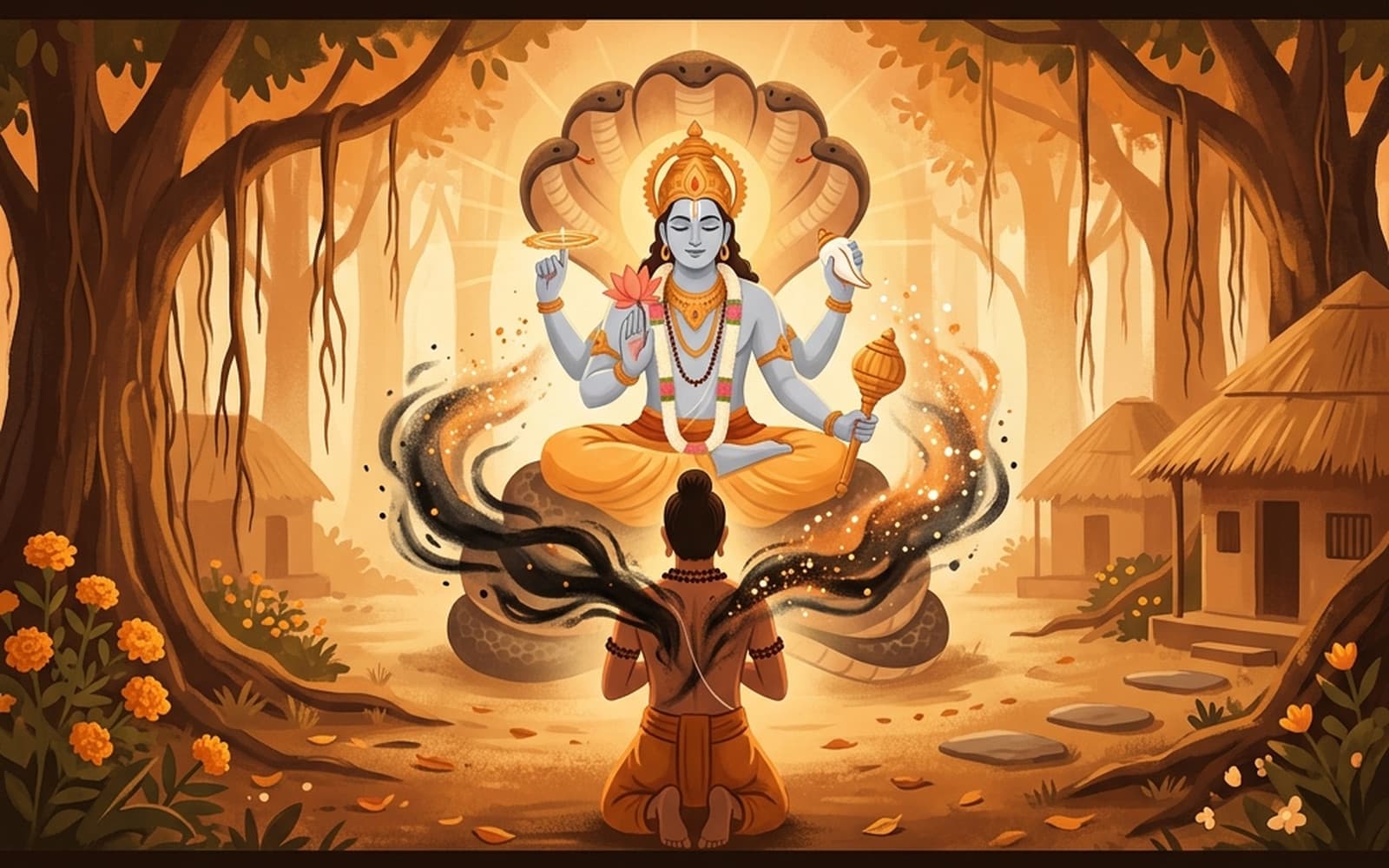
Papamochani Ekadashi is the fast that unbinds sin. Its name breaks into papa — sin, wrongdoing, the weight of a wrong action — and mochani, that which frees or releases; together, the day that lets the burden fall away. It is the eleventh tithi of the dark fortnight of Chaitra, kept for Lord Vishnu, and it carries an old and startling promise: that even grave sins, the kind a person carries in dread, can be washed clean by a single day of sincere fasting and worship.
It is also the year's last Ekadashi. Falling after Holi and before the Chaitra Navratri that opens the new Hindu year, Papamochani stands at the threshold — a final chance to set down what one would not wish to carry across the turn of the year. The story it is remembered by, told by Krishna to Yudhishthira, is of an apsara freed from a curse by this very fast; and the observance closes, as every Ekadashi does, with parana the next morning on Dwadashi.
The year's last fast, in brief
Date in 2027
Friday, 2 April 2027
Lunar month
Chaitra · Krishna Paksha
Deity
Lord Vishnu
What it marks
Last Ekadashi of the year; fast for Vishnu
Name means
Remover of sins
Date and tithi window
The observance day and tithi timing for your city
In 2027, Papamochani Ekadashi is kept on Friday, 2 April 2027 — the Ekadashi tithi opens 02 April 2027, 12:46 AM and closes 03 April 2027, 02:53 AM.
Tithi begins
02 April 2027, 12:46 AM
Tithi ends
03 April 2027, 02:53 AM
Smarta and Vaishnava dates differ
| Year | Observance day |
|---|---|
| 2026 | Sunday, 15 March 2026 |
| 2027 | Friday, 2 April 2027 |
Times shown for New Delhi; pick your city on the Ekadashi calendar for local timings.
The Ekadashi that washes sin away
What 'Papamochani' means, and the burden it lifts
Papamochani is a name that says exactly what the day does. Papa is sin, fault, the weight of wrong action; mochani is the feminine of that which liberates, that which unfastens a knot. Put together, Papamochani is 'the remover of sins' — and of all the Ekadashis in the year, this is the one turned to when a person longs to be free of something they have done.
The tradition does not soften the claim. It holds that the Papamochani fast can wash away even grave sin — the kind for which there seems no ordinary atonement, brahmahatya and its like. This is not offered as a licence to sin lightly, but as a door left open: however far one has strayed, sincere fasting and the worship of Vishnu can bring one back.
Its place in the calendar sharpens the meaning. Papamochani is the last Ekadashi of the outgoing Hindu year, falling in the dark fortnight of Chaitra between Holi and the Chaitra Navratri that begins the year anew. It is a fitting hour to set down old burdens, and to cross into the new year unweighted.
Medhavi, the apsara, and the curse undone
The story Krishna told Yudhishthira
The katha comes from the Bhavishyottara Purana, told by Krishna to Yudhishthira. In the Chaitraratha forest, a young ascetic named Medhavi sat in deep penance, his mind fixed and his austerity severe. Such tapas troubles the ease of the celestial world, and so the apsara Manjughosha was sent to break it. She sang and drew near, and the young tapasvi — for all his discipline — was enchanted.
The years that followed were lost to him. Held by her charm, Medhavi let his penance fall away and lived long in her company, the fire of his austerity forgotten. When at last he woke to himself and saw how much had slipped through his hands, grief turned to anger, and he cursed Manjughosha to become a pishachi, a she-demon.
She fell at his feet, stricken, and begged for a way back. His fury cooled into pity, and he told her of Papamochani Ekadashi — the fast that removes sin. Manjughosha kept it with all her heart, and by its merit the curse loosened and lifted; she was freed of the demon's form and of the sin that had brought it. Medhavi, for his part, returned to the austerity he had abandoned, restored. Two lives, one fast — that is the tale the day carries.
A day of fasting and the worship of Vishnu
How the day is kept
In practice the observance is quiet and inward. The day begins with a bath and a sankalp — the resolve to keep the vow — and turns to the worship of Vishnu: tulsi laid at his feet, a lamp lit, the Ekadashi katha read or heard, and his names kept on the tongue through the day. Grains are set aside, and many keep a full fast, taking only water or fruit as their health allows.
Because the day's whole purpose is the letting-go of wrong, the inward part matters as much as the ritual. It is a day to be honest with oneself, to turn from old faults rather than merely to recite the observance. Where they can, householders spend the evening in remembrance and, by tradition, keep a vigil in Vishnu's names before the fast is completed at dawn.
Keep the fast to your capacity
Completing the vow at dawn
The Dwadashi window that seals the fast
The fast is not complete until it is broken rightly. Parana is done the next morning on Dwadashi — after sunrise, before the Dwadashi tithi ends, and never during Hari Vasara, the first quarter of the tithi. The fast is broken gently, often with something simple, and the merit of the day is held to rest partly on breaking it within this window rather than too early or too late.
This is why the next day's sunrise matters as much as the Ekadashi date itself, and why the window shifts from city to city. Check that day's panchang for the precise parana time where you are.
Mind the parana window
See today's live panchang for your city
Tithi, nakshatra, sunrise and the day's muhurat — computed for wherever you are.
Papamochani Ekadashi — questions answered
The meaning of the name, the katha, and the parana