
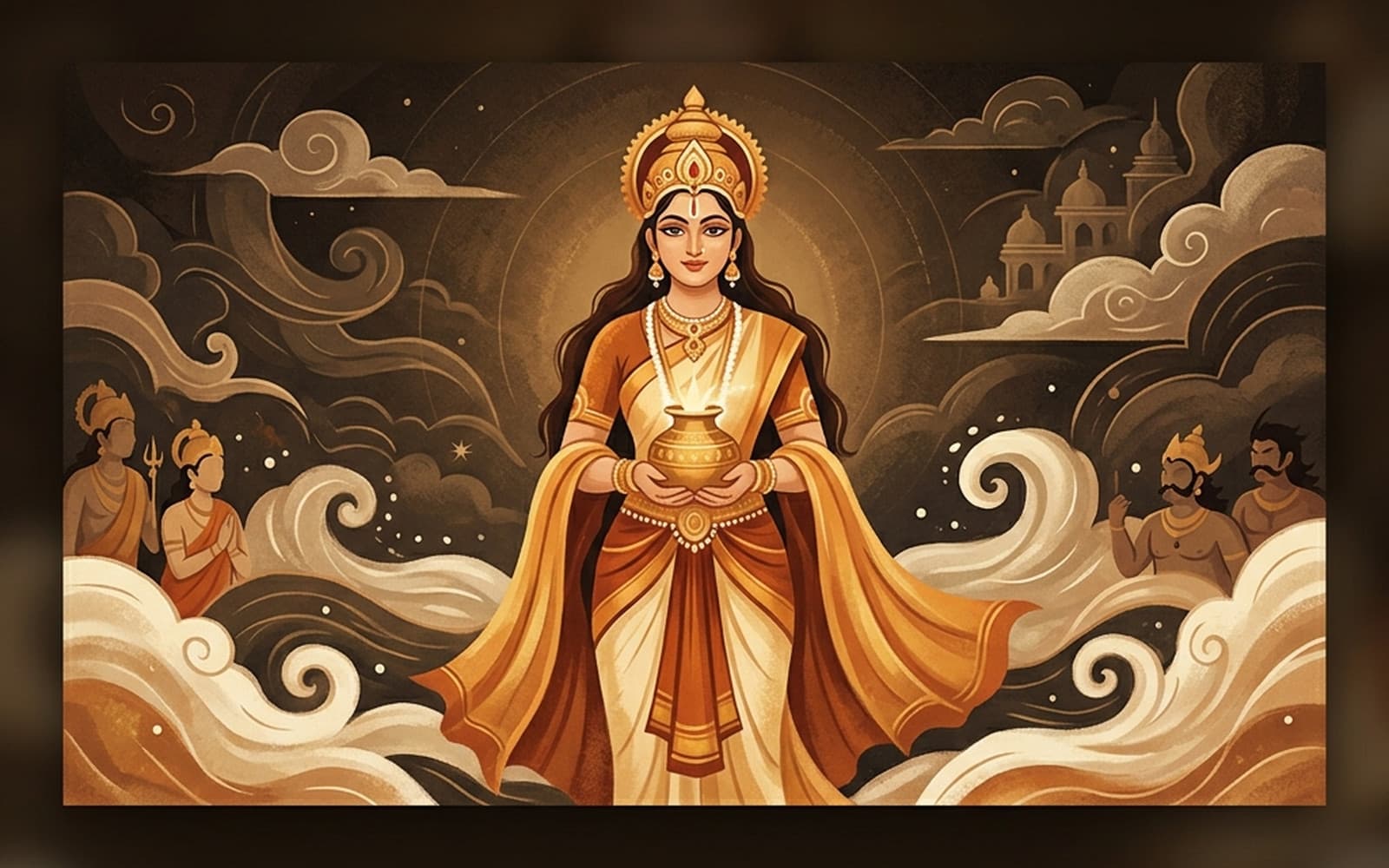
Mohini Ekadashi falls in the bright fortnight of Vaishakha, as the year turns from April into the warmth of May. It carries one of the most striking names in the Ekadashi calendar — Mohini, the enchantress. That was the form Lord Vishnu took at the churning of the ocean, when the amrita, the nectar of immortality, had surfaced and the demons had carried it off. As Mohini he beguiled them, took the nectar back, and gave it to the gods.
The name is not chosen for its beauty alone. Moha is delusion — the pull of attachment and worldly entanglement that clouds the mind. This Ekadashi is kept to be freed of exactly that, and of the weight of past wrongs, so the heart turns a little more toward liberation. Its katha, told by the sage Vasishtha to Rama, is the story of one such deliverance.
Date & tithi window
The observance day and tithi timing for your city
In 2027, Mohini Ekadashi is kept on Sunday, 16 May 2027 — the Ekadashi tithi opens 15 May 2027, 06:18 PM and closes 16 May 2027, 05:14 PM.
Tithi begins
15 May 2027, 06:18 PM
Tithi ends
16 May 2027, 05:14 PM
| Year | Observance day |
|---|---|
| 2026 | Monday, 27 April 2026 |
| 2027 | Sunday, 16 May 2027 |
Times shown for New Delhi; pick your city on the Ekadashi calendar for local timings.
The vrat in brief
Date in 2027
Sunday, 16 May 2027
Lunar month
Vaishakha · Shukla Paksha
Deity
Vishnu · Mohini avatar
Kept for
Release from moha (delusion) & sins
Katha
Dhrishtabuddhi — told by Vasishtha
The enchantress form, and the release from delusion
Why this Ekadashi carries Mohini's name
When the gods and the asuras churned the ocean of milk, the last thing to rise from it was the amrita — the nectar that would make its drinker deathless. The asuras snatched the pot at once, and a quarrel began that the gods could not win by force. So Vishnu took a form no one there could resist: Mohini, a woman of such beauty that the asuras placed the nectar in her hands and asked only that she share it fairly. She served the gods, slipped away, and immortality stayed where it belonged.
That is the scene the day's name recalls, but its point sits deeper. Mohini is the face of maya, the enchantment that makes us reach for the wrong thing and let the worthy one slip away. Moha — attachment, the tangle of wanting — is what keeps a person bound. Mohini Ekadashi is kept to loosen that hold: to be washed of accumulated sins and of the delusion beneath them, and by that much to be drawn toward moksha.
The merchant's son who was made whole
The katha of Dhrishtabuddhi
Rama once asked the sage Vasishtha which vow could lift the greatest burden of sorrow and sin. Vasishtha answered with the story of Mohini Ekadashi. Krishna tells the same tale to Yudhishthira in another telling.
In a town on the Saraswati lived a prosperous merchant, Dhanapala — generous and devout. Of his five sons the youngest, Dhrishtabuddhi, went wrong; he gave himself to drink, gambling and bad company, and squandered whatever came to his hand. His father bore it as long as he could, then put him out of the house. Cast off by family and friends, the son wandered hungry and wretched, selling off his ornaments one by one, until nothing was left.
In his wandering he came to the hermitage of the sage Kaundinya. Seeing the man's ruin and the flicker of remorse in him, the sage told him of Mohini Ekadashi — keep this one vow with faith, he said, and its power will burn away what you have done. Dhrishtabuddhi kept the fast as he was taught. By its merit his sins were washed away and the delusion that had driven him lifted; he was made whole, and in time found his way to a better life. The story is the day's promise in miniature: no fall is final, and this vow is the turn from which a person can come back.
The fast, and the worship it asks
The fast, the puja, and the reading of the katha
The observance begins at dawn on Ekadashi with a bath and a sankalp — the quiet resolve to keep the day. From then the fast holds: most take a nirahar or phalahar vow, keeping to fruit, milk and water and setting aside grains, beans and the ordinary run of meals. The day is given to Vishnu — an image or the Shaligram bathed and dressed, offered tulsi leaves, a lamp, incense and flowers, with his names on the lips through the hours.
What sets an Ekadashi apart from a plain fast is the katha. Reading or hearing the story of Mohini Ekadashi is held to be as much a part of the day as the fasting, for the tale is what carries the meaning. Many keep a light vigil into the night, in kirtan or in reading, rather than turning early to sleep.
A note on fasting
Completing the vow the next morning
Parana, and the window that seals it
The fast is not complete until it is broken rightly. Parana is done the next morning, on Dwadashi — after sunrise, within the Dwadashi tithi, and never in Hari Vasara, its first quarter. The fast is opened simply, often with water and tulsi-charanamrit and then a light meal; many give food or alms first, or feed a brahmin, before eating themselves.
Timing matters here as much as the date. Breaking the fast too early, or letting Dwadashi pass without breaking it, is held to diminish the vow, so the next day's sunrise and the close of Dwadashi both count. The exact window moves with your city — check that morning's panchang for the precise time.
Mind the parana window
See today's live panchang for your city
Tithi, nakshatra, sunrise and the day's muhurat — computed for wherever you are.
Mohini Ekadashi — your questions answered
The Mohini avatar, the katha, and how the vrat is kept