
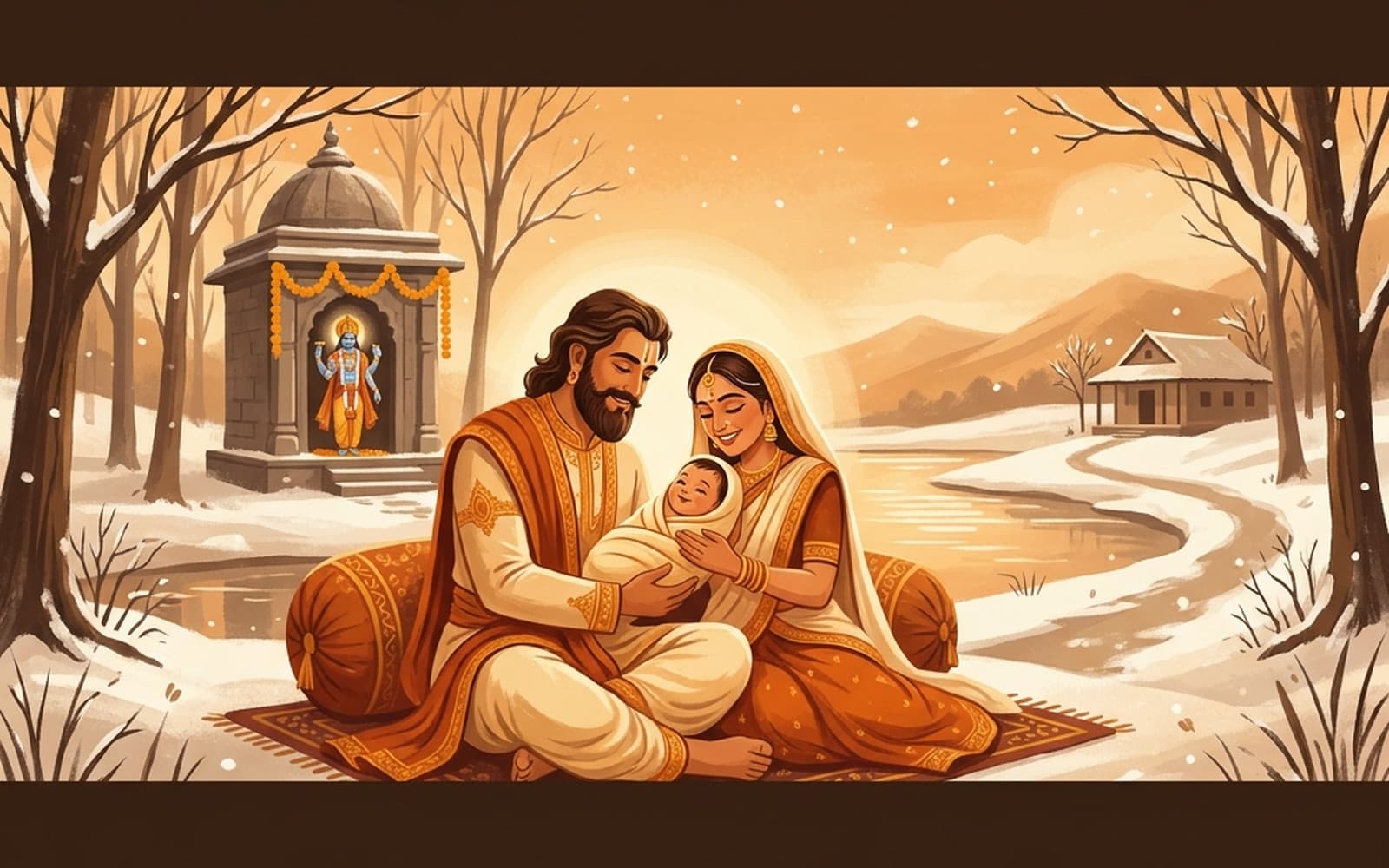
Putrada means 'the giver of progeny,' and Pausha Putrada Ekadashi is the winter fast kept, above all, by couples who long for a child. It is the eleventh tithi of the bright fortnight of Pausha, held for Lord Vishnu in the short, cold days at the year's turn — a day given to the hope of worthy children, and held also to wash away sin and grant well-being.
There are two Putrada Ekadashis in the year, and telling them apart matters. One falls in Shravana, in the warmth of August; this is the other — the Pausha one, kept in deep winter, and across much of North India the more widely observed of the pair. It is remembered by the story of a grieving, childless king who kept this very fast on the counsel of forest sages, and in time was blessed with a son.
When Pausha Putrada falls
The observance day and tithi window for your city
In 2027, Pausha Putrada Ekadashi is kept on Tuesday, 19 January 2027 — the Ekadashi tithi opens 18 January 2027, 10:28 AM and closes 19 January 2027, 07:50 AM.
Tithi begins
18 January 2027, 10:28 AM
Tithi ends
19 January 2027, 07:50 AM
Times shown for New Delhi; pick your city on the Ekadashi calendar for local timings.
What this Ekadashi is, in brief
Date in 2027
Tuesday, 19 January 2027
Lunar month
Pausha · Shukla Paksha
Deity
Lord Vishnu (Narayana)
Observance
Fast, Vishnu puja & the katha
Kept for
The blessing of children
A fast prayed for a child
What 'Putrada' means, and which Ekadashi this is
Putra-da joins two words — putra, a child, and da, the giver: 'the bestower of progeny.' Of all the year's Ekadashis, this is the one the childless turn to. Couples who long for a son or a daughter keep the Pausha Putrada fast in the belief that Vishnu, worshipped with a sincere heart on this day, blesses the devout with worthy children. The merit of the day is said to reach further still — to soften the weight of past wrongs and to bring well-being to the household that keeps it.
One thing is worth settling at the outset, because it is a common tangle: there are two Putrada Ekadashis in a year. The first falls in Shravana, the monsoon month of August; the second — this one — in Pausha, at the heart of winter. They share a name and a purpose but not a season, and across much of North India it is the Pausha fast that is the more widely kept. When a family speaks of 'the Putrada Ekadashi' in winter, this is the day they mean.
It is the eleventh tithi of the bright fortnight of Pausha, and like every Ekadashi it belongs to Lord Vishnu. What gives it its particular tenderness is who keeps it, and why — not for gain or for glory, but for the oldest hope a household carries.
The grief of King Suketuman
How a childless king came to a son
In the city of Bhadravati reigned King Suketuman, and beside him his queen, Shaibya. They wanted for nothing a kingdom could give — and for the one thing it could not. They had no child. The years passed and the ache did not, until it clouded every pleasure the throne could offer; an heirless crown, the king felt, was a burden more than an honour.
Unable to bear the palace and its silence, he rode out alone into the forest, half-wandering, half-fleeing his own sorrow. Deep among the trees he came upon a clear lake, and on its bank a hermitage of sages — and found, on that very day, that they were keeping the Pausha Putrada Ekadashi. He bowed to them and told them his grief. The sages counselled him to keep this very fast, for it is the fast that grants children, and to observe it with his queen and with faith.
The royal couple did as they were told. They kept the Pausha Putrada vrat as the day asks — the fast, the worship of Vishnu, the night given to his name — and in the fullness of time a son was born to them, the heir the kingdom had waited for. The Bhavishya Purana holds the story out as the day's promise: that the sincere keeping of this fast is answered.
The fast, and the prayer within it
The fast, the worship and the reading of the katha
The observance is simple in shape and asks more of the heart than the hand. The day opens with a bath and a sankalp — the spoken resolve to keep the vow — and turns to the worship of Vishnu: tulsi leaves, a lamp, flowers and incense set before his image, and the offering of what the household can give. Grains are set aside for the day, so the fast is kept on fruit and water, or forgone entirely by those who are able.
At the centre of it is the katha — the story of Suketuman read or heard aloud — for the day is as much remembered as observed. Many keep a vigil through the night in Vishnu's names, in bhajan and remembrance, as couples have done for the sake of a child for as long as the fast has been known. The mood is quiet and hopeful rather than grand.
Keep it within your strength
Closing the vow at first light
The parana that completes the fast
A fast is not finished when the night ends but when it is broken rightly, and that breaking — parana — has its own appointed hour. It is done the next morning, on Dwadashi: after sunrise, before the Dwadashi tithi runs out, and not during Hari Vasara, the first quarter of the tithi. After a day of fruit and a night without sleep, the fast is broken gently, with the food set aside the day before.
To break it too early, or to let the window pass, is held to lessen the fruit of the vrat — which is why the next day's sunrise matters as much as the Ekadashi itself. The exact window moves with your city and the season; check that morning's panchang for the precise time before you eat.
Mind the parana window
See today's live panchang for your city
Tithi, nakshatra, sunrise and the day's muhurat — computed for wherever you are.
Pausha Putrada Ekadashi — your questions answered
The winter Putrada, the Suketuman story and how the vrat is kept