
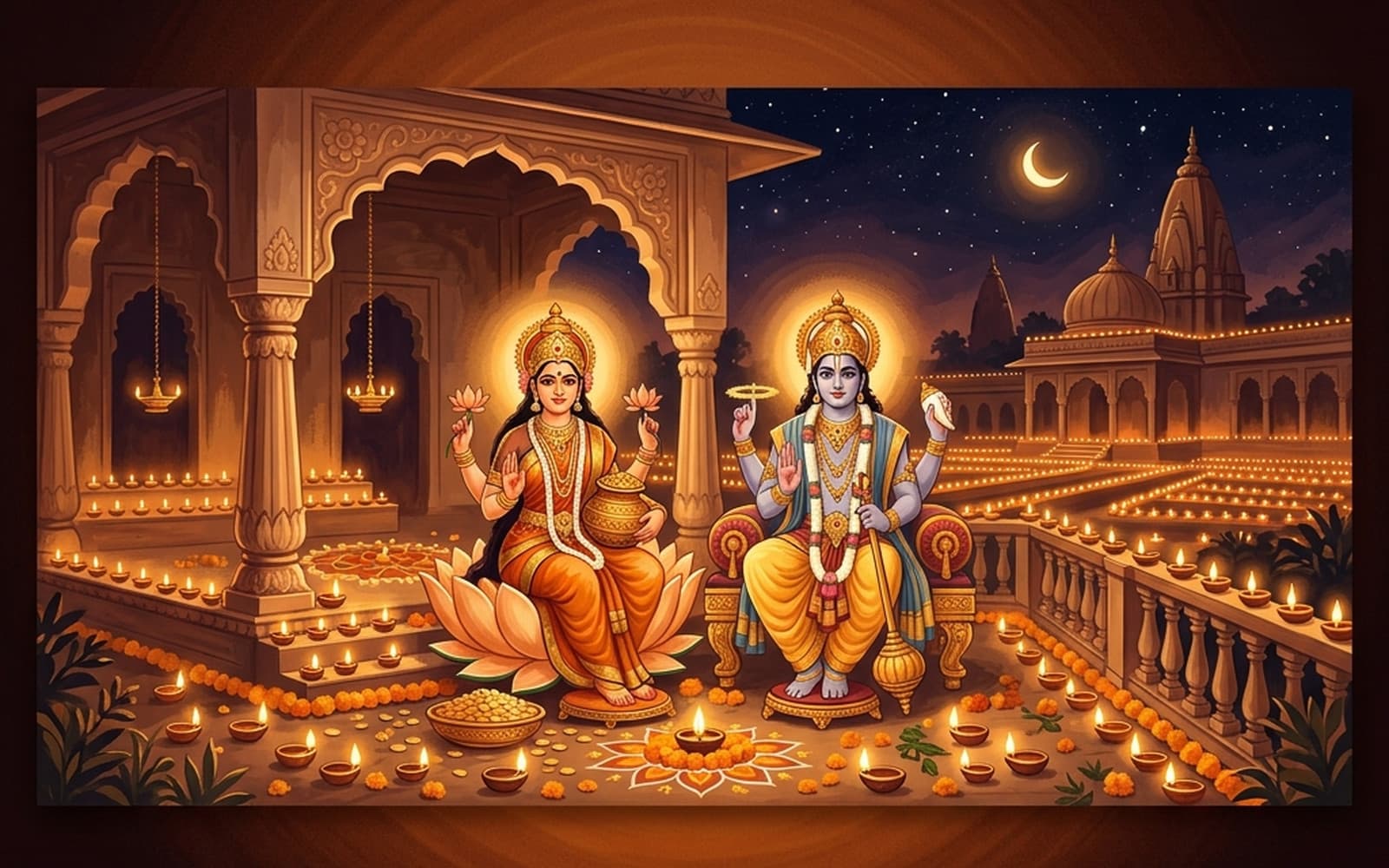
Rama Ekadashi is the eleventh tithi of the dark fortnight of Kartika, and it falls in the last few days before Diwali — the final Ekadashi before the festival of lights. Kept as a fast for Vishnu, it is named not for Lord Rama of the Ramayana but for Ramaa, one of the names of Goddess Lakshmi; and it is her grace, more than anything else, that the day is held to bring.
Coming at the crest of the festival season, the fast is spoken of as one that washes away old and heavy wrongs and readies the household for the fortune Diwali is meant to invite. Around it is told the story of Shobhana and Chandrabhaga — a frail prince and his wife — which the tradition offers as proof of how much a single Ekadashi, kept in earnest, can carry.
Date & tithi window
The observance day and tithi times for your city
In 2026, Rama Ekadashi is observed on Thursday, 5 November 2026. The Ekadashi tithi begins 04 November 2026, 11:04 AM and ends 05 November 2026, 10:36 AM.
Tithi begins
04 November 2026, 11:04 AM
Tithi ends
05 November 2026, 10:36 AM
| Year | Observance day |
|---|---|
| 2026 | Thursday, 5 November 2026 |
| 2027 | Monday, 25 October 2027 |
Times shown for New Delhi; pick your city on the Ekadashi calendar for local timings.
Rama Ekadashi in brief
Date in 2026
Thursday, 5 November 2026
Lunar month
Kartika · Krishna Paksha
Deity
Lord Vishnu
The day marks
The last Ekadashi before Diwali
Also called
Ramaa Ekadashi (from Lakshmi, not Rama)
Four days before the lamps
The last Ekadashi of the run-up to Diwali
Rama Ekadashi is the eleventh tithi of the waning fortnight — the Krishna Paksha — of Kartika, and it arrives in the last quiet days before Diwali. Kartik Amavasya, the new-moon night when the lamps are lit, is only a few days off; Rama Ekadashi falls about four days ahead of it, the final Ekadashi before the festival of lights.
That placement is much of its meaning. The weeks of Kartika are already turned toward Vishnu and toward Lakshmi, and this fast sits at the very threshold of the season's brightest night. Keeping it is understood as a way of preparing the household — inwardly and outwardly — for the wealth and welcome that Diwali is meant to invite.
The grace the day asks for is Lakshmi's. The Ekadashi is worshipped to Vishnu, yet its name carries her presence, and the good fortune it is held to bring — the lifting of old wrongs, the softening of hardship as the year's most auspicious nights draw near — is spoken of as her gift.
Ramaa, not Rama
The name belongs to Lakshmi, not to the Ramayana
The name misleads almost everyone who meets it for the first time. Rama Ekadashi has nothing to do with Lord Rama of the Ramayana. It is named for Ramaa — रमा — one of the names of Goddess Lakshmi, the consort of Vishnu, and the two words are separated by a single long vowel that is easy to lose in speech.
Read correctly, the day's character comes clear. This is a Vishnu fast that leans, through Ramaa, toward Lakshmi — toward fortune, abundance and grace — which is why it belongs so naturally to the days before Diwali, the festival that is itself Lakshmi's own.
Shobhana and Chandrabhaga
The frail prince who kept the fast — a tale from the Brahmavaivarta Purana
The story told for this day comes from the Brahmavaivarta Purana. Chandrabhaga, daughter of King Muchukunda, was married to Shobhana, the son of King Chandrasena. Shobhana was gentle in nature but weak in body — he could not easily bear hunger, and a day without food or water taxed him greatly.
When Rama Ekadashi came, he chose to keep the fast even so. He held the vow sincerely through the day and the night, and the effort cost him his life. Yet the merit of a fast kept in earnest is not lost with the body. By the strength of that single Ekadashi, Shobhana was reborn into a luminous divine city on the slopes of Mount Mandarachala — a place of splendour he had done nothing else to earn.
In time Chandrabhaga learned where her husband had gone and made her way to him, and by the merit of her own devotion she was able to remain with him in that radiant city. The tale is remembered less for its wonders than for its plain claim: that a fast kept with a whole heart, even by the weak, carries a weight that outlasts a lifetime.
Keeping the fast before the festival
The vow, the worship of Vishnu, and a still day
The day begins early, with a bath and a sankalp — the quiet resolve to keep the vow — followed by the worship of Vishnu with tulsi leaves, a lamp, incense, and the reading or hearing of the Rama Ekadashi katha. Grain and pulses are set aside for the day; some keep a complete fast, others take fruit and milk, a phalahara fast, according to their strength.
Much of the day is meant to be kept quiet and inward — spent in the name of Vishnu, in remembrance and restraint rather than bustle. Falling as it does just before Diwali, the fast reads almost like a pause drawn before the noise of the festival: a day of stillness set against the lamps that are about to be lit.
Faith within your strength
Completing the vow on Dwadashi
The parana window that seals the fast
The fast is completed the next morning, on Dwadashi, in the span called parana — after sunrise, before the Dwadashi tithi ends, and never during Hari Vasara, the first quarter of Dwadashi. It is broken gently, with tulsi water and simple sattvik food, and many give something in charity before they eat.
Breaking the fast too early, or letting the window slip past, is held to lessen its fruit — so the next morning's timing matters as much as the Ekadashi itself. The exact parana window shifts with your city; check that day's panchang for the precise time where you are.
Mind the parana window
See today's live panchang for your city
Tithi, nakshatra, sunrise and the day's muhurat — computed for wherever you are.
Rama Ekadashi — questions answered
The name, its place before Diwali, the katha and parana