
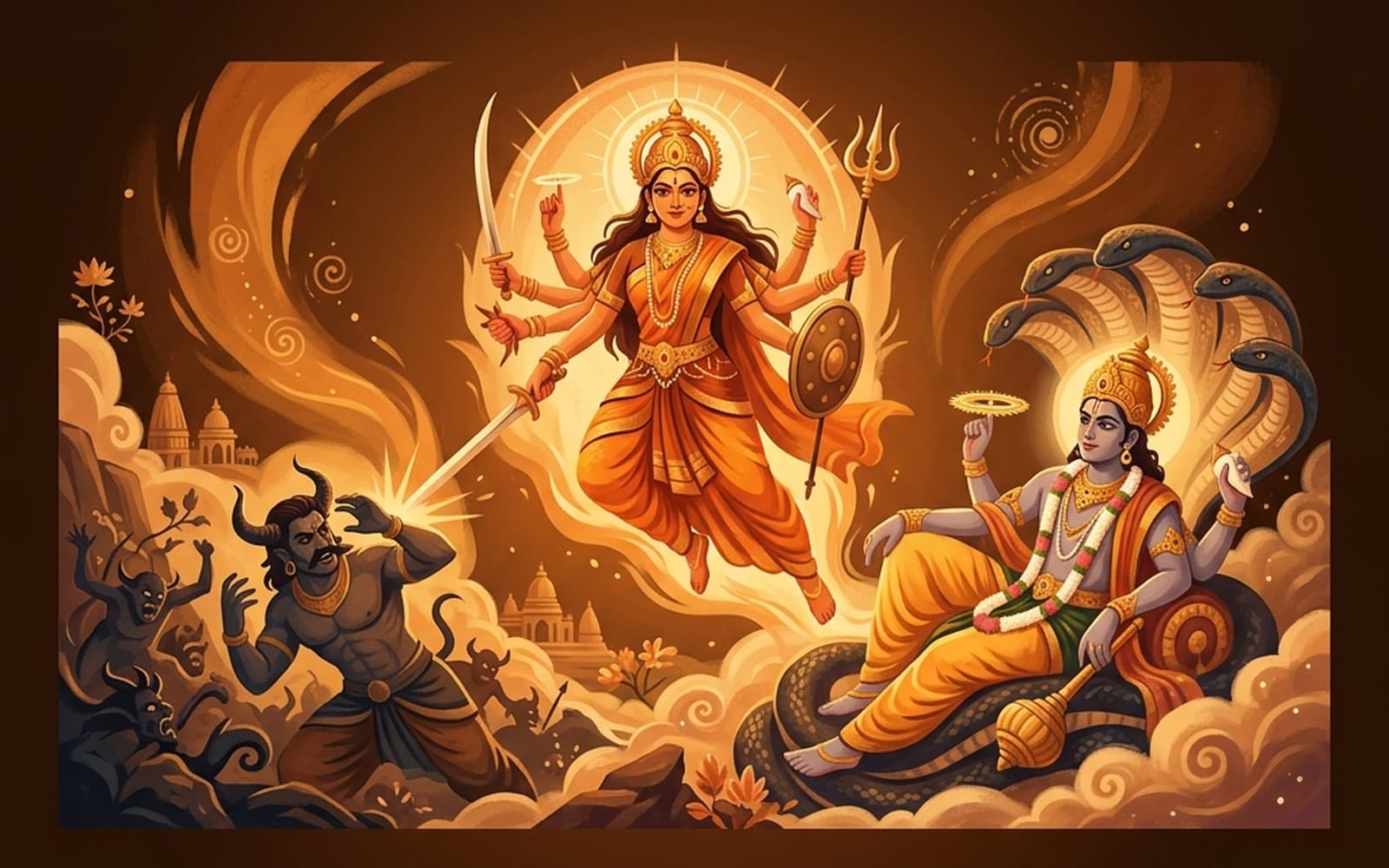
Utpanna Ekadashi is unlike the other Ekadashis of the year, because it is the one on which the observance itself began. The word utpanna means “arisen” or “come into being,” and the day is named for a birth: on the eleventh tithi of the dark fortnight of Margashirsha — the month also called Agahan, as autumn hardens into winter — a goddess is said to have risen from the body of Vishnu. That goddess was given the name Ekadashi, and with her the fast that carries her name came into the world.
So this is the source of every other Ekadashi. Rama, Nirjala, Devshayani, Mokshada — each of the year's Ekadashis is a return to the vow first granted here. For that reason those who wish to keep Ekadashi through the coming year, but have not kept it before, are counselled to begin from Utpanna: to take up the vow on the very day it was born, and carry it forward from fortnight to fortnight.
The birth of Ekadashi
How a goddess rose from Vishnu's rest to slay the demon Mur
The story belongs to an age when a demon named Mur had grown strong enough to trouble the gods and drive them from their places. He was relentless, and even the devas found no answer to him. At last they turned to Vishnu, who took up the fight himself. The struggle was long, and when Vishnu finally withdrew to a cave in the mountains to rest, Mur followed, meaning to strike the Lord as he slept.
As the demon raised his weapon, a radiance gathered from Vishnu's own body and took form — a fierce goddess, armed and unafraid, born of his sleeping strength. She met Mur where he stood and destroyed him before he could reach the Lord. When Vishnu woke and saw what she had done, he was pleased beyond measure, and he gave her a name and a boon together. He called her Ekadashi, for she had arisen on the eleventh tithi, and he granted that whoever kept a fast on her day would be freed of accumulated sin and drawn toward liberation.
That is the birth this day remembers. The fast we call the Ekadashi vrat did not always exist; it was given on this Margashirsha day, in the dark fortnight, out of gratitude for a goddess who guarded the Lord in his sleep.
Where every Ekadashi begins
Date in 2026
Friday, 4 December 2026
Lunar month
Margashirsha (Agahan) · Krishna Paksha
Deities
Lord Vishnu & Ekadashi Devi
The day marks
Origin of the Ekadashi vrat
Also called
Utpatti Ekadashi
Date & tithi timing
Observance day and tithi window for your city
In 2026, Utpanna Ekadashi is observed on Friday, 4 December 2026. The Ekadashi tithi begins 03 December 2026, 11:04 PM and ends 04 December 2026, 11:45 PM.
Tithi begins
03 December 2026, 11:04 PM
Tithi ends
04 December 2026, 11:45 PM
| Year | Observance day |
|---|---|
| 2026 | Friday, 4 December 2026 |
| 2027 | Wednesday, 24 November 2027 |
Times shown for New Delhi; pick your city on the Ekadashi calendar for local timings.
The Ekadashi where the year's vow begins
Why devotees take up the fast from this day
Every fortnight brings an Ekadashi, and each has its own name and its own promise — but all of them trace back to the boon granted here. Utpanna is the root; the rest are its branches through the year.
This gives the day a particular use. Someone who has never kept Ekadashi, or who has kept it only now and then and wishes to hold it steadily through the coming year, is traditionally advised to begin from Utpanna. To start the vow on the day the vow itself arose is felt to be the truest opening — the vrat taken up at its own source, then carried unbroken from one Ekadashi to the next.
There is a plainer wisdom in it too. Margashirsha's dark fortnight falls in the cool months, when fasting sits lightly on the body, and a resolve made here has a full turn of the year ahead of it to settle into habit.
A day to take the vow
Fast, worship, and the night's vigil
Honouring Vishnu and Ekadashi Devi through the day and into the night
The day begins before dawn with a bath and a sankalp — the spoken resolve to keep the fast — and then the worship of Vishnu, offered with tulsi leaves, a lamp, incense and the reading of the Ekadashi katha. What sets Utpanna apart is that the goddess Ekadashi herself is honoured alongside him, for the day is as much hers as his; it was her deed that the fast was given to commemorate.
Grain and pulses are set aside for the day. Some keep a complete fast, taking nothing but water; others take fruit and milk — a phalahara fast — as their strength allows. The hours are meant to be turned toward the Lord rather than toward the kitchen, filled with japa, the singing of bhajans and the telling of the day's story.
Utpanna carries one more observance that many hold dear: the night vigil, or jagran. Devotees stay awake through the night in the presence of Vishnu and Ekadashi Devi, keeping the lamp burning and the name sounding until morning, so that the fast is watched over from dusk to dawn.
Keep it within your strength
Closing the vow on Dwadashi
The next-morning window that completes the fast
The fast is not complete until it is closed the next morning on Dwadashi, in the act called parana. It is done after sunrise and before the Dwadashi tithi ends, and never during Hari Vasara, the first quarter of Dwadashi; within that window the fast is broken gently, with tulsi water and simple sattvik food.
The timing carries weight of its own. To break the fast too early, or to let the window pass, is held to lessen what the fast earns, which is why the next morning's parana is watched as closely as the Ekadashi itself. The exact window shifts with your city and the year; that day's panchang will give the precise time.
Mind the parana window
See today's live panchang for your city
Tithi, nakshatra, sunrise and the day's muhurat — computed for wherever you are.
Utpanna Ekadashi — questions answered
The origin story, beginning the vow, worship and parana