
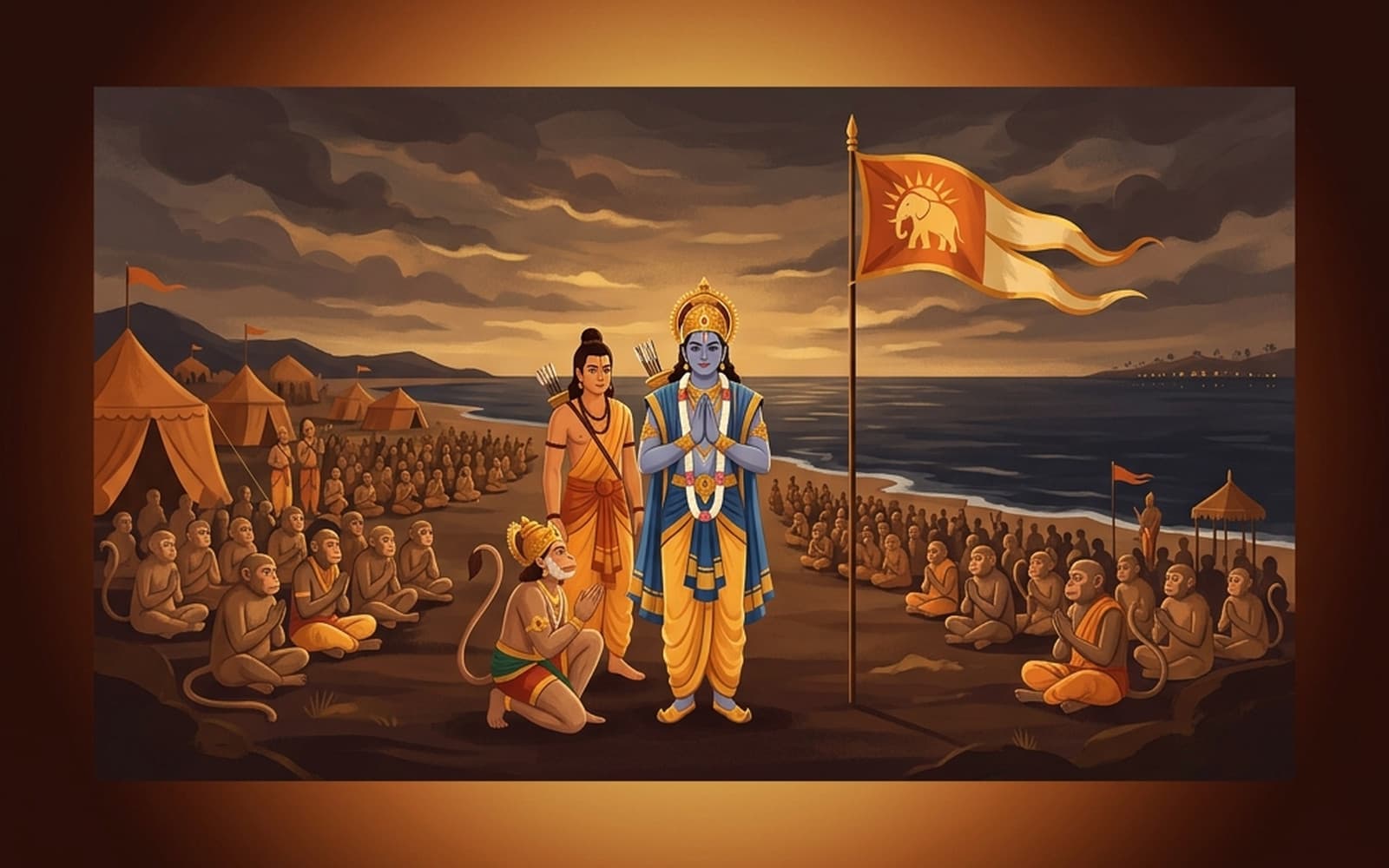
Vijaya Ekadashi is the eleventh tithi of the dark fortnight — the Krishna Paksha — of Phalguna, kept as a fast for Vishnu, worshipped here in the form of Rama. The word Vijaya means victory, and that is exactly what the day is held to grant: victory over enemies, over obstacles that will not move, and over undertakings that look too large to win.
Its fame rests on a single scene from the Ramayana. With his army halted on the shore, unable to cross the ocean to Lanka, Rama is said to have kept this fast on a sage's counsel — and the crossing that had seemed impossible was won. Ever since, the day has been kept before hard and decisive undertakings, by those who want the odds turned in their favour.
The army halted at the shore
How Rama came to keep the fast that carried him to Lanka
The story that gives this Ekadashi its name is told at one of the tautest moments of the Ramayana. Rama had gathered his army and marched to the very edge of the sea, and there the march stopped. The ocean lay between him and Lanka, between him and Sita, and no bridge and no boat could carry an army across it. For all his strength, he could not take the next step.
On the counsel of those around him, Rama went to the sage Bakadalbhya, who lived in penance nearby, and asked how the crossing might be won. The sage told him of the Ekadashi that falls in the dark fortnight of Phalguna — the Vijaya Ekadashi — and bid him keep its fast, together with his commanders, in faith and restraint.
Rama did as he was told. He and his leaders held the vow, and what had seemed impossible gave way: the ocean was crossed, Lanka was reached, and the war that followed ended in victory. From that day the Ekadashi has borne the name Vijaya — victory — and is remembered as the fast that turned a halted army toward its triumph.
The victory fast, in short
Date in 2027
Wednesday, 3 March 2027
Lunar month
Phalguna · Krishna Paksha
Deity
Lord Vishnu, worshipped as Rama
The fast grants
Victory over enemies and obstacles
Famed for
Rama's fast before crossing to Lanka
When it falls & the tithi window
The day to keep it, and the tithi times where you are
Vijaya Ekadashi 2027 falls on Wednesday, 3 March 2027. The Ekadashi tithi runs from 03 March 2027, 04:45 AM to 04 March 2027, 07:25 AM.
Tithi begins
03 March 2027, 04:45 AM
Tithi ends
04 March 2027, 07:25 AM
Smarta and Vaishnava dates differ
| Year | Observance day |
|---|---|
| 2026 | Friday, 13 February 2026 |
| 2027 | Wednesday, 3 March 2027 |
Times shown for New Delhi; pick your city on the Ekadashi calendar for local timings.
Why victory is asked of this day
The Ekadashi kept before a hard or decisive undertaking
What Rama sought at the shore is what the day is kept for still. Vijaya Ekadashi is turned toward victory in its plainest sense — over enemies, over obstacles that will not move, over tasks whose outcome is in doubt. Where other Ekadashis lean toward release or fortune, this one leans toward the hard-won result.
For that reason it has long been kept before difficult undertakings — a contest, a journey, a matter that must go one's way. The tradition does not promise that effort can be set aside; it holds, rather, that the fast kept in earnest turns the balance, the way it once turned an ocean into a road. It is, in a sense, the Ekadashi of the uphill task.
Keeping the vow, from the morning bath onward
The sankalp, the worship of Rama, and a day held in restraint
The day opens early, with a bath and a sankalp — the spoken resolve to keep the fast — followed by the worship of Vishnu in the form of Rama, with tulsi, a lamp, incense, and the reading or hearing of the Vijaya Ekadashi katha. Grain and pulses are set aside; some keep a complete fast, others take fruit and milk, a phalahara fast, as their strength allows.
The hours are meant to be kept quiet and inward — spent in the name of Rama, in remembrance and restraint rather than distraction. Those who keep it before a decisive task often use the day as much to steady the mind as to seek the blessing, treating the fast as a way of gathering resolve before the undertaking itself.
Faith within your strength
Closing the fast on Dwadashi
The parana window that completes the vow
The fast is completed the next morning, on Dwadashi, in the span called parana — after sunrise, before the Dwadashi tithi ends, and never during Hari Vasara, the first quarter of Dwadashi. It is broken gently, with tulsi water and simple sattvik food, and many give something in charity before they eat.
Breaking it too early, or letting the window slip past, is held to lessen the fruit of the whole vrat — so the next morning's timing counts as much as the Ekadashi itself. The parana window shifts with your city; check that day's panchang for the exact time where you are.
Mind the parana window
See today's live panchang for your city
Tithi, nakshatra, sunrise and the day's muhurat — computed for wherever you are.
Vijaya Ekadashi — questions answered
Rama's fast, its purpose, the katha and parana