
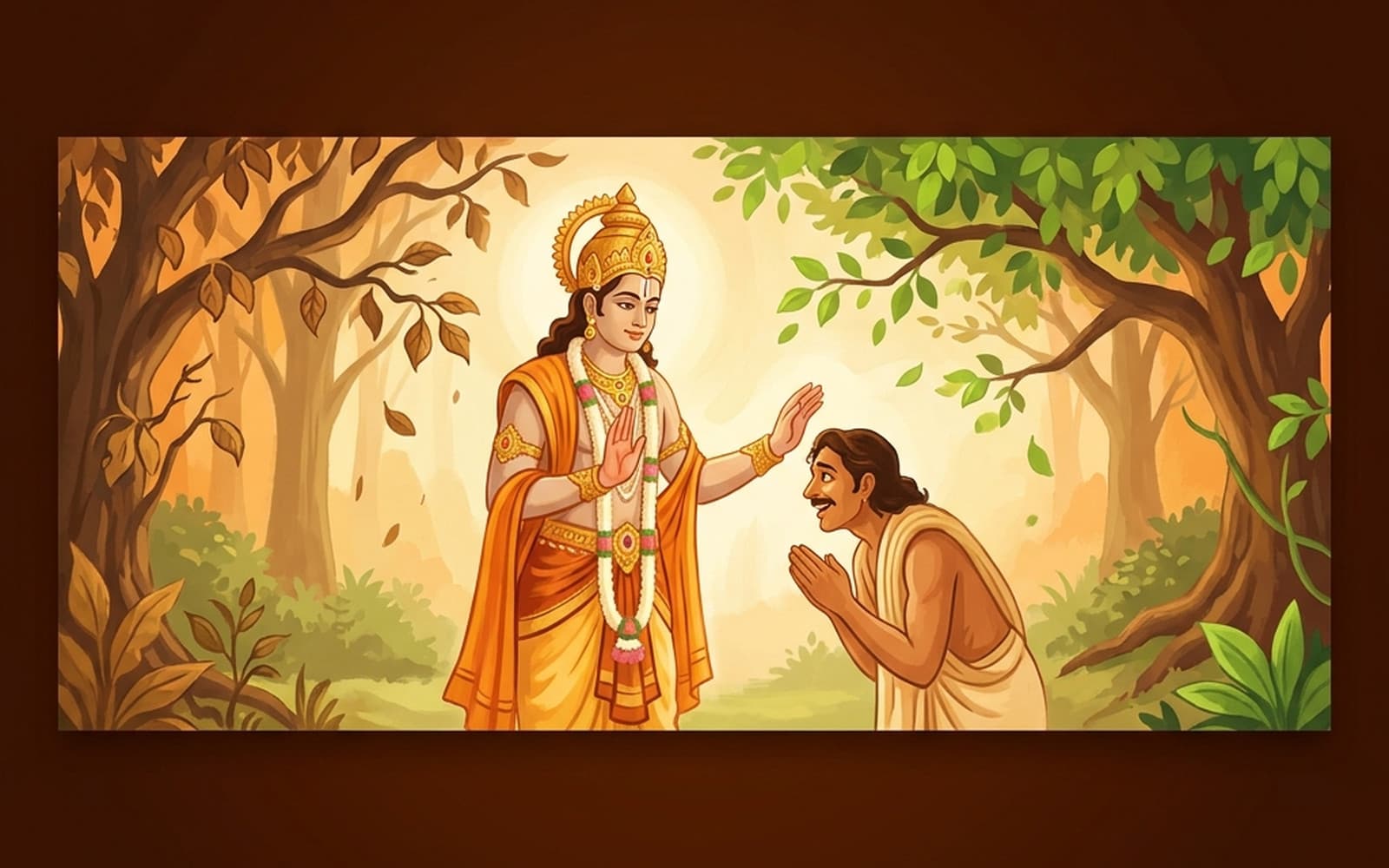
Yogini Ekadashi is the Ekadashi of the waning fortnight of Ashadha, kept as a fast for Lord Vishnu and remembered above all as a day of release. Where other vows are turned toward merit, this one is turned toward what weighs a person down — old wrongs, curses carried without knowing, afflictions that seem to arrive without cause. To keep it is to ask, quietly, to be set free.
Its promise is large. The scriptures liken the merit of a single Yogini fast to the feeding of eighty-eight thousand brahmins — an image meant less as arithmetic than as a measure of how far the day's grace is said to reach. It comes at a telling moment in the calendar: the last Ekadashi before Devshayani, when Vishnu withdraws into sleep and Chaturmas begins. The story the day carries, of a cursed gardener named Hem Mali, is about exactly this — a man freed from an affliction he could not otherwise escape.
Date & tithi timing
Observance day and tithi window for your city
In 2027, Yogini Ekadashi is kept on Wednesday, 30 June 2027 — the Ekadashi tithi opens 29 June 2027, 10:05 PM and closes 30 June 2027, 08:31 PM.
Tithi begins
29 June 2027, 10:05 PM
Tithi ends
30 June 2027, 08:31 PM
| Year | Observance day |
|---|---|
| 2026 | Friday, 10 July 2026 |
| 2027 | Wednesday, 30 June 2027 |
Times shown for New Delhi; pick your city on the Ekadashi calendar for local timings.
Yogini Ekadashi at a glance
Date in 2027
Wednesday, 30 June 2027
Lunar month
Ashadha · Krishna Paksha
Deity
Lord Vishnu
Kept for
Release from sin & bondage
Also called
Ashadha Krishna Ekadashi
A fast for release from sin and bondage
Why Yogini Ekadashi is kept
Every Ekadashi is a fast for Vishnu, but each carries its own emphasis, and Yogini's is unmistakable. It is the Ekadashi of freedom — kept for release from sin, from curses, and from the afflictions of body and mind that hold a life in place. The tradition speaks of it as loosening bondage itself: the knots we tie for ourselves, and the ones tied for us by others.
That reach is why the day is praised so highly. The Puranas compare the merit of one Yogini fast to feeding eighty-eight thousand brahmins — an old way of saying that its fruit is beyond ordinary counting. The number is not really the point; the point is that a single day, kept with sincerity, is held to answer for a great deal.
In the calendar it is the dark-fortnight Ekadashi of Ashadha, falling as the monsoon gathers and the year turns toward its quieter months. Coming when it does, just before Vishnu's long sleep, it reads like a chance to settle old accounts before a season of restraint begins.
The story of Hem Mali
The gardener cured of his curse
The day's power is carried in a story that Krishna tells Yudhishthira, drawn from the Brahmavaivarta Purana. In Alakapuri, the city of Kubera, lord of wealth, there lived a yaksha named Hem Mali who tended the garden. His single duty was to bring fresh flowers each day for Kubera's worship of Shiva. He was also deeply devoted to his wife.
One morning, lost in that devotion, Hem Mali forgot the flowers and came late to the court. Kubera, waiting to begin his worship and finding the offering missing, was seized with anger. He cursed the gardener with leprosy and with separation from the very wife whose company had made him forget — and cast him out of the city.
Hem Mali wandered in misery, his body ruined and his home lost, until his path brought him to the hermitage of the sage Markandeya. The sage, seeing his suffering and its cause, told him of Yogini Ekadashi and bade him keep its fast. Hem Mali did as he was told, and by the merit of that one vow his leprosy left him and he was restored — his body whole again, his life and his wife returned to him. It is his deliverance that the day remembers.
The day's fast and worship
The vow, the worship, and the day's discipline
The observance follows the shape common to every Ekadashi. It begins at dawn with a bath and a sankalp, the quiet resolve to keep the fast, and the day is then given to Vishnu — worshipped with tulsi leaves, a lamp, incense and yellow flowers, and honoured by reading or hearing the Yogini Ekadashi katha, the story of Hem Mali.
Grains are set aside for the day. Some keep a full fast without food; many take only fruit, milk and water, or a single light meal of permitted foods. The hours are meant to be spent in his name — in remembrance, in charity, in stillness — rather than in the ordinary run of errands. The fast holds until the parana the next morning.
What matters is sincerity within one's capacity, not severity for its own sake. The vow is an offering, and it is best kept in the measure a person can honestly sustain.
Keep the fast to your strength
The last Ekadashi before Vishnu sleeps
Yogini's place in the Ashadha calendar
Yogini sits at a hinge in the year. It is the Ekadashi of Ashadha's waning fortnight, and the very next Ekadashi on the calendar is Devshayani — the day Vishnu enters yoga-nidra, his four-month cosmic sleep, and the season of Chaturmas begins. For those who follow the Ekadashis in order, Yogini is the final fast before that long rest.
That placement gives the day part of its meaning. With Chaturmas the tradition asks for restraint — weddings and new ventures are set aside, and many take on a personal vow for the four months. Yogini, arriving just before the door closes, becomes a natural moment to unburden oneself: to seek release from what has gone wrong before entering a season meant for discipline and devotion.
If you keep the Ekadashis through the year, it is worth marking Devshayani in the same breath. The two stand together at the threshold of Vishnu's sleep — one clearing the ledger, the other beginning the rest.
Ending the fast at first light
The window that completes the vow
Parana is the breaking of the fast, and its timing belongs to the observance as much as the fast itself. It is done the next morning on Dwadashi — after sunrise, before the Dwadashi tithi ends, and never during Hari Vasara, the first quarter of Dwadashi. The fast is broken gently, with water first and then simple food.
Breaking too early, or letting the window pass, is held to diminish the fast, which is why the next day's sunrise matters as much as the Ekadashi date. The precise window shifts with your city and its sunrise, so check that day's panchang for the exact time before you break the fast.
Mind the parana window
See today's live panchang for your city
Tithi, nakshatra, sunrise and the day's muhurat — computed for wherever you are.
Yogini Ekadashi — questions answered
The sin-absolving fast, the Hem Mali story and parana