
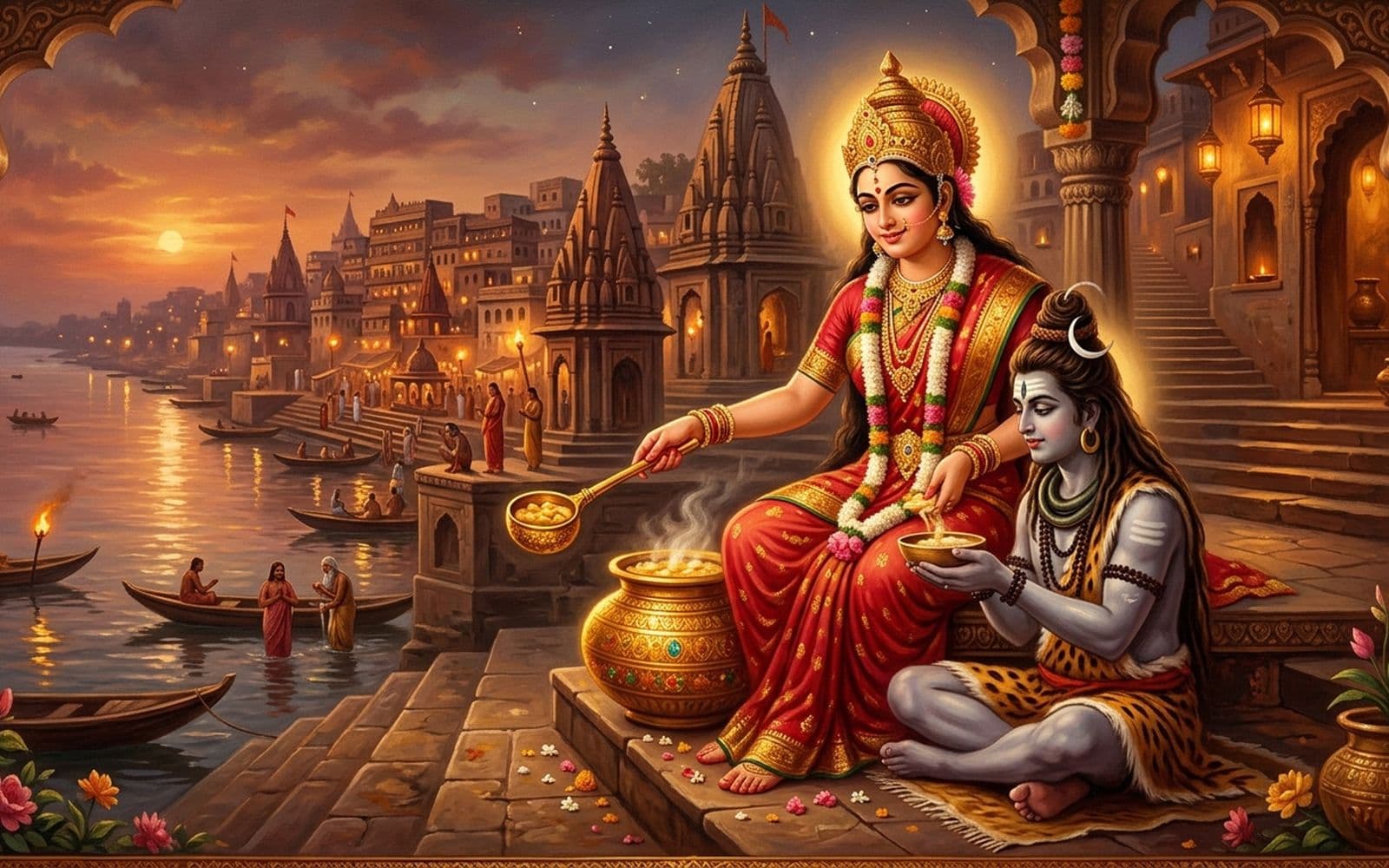
Annapurna Jayanti marks the appearance of Goddess Annapurna — Parvati as the giver of food and nourishment, whose name means 'full of anna,' full of food. She is shown with a golden ladle and a pot of food, ever ready to serve, and she is worshipped so that a home is never short of nourishment. In 2026 the day falls on Wednesday, 23 December.
It is kept on Margashirsha Purnima, the full moon of Margashirsha — the same full moon as Dattatreya Jayanti. The Purnima tithi runs from 10:48 AM on 23 December to 6:59 AM on the 24th. On this day the kitchen becomes the shrine: the hearth and the grain store are worshipped, food is offered and, above all, shared — for the day carries a single, plain teaching, that anna, food, is a form of the divine and must never be scorned or wasted.
Annapurna Jayanti 2026 at a glance
- Festival day
- Wed, 23 December 2026
- Lunar month
- Margashirsha (Agahan) · Purnima
- Purnima tithi
- 23 Dec 10:48 AM → 24 Dec 6:59 AM
- Deity
- Goddess Annapurna (Parvati)
- The day marks
- Food honoured as the divine
- Chief centre
- Annapurna temple, Kashi
Annapurna Jayanti 2026 is Wednesday, 23 December — Margashirsha Shukla Purnima. The Purnima tithi opens at 10:48 AM on 23 December and closes at 6:59 AM on the 24th. The same full moon is kept as Dattatreya Jayanti, so the two observances share the date. The tithi window shifts a little with your city; confirm your local timing on the panchang.
The Kashi legend
When Shiva took alms from Annapurna
The best-loved story of the goddess is set in Kashi. Shiva once said to Parvati that the whole material world — the body, wealth, even food — was maya, mere illusion, of no lasting worth. To answer him, Parvati withdrew herself from creation, and at once the world felt her absence: the seasons failed, nothing would grow, and gods and mortals alike were struck by famine and hunger. Moved by their suffering, she appeared again in Kashi as Annapurna, setting up a kitchen and feeding every hungry soul who came to her. And Shiva himself, to receive what she gave, came before her as a mendicant with his begging bowl and took alms from her hand. In that moment the lesson was made plain: even the great renouncer cannot deny anna — that food is not illusion but a living form of the divine, and the one who gives it, the Mother herself.
Step 1
'The world is maya'
Shiva calls the material world, and food, illusion.
Step 2
Annapurna appears
Parvati becomes Annapurna in Kashi, feeding all.
Step 3
Shiva takes bhiksha
Even Shiva receives alms from her — anna is divine.
How the day is kept
The kitchen, the offering, and annadaan
On Annapurna Jayanti the kitchen is treated as a temple, and the day's merit is measured less by ritual than by how many are fed.
Worship the kitchen
The hearth, stove and grain store are honoured.
Offer bhog
Freshly cooked food offered to Annapurna.
Annadaan
Feeding the hungry earns the day’s merit.
Waste no food
A vow never to waste or disrespect food.
Kashi Annapurna
Darshan of the golden Annapurna of Varanasi.
Why the day matters
Food as the divine, and gratitude
Beneath the customs sits one idea: that anna is Brahman, that food is sacred and life itself. The day asks for gratitude — for the grain, for the hands that grew and cooked it, for the goddess who sustains all — and for that gratitude to become action, in feeding others and in never letting food be wasted or treated with contempt. It is a quiet, householder's festival, kept less in grand processions than at the hearth and the dining place, and its reach is as wide as the human need it honours.
See the panchang for your city on 23 December
The Margashirsha Purnima here — 23 Dec 10:48 AM to 24 Dec 6:59 AM — is for New Delhi. For your own city's sunrise, tithi and choghadiya, open the live panchang.
Annapurna Jayanti 2026 — your questions
The date, the goddess, the Kashi story, and how it is observed