
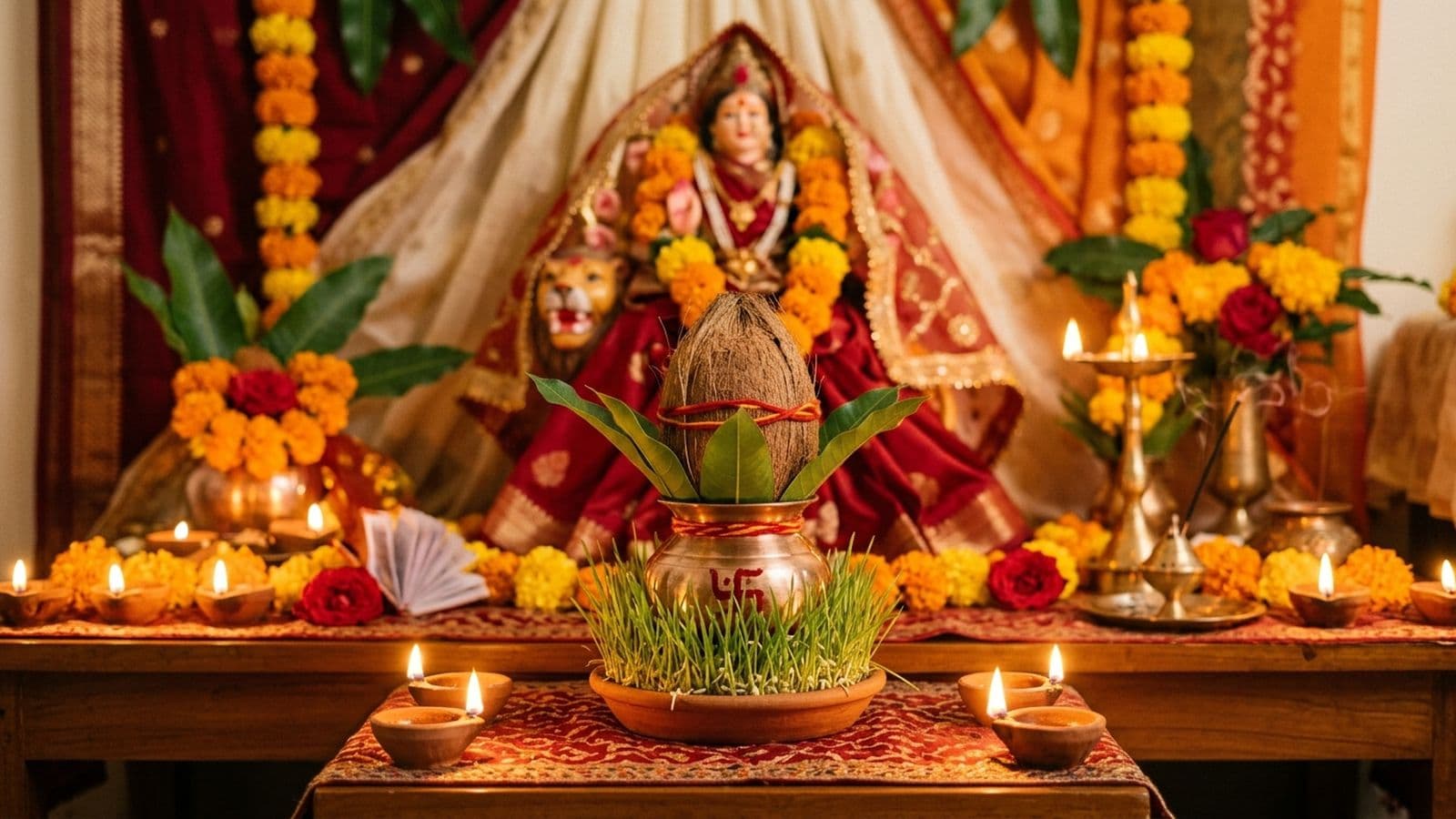
The year holds two Navratris, and this is the larger one: Sharad, or Sharadiya, Navratri — the nine nights of Durga kept in autumn, in the bright fortnight of Ashwina, while the other, Chaitra Navratri, comes in spring. Over these nine nights a different form of the goddess is honoured each night, Shailaputri to Siddhidatri, and the fast climbs from the first Ghatasthapana to the victory of Dussehra. In 2026 it opens on Sunday, 11 October — Shukla Pratipada is present at sunrise and lasts to 21:32, so the Kalash is set on the 11th — and closes with Vijayadashami on Tuesday, 20 October.
This year carries an honest quirk worth knowing before you plan: the tithis are compressed near the end. On Monday, 19 October, Ashtami is present at sunrise but ends early, at 10:53, and Navami then fills the rest of the day, running on to 12:52 the next afternoon. So Maha Ashtami, the Sandhi Puja at their junction, and Maha Navami are all kept together on the 19th, with Dussehra on the 20th. The morning of Ghatasthapana carries its own note too: Chitra nakshatra and Vaidhriti yoga both span it, and because both are set aside for Kalash sthapana, the Abhijit muhurat around noon is the safer choice.
Sharad Navratri 2026 at a glance
Festival window
Sun 11 – Tue 20 Oct 2026
Ghatasthapana
Sun, 11 October 2026
Ghatasthapana muhurat
Delhi 6:19 – 10:12 AM
Ashtami & Navami
Both on Mon, 19 Oct
Vijayadashami
Tue, 20 October 2026
Nine forms
Shailaputri → Siddhidatri
Ghatasthapana muhurat and key dates
When to set the Kalash, and the days that anchor the nine nights
Ghatasthapana muhurat (New Delhi)
6:19 – 10:12 AM
Abhijit 11:44 AM – 12:30 PM · Sun, 11 Oct 2026
Key dates
Ghatasthapana 11 Oct · Dussehra 20 Oct
Maha Ashtami, Sandhi Puja & Maha Navami all on 19 Oct
Ghatasthapana — the sowing of barley and the setting of the Kalash — is done in the first part of the day after sunrise, while Pratipada still holds, which in New Delhi means the window from 6:19 to 10:12 AM on 11 October. There is a catch this year: Chitra nakshatra (to 22:32) and Vaidhriti yoga (to 21:05) both run through that morning, and both are traditionally avoided for Kalash sthapana. That is why the Abhijit muhurat — the short, always-auspicious span around local noon, 11:44 AM to 12:30 PM in Delhi and 12:01 to 12:48 PM in Mumbai — is the safer choice for the sthapana this time. The dates that anchor the rest are simple: Ghatasthapana on the 11th, the Ashtami–Navami day on the 19th, and Dussehra on the 20th.
The nine nights and nine forms
One form to each tithi, 11 to 19 October — and the day two share
Shailaputri
Pratipada
Brahmacharini
Dwitiya
Chandraghanta
Tritiya
Kushmanda
Chaturthi
Skandamata
Panchami
Katyayani
Shashthi
Kalaratri
Saptami
Mahagauri
Ashtami
Siddhidatri
Navami
A form of Durga belongs to each of the nine tithis, and the nine nights read like a rising order: Shailaputri, Brahmacharini, Chandraghanta, Kushmanda, Skandamata, Katyayani, Kalaratri, Mahagauri and Siddhidatri. Because the forms follow the tithis and not the calendar, this year the last two arrive together. Seven nights run one form to a day from 11 to 17 October. Ashtami then sets in on the 18th and is still present at sunrise on the 19th, ending at 10:53, after which Navami holds the rest of that day — so Mahagauri and Siddhidatri, Maha Ashtami and Maha Navami, are all honoured on 19 October, with the Sandhi Puja at their junction. Vijayadashami follows on the 20th.
The Ashtami–Navami day: 19 October
How Navratri is observed, and why
Ghatasthapana, the fast, kanya pujan and the meaning of the nine nights
Navratri opens with Ghatasthapana: barley seed is sown in a bed of soil and a water-filled Kalash is set upon it, often beside an akhand jyoti, an unbroken lamp kept alight through all nine nights. Many keep a vrat — some for the full nine days, others only on the first and last — taking fruit and vrat food in place of grain and salt. On Ashtami or Navami comes the kanya pujan, when young girls are fed and honoured as living forms of the goddess, their feet washed and gifts given. At the close the barley shoots, grown green by the ninth day, are offered as a sign of the harvest to come. Beneath the ritual sits the meaning the season carries: the nine nights mark Durga's long duel with Mahishasura and her victory on the tenth day, which is why Sharad Navratri ends not quietly but in Dussehra — the burning of Ravana in the north, the immersion of Durga in the east — the good that outlasts the strong.
See today's panchang and muhurat for your city
The Ghatasthapana and Abhijit windows above are for Delhi and Mumbai. For your own city's tithi, sunrise and choghadiya on the 11th — or any day of the nine — open the live panchang.
Sharad Navratri 2026 — your questions
Dates, the Ghatasthapana muhurat, the Ashtami–Navami day and the nine forms