
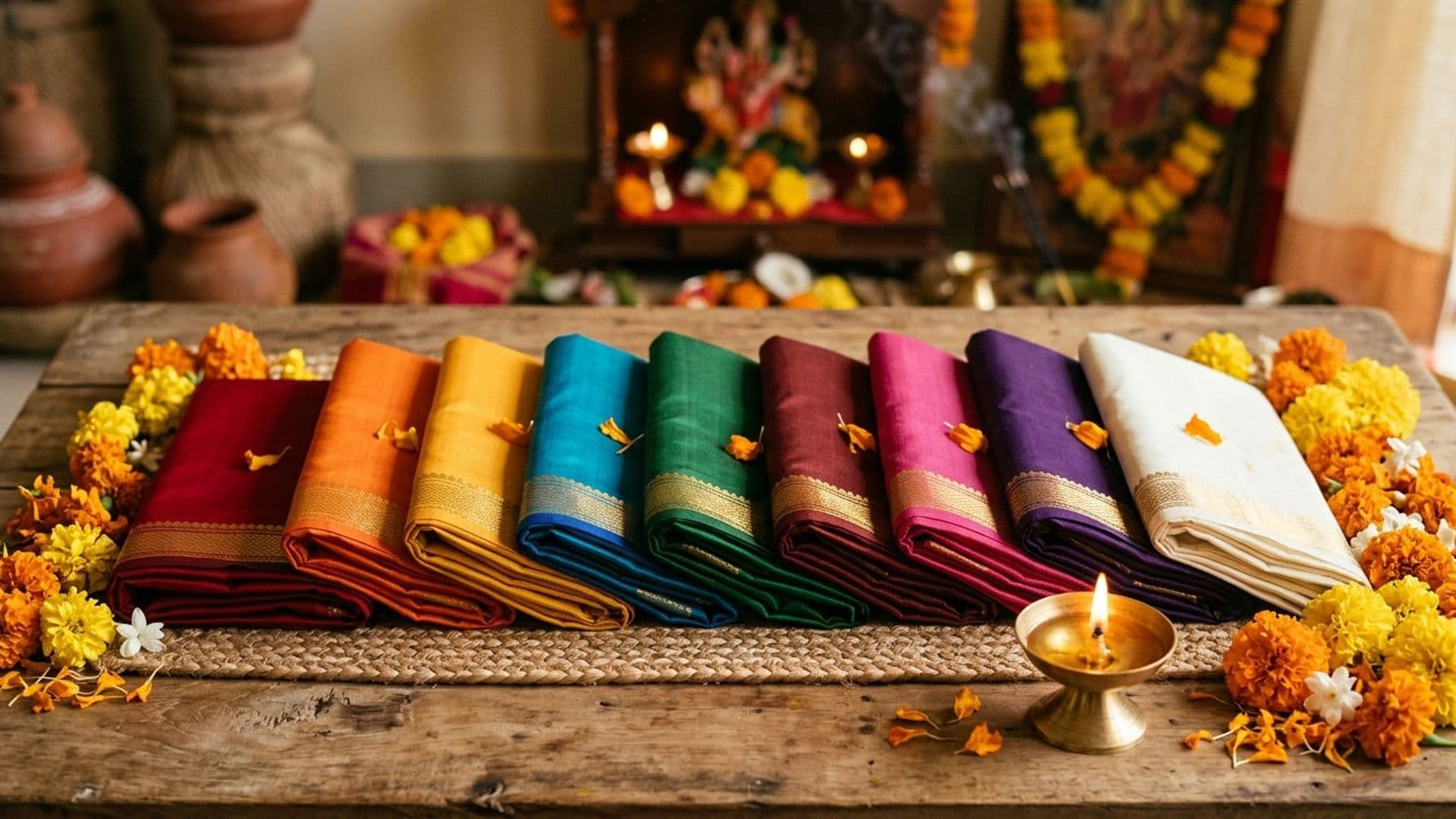
Sharadiya Navratri in 2026 runs from Sunday, 11 October to Monday, 19 October — nine nights in which a different form of the goddess Durga is honoured on each tithi, from Shailaputri on Pratipada to Siddhidatri on Navami. The order is fixed by the tithi, not by the calendar box: which form belongs to a day depends on the lunar day the sunrise carries, so the sequence is read tithi-to-form rather than simply date-to-form.
The colours people wear day by day are a separate, far newer layer. They are a regional custom — spread through western-India practice and newspaper listings — mapped to the weekday, not to the goddess or the scripture, so the sequence rotates every year. 2026 also tightens at the finish: because the Ashtami and Navami tithis both fall on 19 October, the closing tithis overlap on one date instead of spreading across two.
Navratri 2026 at a glance
Festival
Sharadiya Navratri 2026
Nine nights
11–19 October 2026
Begins
Pratipada · Sun 11 Oct
Nine forms
Shailaputri → Siddhidatri
Colours
Regional custom · vary yearly
2026 note
Ashtami & Navami on 19 Oct
The first night and the last
Where the nine nights open and where they close in 2026
Day 1 · Pratipada
Shailaputri
Sun, 11 Oct 2026 · Ghatasthapana opens the nine nights
Day 9 · Navami
Siddhidatri
Mon, 19 Oct 2026 · Ashtami and Navami share this date
The nine nights open with Ghatasthapana on Pratipada and the worship of Shailaputri, the daughter of the mountain, and close on Navami with Siddhidatri, who grants perfection. Between them, one form of Durga is honoured on each tithi. The two cards below mark the ends of that arc; the full day-by-day sequence — with the colour and the traditional bhog for each night — follows in the table.
Nine nights, day by day
The form, the colour and the bhog for each tithi
Day 1 · Pratipada (Sun, 11 Oct) honours Shailaputri, the daughter of the Himalaya; the widely-followed colour is orange and the traditional bhog is pure ghee. Day 2 · Dwitiya (Mon, 12 Oct) is Brahmacharini, the ascetic; the colour is white and the bhog is sugar. Day 3 · Tritiya (Tue, 13 Oct) is Chandraghanta, who wears the half-moon like a bell; red, with a bhog of milk or kheer. Day 4 · Chaturthi (Wed, 14 Oct) is Kushmanda, said to have made the cosmos with a smile; royal blue, with malpua. Day 5 · Panchami (Thu, 15 Oct) is Skandamata, mother of Kartikeya; yellow, with a bhog of banana. Day 6 · Shashthi (Fri, 16 Oct) is Katyayani, the warrior who slew Mahishasura; green, with honey. Day 7 · Saptami (Sat, 17 Oct) is Kalaratri, the fierce night that destroys fear; grey, with a bhog of jaggery. Day 8 · Ashtami (Sun, 18 Oct) is Mahagauri, luminous and calm; the weekday brings orange round again, and the bhog is coconut. Day 9 · Navami (Mon, 19 Oct) is Siddhidatri, who grants the siddhis; white returns, and the bhog is sesame, often with the halwa, puri and chana of the kanya bhoj. One 2026 caveat sits at the end: the Ashtami and Navami tithis both fall on 19 October, so the closing tithis overlap on a single date rather than spreading across two — households that follow the tithi keep Durga Ashtami and Mahanavami close together, so confirm the exact Ashtami window on the Durga Ashtami page before you fix the puja.
Where the colours come from — and what the nine forms mean
A weekday custom, and the Navadurga behind it
The colours are the newest part of Navratri and the least fixed. In the version that spread through western India and the daily papers, each day's colour follows the weekday — Sunday orange, Monday white, Tuesday red, Wednesday royal blue, Thursday yellow, Friday green, Saturday grey — so the whole sequence is rebuilt every year from whichever weekday Pratipada falls on. In 2026 the nine nights run Sunday to Monday, which means two weekdays recur, and published lists diverge on the repeats: some keep the colour, others substitute pink, purple or peacock green on the eighth and ninth days. None of this is scripture. It is a modern, regional custom, and it varies by region as much as by year, so treat any single colour chart as one popular version, not a rule. The nine forms, the Navadurga, are the older and steadier layer. Shailaputri, the daughter of the mountain, is rootedness and the start; Brahmacharini is penance and resolve; Chandraghanta, with the half-moon on her brow, is courage that dispels fear; Kushmanda is the warmth that holds the cosmos; Skandamata is the nurturing mother; Katyayani is the warrior who ends Mahishasura; Kalaratri is the dark night that burns away ignorance; Mahagauri is purity and calm restored; and Siddhidatri, worshipped even by the gods, is completion and the granting of attainment. Read in order, the nine move from the mountain's stillness through struggle and ferocity to serenity and fulfilment — which is the real spine of the nine nights, under whatever colour the day is dressed in.
See today's panchang and muhurat for your city
Navratri's tithis and the Ghatasthapana window shift with your city's sunrise. For the tithi, nakshatra and choghadiya on any of the nine days, open the live panchang.
Navratri 2026 — your questions
Dates, colours, the nine forms and the 19 October overlap