
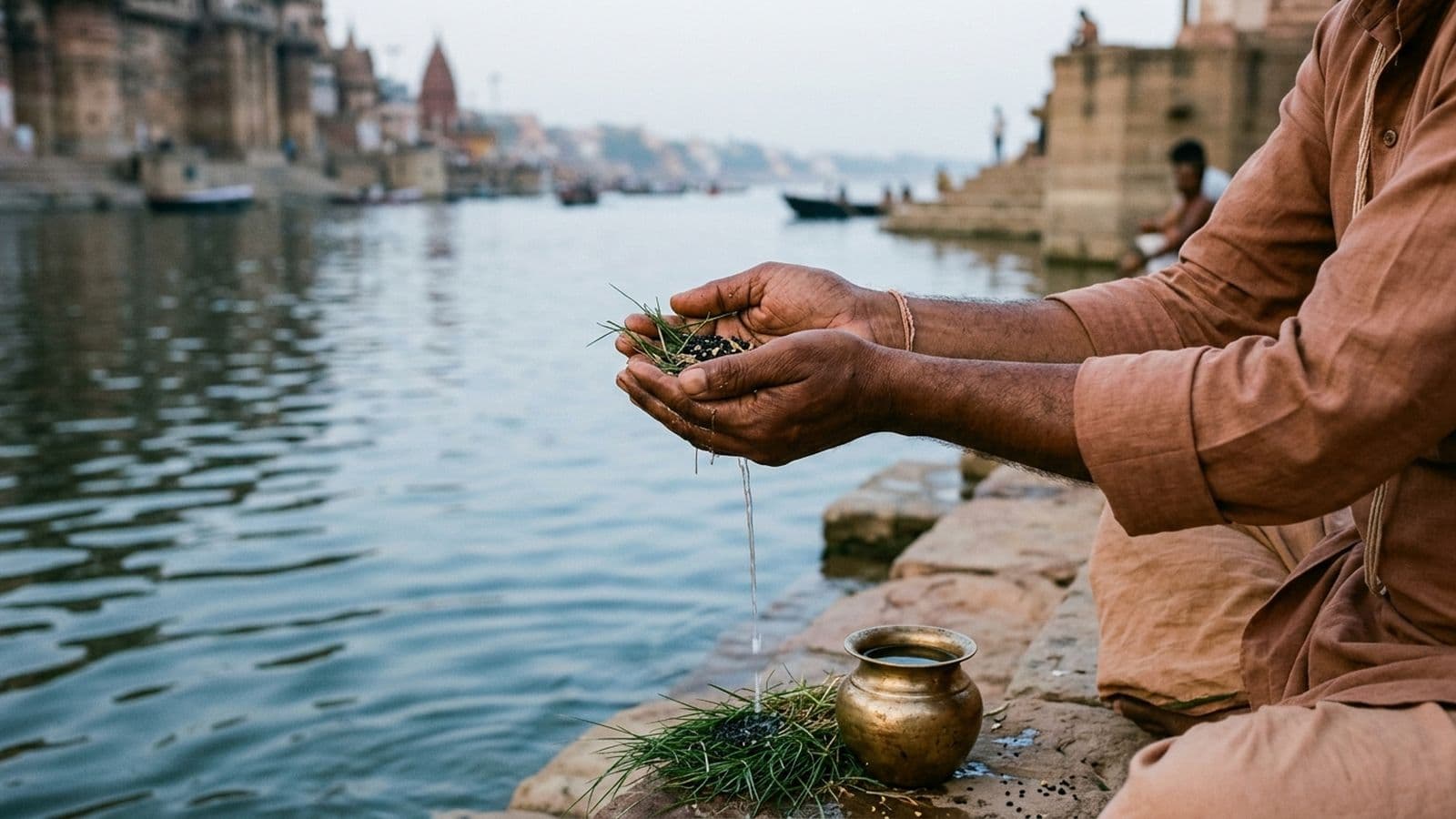
Shraddha is an afternoon rite, and that single fact governs almost everything about how it is done. The day is read in three portions — the forenoon belongs to the devas, the midday to the rishis, and the aparahna, the stretch after solar noon, to the pitrs, one's own departed. Because the offering is made to the ancestors, it is made in their portion of the day: not at sunrise with the morning prayers, but in the aparahna, once the sun has begun to descend. A shraddha done in the morning, however early and sincere, misses the ancestors' appointed portion.
Within that afternoon the tradition marks three windows. The Kutup muhurat, roughly 11:48 AM to 12:35 PM in New Delhi, is held the most fit to begin the rite; the Rohina that follows, about 12:35 to 1:23 PM, is the next; and the wider Aparahna kaal, near 1:23 to 3:47 PM, completes the period. Pitru Paksha itself is the fortnight from 27 September to 10 October in 2026, closing on Sarva Pitru Amavasya. And the day a family keeps for a particular ancestor is not chosen freely — it is the Krishna-paksha tithi on which that person died, the same lunar date returning each year.
Shraddha & Tarpan 2026 at a glance
Rite window
Aparahna — the afternoon
Kutup muhurat (Delhi)
11:48 AM – 12:35 PM
Pitru Paksha 2026
27 Sep – 10 Oct 2026
Sarva Pitru Amavasya
Sat, 10 October 2026
Face
South; janeu apasavya
Annual shraddha day
Krishna-paksha tithi of death
The three shraddha muhurats
New Delhi — the afternoon, portion by portion
Kutup muhurat
11:48 AM – 12:35 PM
Most recommended to begin
Rohina muhurat
12:35 PM – 1:23 PM
The second window
Aparahna kaal
1:23 PM – 3:47 PM
The ancestors’ portion of the day
Pitru Paksha 2026
27 Sep – 10 Oct
Ends on Sarva Pitru Amavasya, 10 Oct
The afternoon is not one undivided block; the shastra names its parts. The Kutup muhurat opens the sequence — a brief span just after solar noon held to still the inauspicious, which is why it is the most recommended time to begin the shraddha. The Rohina window follows, and after it the broad Aparahna kaal, in which the rite may be completed. The times above are for New Delhi on a representative day of the fortnight; because each window is fixed from the sun's position, they shift by a few minutes with your longitude, so confirm the day's muhurat for your own city before you sit.
Tarpan vidhi — the daily water offering
Water, black sesame and kusha, facing south
Tarpan is the daily act of the fortnight, simpler than the full shraddha and offered each morning of Pitru Paksha. Facing south — the direction of Yama and the ancestors — the janeu is moved to hang over the right shoulder, the position called apasavya that marks every rite for the dead. Water is taken in the cupped palms with black sesame, til, and a blade of kusha grass laid across the hand, and it is poured out through the part of the palm between thumb and forefinger, the tirtha sacred to the pitrs. With the sankalp — a spoken resolve naming the ancestors and the intention — the water is offered three times, or as the family tradition holds, so that it reaches those it is meant for. The til and kusha are not garnish: the sesame is said to carry the offering and ward off obstruction, and the kusha to hold its purity.
Shraddha vidhi — pind daan and panchbali
The fuller rite, and which tithi to keep
Shraddha is the fuller rite the fortnight is named for. Its heart is the pind daan — balls of cooked rice and barley flour, worked with black sesame and ghee, offered to the ancestors as a body of nourishment for their onward journey. Around it comes the panchbali, five portions set aside before the family eats: for the cow, the crow, the dog, the devas and the ant — the crow's share above all, held to be the form the pitrs come in. Brahmins are then invited and fed, the meal offered as though to the ancestors themselves, often with a dakshina and the departed's favoured dishes. As for the day: a person's annual shraddha is kept on the Krishna-paksha tithi on which they died — if the death fell on a Panchami, the Panchami of Pitru Paksha is theirs. Those who do not know the tithi, or who honour all the ancestors together, keep the rite on Sarva Pitru Amavasya, the last day, which gathers every departed soul.
When the tithi is unknown, or for all ancestors
Check the shraddha muhurat for your city
The Kutup, Rohina and Aparahna windows above are for New Delhi. For your own city's aparahna and afternoon muhurat on any day of the fortnight, open the live panchang.
Shraddha & Tarpan — your questions
Timing, direction, tithi and the offerings