
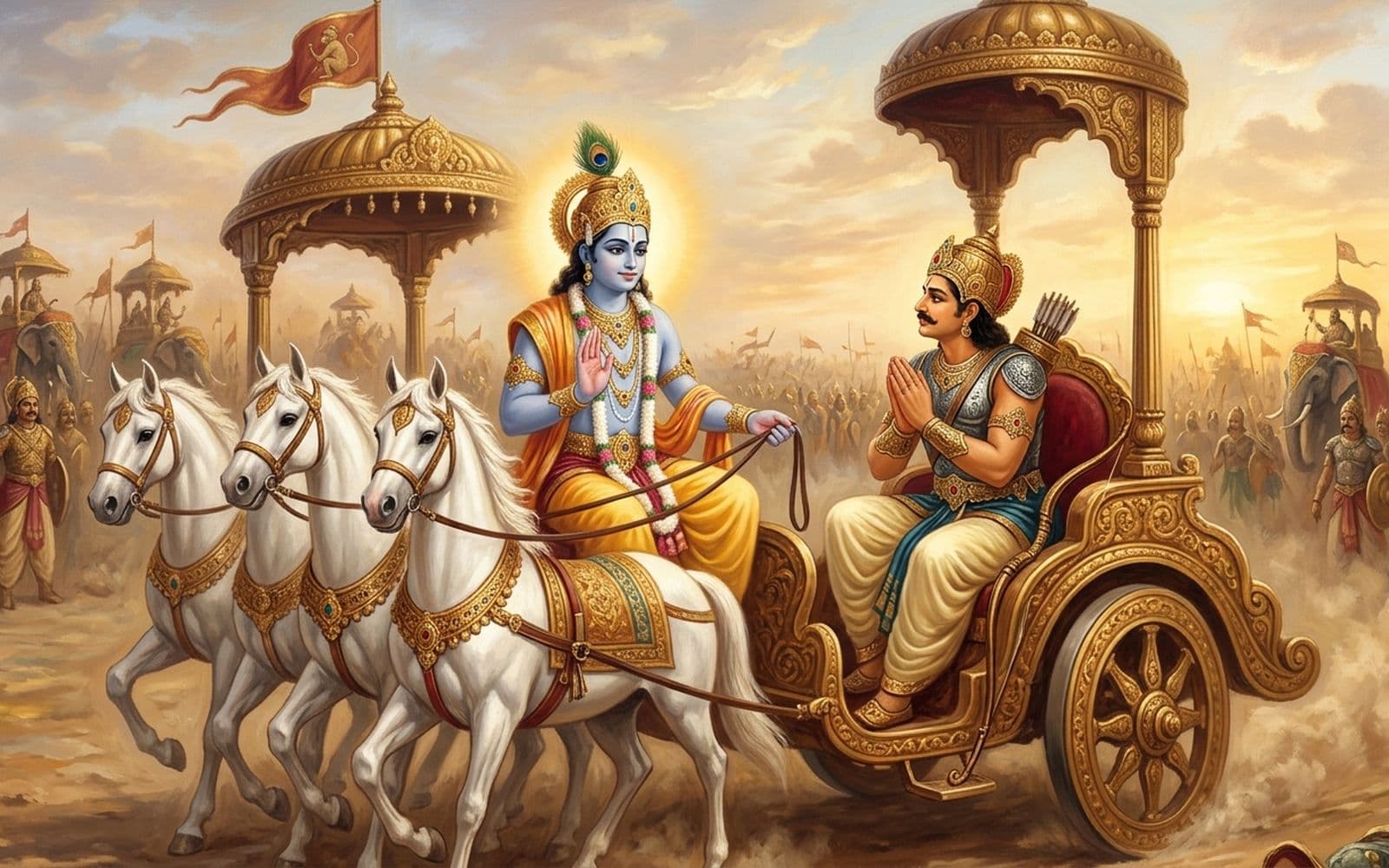
Gita Jayanti is the day the Bhagavad Gita was spoken. On the first morning of the Mahabharata war, with the two armies drawn up and the conches sounding, Arjuna asked Krishna to halt the chariot between them — and there, seeing his own teachers and kinsmen ready to be killed, his resolve broke and he set down his bow. What Krishna said to him then, to answer that despair, is the Gita: seven hundred verses across eighteen chapters, spoken on the field of Kurukshetra. In 2026 the day falls on Sunday, 20 December.
The date is Margashirsha Shukla Ekadashi — the same tithi kept as Mokshada Ekadashi, the Vishnu fast for liberation. One day, two lenses: to keep the fast is to observe Mokshada Ekadashi; to read or hear the Gita is to mark Gita Jayanti. The Ekadashi tithi runs from 10:10 PM on 19 December to 8:15 PM on the 20th, and both the Smarta and Vaishnava traditions keep the day on the 20th this year. At Jyotisar in Kurukshetra, the traditional spot of the discourse, the Gita Mahotsav is held around this time each year, with the Ekadashi at its centre.
Gita Jayanti 2026 at a glance
- Festival day
- Sun, 20 December 2026
- Lunar month
- Margashirsha (Agahan) · Shukla
- Ekadashi tithi
- 19 Dec 10:10 PM → 20 Dec 8:15 PM
- The day marks
- Krishna’s Gita discourse to Arjuna
- Same day as
- Mokshada Ekadashi (the vrat)
- Place
- Kurukshetra · Gita Mahotsav
The two cards hold the two facts a reader comes for. Gita Jayanti 2026 is Sunday, 20 December, kept on Margashirsha Shukla Ekadashi. The Ekadashi tithi itself opens at 10:10 PM on 19 December and closes at 8:15 PM on the 20th, so the day of observance is the 20th — the day the tithi covers the sunrise. The times here are for New Delhi in IST; the tithi window shifts a little with your city, so confirm your local timing on the panchang.
What Gita Jayanti marks
Arjuna's despair, and Krishna's answer at Kurukshetra
The setting is the field of Kurukshetra, at the opening of the Mahabharata war. Arjuna, the finest archer of his age, asks Krishna — his charioteer for the day — to draw up the chariot in the space between the armies so he can look on those he must fight. What he sees undoes him: not strangers but his own grandsire Bhishma, his teacher Drona, cousins, uncles and friends, arrayed to kill and be killed. His limbs fail, his bow slips from his hand, and he says he will not fight. Krishna's reply to that collapse of will is the Gita. It moves from the soul that neither kills nor is killed, through the paths of selfless action, devotion and knowledge, to the great vision of Krishna's universal form, and ends by returning Arjuna to his duty with his eyes open. Eighteen chapters, seven hundred verses — spoken, tradition holds, on this Ekadashi of Margashirsha.
Margashirsha Shukla Ekadashi
Sun, 20 December 2026
📖
Gita Jayanti
Read or hear the Gita
🌙
Mokshada Ekadashi
Keep the Vishnu fast →
The Gita — 18 chapters, three paths
The whole discourse, from Arjuna's despair to surrender
The Gita is seven hundred verses in eighteen chapters, and tradition reads those eighteen as three journeys of six — the path of action, the path of devotion, and the path of knowledge. Together they carry Arjuna from the collapse of his will to a clear-eyed return to his duty.
Karma — the path of action
Chapters 1–6
Do your duty, unattached to its fruit.
- 1Arjuna's Despair
- 2The Eternal Soul
- 3Selfless Action
- 4Knowledge in Action
- 5Renunciation
- 6Meditation
Bhakti — the path of devotion
Chapters 7–12
Love and surrender to the Divine.
- 7Knowledge & Realisation
- 8The Imperishable
- 9The Royal Secret
- 10Divine Glories
- 11The Universal Form
- 12The Path of Love
Jnana — the path of knowledge
Chapters 13–18
Discern the eternal, and be free.
- 13Field & Knower
- 14The Three Gunas
- 15The Supreme Person
- 16Divine & Demonic
- 17Threefold Faith
- 18Liberation
How the day is kept
Reading the Gita, the Mokshada fast, and the Gita Mahotsav
The central act of Gita Jayanti is the Gita itself. Many read or hear it on the day — a chapter, a favourite passage, or the whole of it, and some complete a full parayan of all eighteen chapters aloud. It is done alongside the worship of Krishna, and for those who keep the fast, alongside the Mokshada Ekadashi vrat: a day without grain, given to japa and the reading, and broken the next morning at parana on Dwadashi. Temples, homes and Gita pathshalas hold recitations and discourses, and at Kurukshetra the Gita Mahotsav gathers its largest crowd of the year, with an evening aarti on the Brahma Sarovar. Because the day is also Mokshada Ekadashi, its merit is traditionally offered not only for oneself but for the release of departed ancestors — see the Mokshada Ekadashi page for the vrat vidhi and the parana window.
See the panchang for your city on 20 December
The Ekadashi tithi here — 19 Dec 10:10 PM to 20 Dec 8:15 PM — is for New Delhi. For your own city's sunrise, tithi and choghadiya on 20 December, or any day, open the live panchang.
Gita Jayanti 2026 — your questions
The date, the link to Mokshada Ekadashi, and how the day is observed