
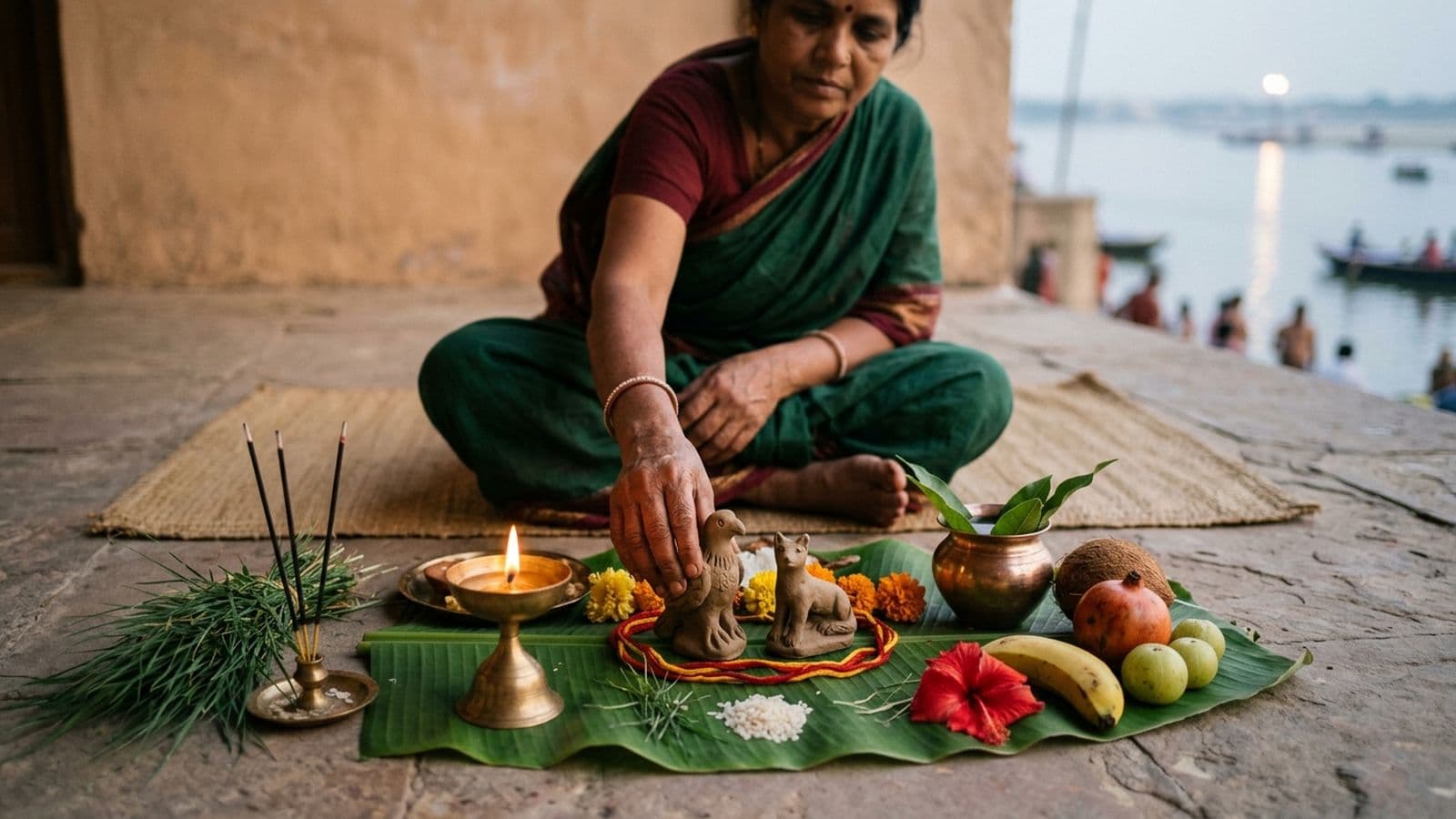
Jivitputrika Vrat — Jitiya or Jiutiya in the everyday speech of Bihar and Jharkhand — is the one fast a mother keeps not for herself but for the life of her child. On Ashwina Krishna Ashtami, which in 2026 falls on Saturday 3 October, mothers hold a nirjala vrat: a full day and night without food and without so much as a sip of water, offered for the long life, health and safety of their sons and daughters. It is observed most closely in Bihar, Jharkhand, the eastern districts of Uttar Pradesh and the Terai of Nepal, and it falls within Pitru Paksha, the fortnight given to the ancestors.
The vrat is not a single day but an arc of three, in the manner of Chhath. It opens on Friday 2 October with Nahay Khay — a bath and one sattvic meal that steadies the body for what follows. Saturday 3 October is the nirjala fast itself. The parana, the breaking of the fast, waits until Sunday morning, 4 October: the Ashtami tithi does not end until 05:53 that dawn, and the fast may be broken only once it has passed, which is why families sit to eat around 7:29 AM rather than at first light. Behind the discipline lie two stories told on this day — the sacrifice of King Jimutavahana, who offered his own body to spare the serpents, and the parable of the eagle and the jackal who kept the same vrat with unequal faith.
Jitiya Vrat 2026 at a glance
Vrat day
Sat, 3 October 2026
Tithi
Ashwina Krishna Ashtami
Nahay Khay
Fri, 2 October
Parana
Sun, 4 October (morning)
Ashtami tithi
3 Oct 08:00 → 4 Oct 05:53
Observed in
Bihar, Jharkhand, Purvanchal, Nepal
The three days of Jitiya Vrat
Nahay Khay, the nirjala fast and the parana — with the Ashtami tithi
Nahay Khay
Fri, 2 October
Bath and one sattvic meal
Nirjala Vrat
Sat, 3 October
Waterless fast, evening puja
Parana
Sun, 4 October
Fast broken in the morning
Ashtami tithi
3 Oct 08:00 → 4 Oct 05:53
New Delhi · parana after it ends
Like Chhath, Jitiya is kept across three days rather than one. Friday 2 October is Nahay Khay: the mother bathes and takes a single sattvic meal to steady the body for what is to come. Saturday 3 October is the vrat proper — nirjala, without food or a drop of water, held through the day and the night that follows. The Ashtami tithi begins at 08:00 on the 3rd and ends at 05:53 on the 4th in New Delhi; because the fast may be broken only after the tithi has passed, the parana falls on Sunday morning, with most families sitting to eat around 7:29 AM.
Vrat vidhi: how the fast is kept
The three days, the waterless rule, and the clay eagle and jackal
On the fast day the mother rises before dawn, bathes, and takes a sankalp to keep the vrat for her children. Through the day and the night she takes neither food nor water — this is the heart of Jitiya, and its most demanding part. In the evening the puja is done: small figures of an eagle (cheel) and a jackal (siyarin) are shaped from clay or cow-dung and worshipped alongside the image of Jimutavahana, for the two animals belong to the katha of the day. Red thread, flowers, dhoop and an offering of fruit accompany the prayer, and the vrat katha is read or heard before the lamp. The nirjala form is the ideal, but it is not a test to be failed: a mother who is pregnant, unwell, elderly or nursing may keep a phalahar vrat on fruit and water instead, and the tradition holds that the intention carries the same weight.
The katha, and why mothers keep it
Jimutavahana, the eagle and the jackal, and the regions of the vrat
Two stories are told on Jitiya. The first is of Jimutavahana, a prince of the Vidyadharas who came upon a mother weeping because her son was owed that day to Garuda, the eagle-king who fed on the serpents. Jimutavahana lay down in the boy's place and offered his own body, and Garuda, moved by a sacrifice made for another's child, spared the Nagas and restored the lives he had taken — the vrat carries his name as Jivitputrika, 'the one who grants a living son.' The second is the parable of the eagle and the jackal: two creatures who kept this same fast, the eagle with a steady, undistracted mind and the jackal who broke it, and whose next births turned on how faithfully each had held the vow — the reason the clay eagle and jackal sit in the evening puja. The fast lives most strongly in Bihar, Jharkhand, the eastern districts of Uttar Pradesh and the Nepal Terai, where mothers keep it each year within Pitru Paksha, joining the day's austerity to the fortnight's remembrance of those who came before.
See the Ashtami tithi and parana time for your city
The tithi and parana above are for New Delhi. For the Ashtami start and end, the sunrise and the day's choghadiya where you live, open the live panchang.
Jitiya Vrat 2026 — your questions
Dates, the parana time, the nirjala rule and the katha