
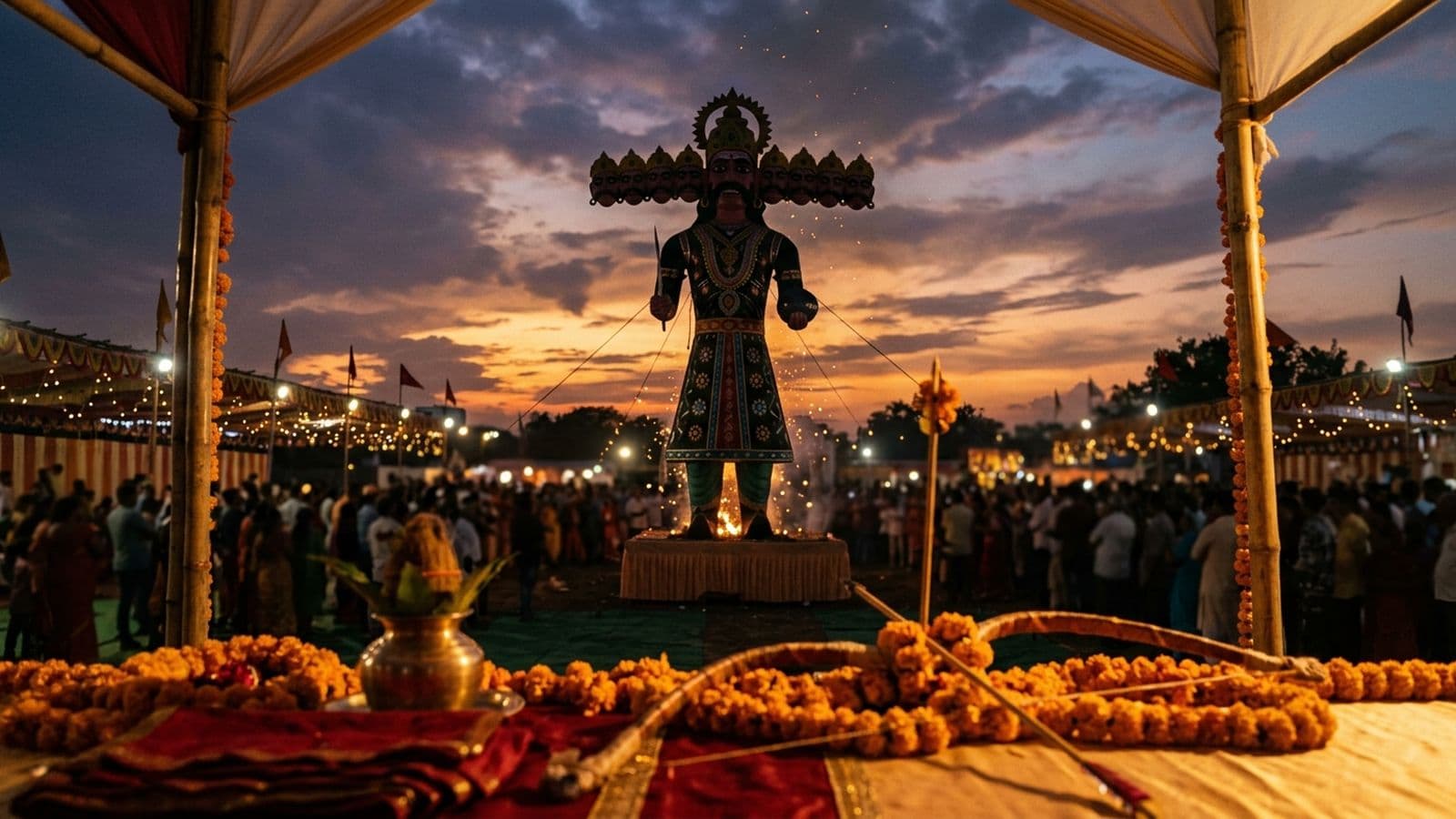
Dussehra — Vijayadashami — turns on a single afternoon watch called the aparahna, and on the short victory hour, the Vijaya Muhurat, that sits inside it. The festival is aparahna-vyapini: it is kept on the day the Dashami tithi is present through the aparahna, the late-afternoon watch that dharma reserves for undertakings meant to win. In 2026 the Dashami begins only at 12:52 PM on Tuesday 20 October, but the aparahna in New Delhi runs 1:14 to 3:30 PM — so the tithi holds the whole of it, and that is what fixes Vijayadashami to the 20th and not the 19th.
Inside that aparahna falls the Vijaya Muhurat itself, the year's most auspicious hour for anything begun to conquer — 1:59 to 2:45 PM in New Delhi, and 2:19 to 3:06 PM in Mumbai, later as you move west with the sun. The day carries two victories at once: Rama's over Ravana, and Durga's over the buffalo-demon Mahishasura on the tenth day of the fight. So the Shami and Aparajita puja are done by daylight in the aparahna, while the Ravan Dahan — the burning of the effigies — waits for after sunset, about 5:46 PM in Delhi, when the pradosh twilight opens.
Dussehra 2026 at a glance
Festival day
Tue, 20 October 2026
Tithi
Ashvin Shukla Dashami
Vijaya Muhurat
Delhi 1:59 – 2:45 PM
Aparahna (Delhi)
1:14 – 3:30 PM
Ravan Dahan
After sunset, ~5:46 PM
Also observed
Ayudha & Saraswati Puja
Vijaya Muhurat, by city
The year's most auspicious hour — computed for where you are
New Delhi
1:59 – 2:45 PM
Vijaya Muhurat, within aparahna 1:14–3:30 PM
Mumbai
2:19 – 3:06 PM
Vijaya Muhurat, about 20 minutes later than Delhi
The Vijaya Muhurat is a fixed span inside the aparahna, and because the aparahna is measured from your own sunrise and sunset, it is not one national time. New Delhi's opens at 1:59 PM and Mumbai's at 2:19 PM, and it slides later the further west you are. This is the window traditionally chosen to start a journey, a new venture, a purchase or any work meant to succeed — vijaya means victory. For the Shami puja and the Aparajita puja the wider aparahna itself is used; in New Delhi that runs 1:14 to 3:30 PM. For your own city, take its sunrise and sunset from the live panchang and work out the window with the method in our Vijay Muhurat guide.
What is done on Vijayadashami
Shami and Aparajita puja, Ayudha and Saraswati puja, and the Ravan Dahan
Vijayadashami is worked in the open air of the afternoon. The Aparajita puja invokes the goddess Aparajita, the unconquered, for success in the year's undertakings, and is done in the aparahna facing north-east. The Shami puja honours the shami tree, remembered from both Rama's story and the exile of the Pandavas; its leaves are exchanged as tokens of victory. Ayudha Puja is the worship of tools, weapons, vehicles and the instruments of one's craft, cleaned and honoured on this day. In much of South India the same day is kept as Saraswati Puja and Vidyarambham, when children are first led to write and the books set aside on the earlier Navratri days are taken up again. Then, after sunset — about 5:46 PM in Delhi, as the pradosh twilight opens — the tall effigies of Ravana, Kumbhakarna and Meghnad are burned in the Ravan Dahan.
Two victories, one tenth day
Rama over Ravana, Durga over Mahishasura — and why it is called Vijayadashami
The tenth day is a victory twice over. In the Ramayana it is the day Rama killed Ravana and ended the war for Sita's return, after the nine nights of battle — the Ramlila plays across North India close tonight with the effigy burning. In the Devi tradition it is the day Durga slew Mahishasura, the shape-shifting buffalo-demon, after the nine-night fight that Sharad Navratri recounts; the immersion of her images, the Durga visarjan, falls now. The name Vijayadashami — vijaya, victory, plus dashami, the tenth — holds both. It is counted among the three-and-a-half muhurats of the year on which no separate auspicious time need be sought: the whole day is fit for beginnings, which is why weddings, housewarmings, new account books and a child's first lessons are all traditionally started on it.
See today's panchang and Vijaya Muhurat for your city
The Vijaya Muhurat and aparahna above are for Delhi and Mumbai. For your own city's tithi, sunrise and the muhurat on 20 October — or any day — open the live panchang.
Dussehra 2026 — your questions
The date, the Vijaya Muhurat and the day's observances