
Every year, sometime around mid-July, an invisible switch flips in the Hindu calendar. Pandits stop giving wedding dates. Temple priests rearrange their schedules. Families that were planning a Griha Pravesh quietly push the ceremony to November. The reason is always the same: Chaturmas has begun.
But what exactly are these "four months"? Why does an entire civilisation put its most important rituals on hold? And — the question that rarely gets a straight answer — what are you actually supposed to do during Chaturmas?
This guide covers the real tradition: the astronomy behind the dates, the theology behind the restrictions, the month-by-month rhythm, and the practical rules that apply to modern life.
What Is Chaturmas?
Chaturmas (Sanskrit: chatur = four, māsa = month) is the four-month sacred period that runs from Devshayani Ekadashi (Ashadha Shukla 11) to Prabodhini Ekadashi (Kartika Shukla 11). It typically spans late June or July through October or November — roughly 118 to 120 days.
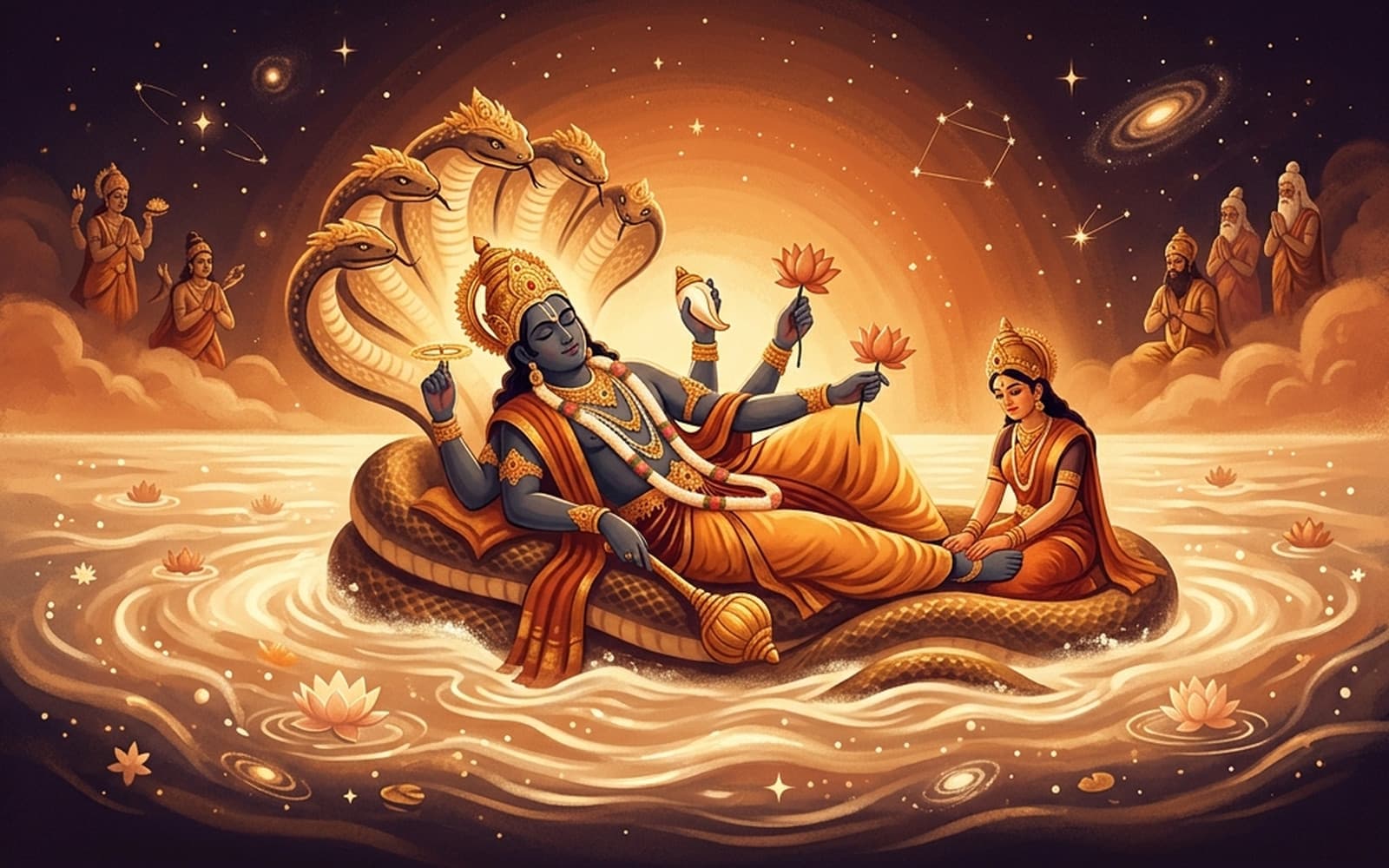
The period is anchored to a single mythological event: Vishnu's Yoga Nidra. On Devshayani Ekadashi, Vishnu reclines on the cosmic serpent Shesha in the Ksheer Sagar and enters a state of divine sleep. For the next four months the sustainer of the universe is at rest. On Prabodhini Ekadashi he wakes, and life resumes its full ceremonial rhythm.
This narrative maps neatly onto the Indian monsoon. The rains arrive around the same time, making travel difficult, flooding rivers, and turning roads into mud. Historically, large gatherings — wedding processions, trade caravans, pilgrimage convoys — became impractical. The calendar formalised what nature already demanded: a pause.
The Astronomy Behind the Dates
Chaturmas dates are not arbitrary. They are computed from the same tithi-nakshatra machinery that drives the entire Hindu calendar.
- Start: Ashadha Shukla Ekadashi — the 11th tithi of the bright fortnight when the moon is in (or near) the Ashadha-month cycle. The sun is typically in Mithuna or Karka at this point, close to the summer solstice.
- End: Kartika Shukla Ekadashi — the 11th tithi of the bright fortnight two lunar months after Sharad Purnima. The sun is in Tula or Vrischika by now.
Because these are lunar dates, they shift by about 10–11 days each solar year and occasionally get pushed further by an Adhika Masa (intercalary month). When Adhika Ashadha occurs, the "real" Ashadha — and therefore Devshayani Ekadashi — arrives a month later than usual, making that year's Chaturmas start in August instead of July.
The dates also depend on your city's sunrise. Tithi transitions happen at a fixed moment in universal time, but the civil date on which you observe a tithi is tied to which tithi is running at your local sunrise. Two cities 2,000 km apart may occasionally observe Devshayani Ekadashi on different dates.
Keep in Mind
What Stops During Chaturmas
The single biggest practical consequence of Chaturmas is this: no auspicious muhurat ceremonies. The traditional muhurat engine treats the entire Chaturmas window as a block, meaning the following events are typically postponed:
- Vivah (Wedding) — the most widely observed restriction. Hindu marriage rites invoke Vishnu as witness; performing them during his Yoga Nidra is considered inauspicious.
- Griha Pravesh (Housewarming) — entering a new home with ceremonial puja is deferred. Practical move-ins (rented flats, job transfers) are not the same as a Griha Pravesh.
- Upanayana (Sacred Thread) — the thread ceremony is a samskara that requires auspicious timing.
- Sagai / Engagement — formal engagement ceremonies are postponed alongside weddings.
- New business launches — opening a shop, signing a founding contract, or breaking ground on construction is generally avoided.
The block is not a blanket prohibition on all activity. Daily work, cooking, routine pujas, medical treatment, education, and essential travel continue normally. The restriction targets inaugural ceremonies — events where you would traditionally consult a pandit for a muhurat.
When Is Chaturmas This Year?
Get exact Devshayani and Prabodhini Ekadashi dates for your city — our calculator uses panchang computation for precise, location-specific dates.
Month by Month: What Each Masa Brings
Ashadha (partial)
Chaturmas begins partway through Ashadha, on Devshayani Ekadashi. The monsoon is just arriving. Devotees take their vows — dietary commitments, extra prayers, charitable pledges — and the four-month discipline begins. Guru Purnima, one of the most important days for honouring teachers and gurus, usually falls within a few days of the start.
Shravan
The most intensely observed month. Monday fasts (Shravan Somvar) dedicated to Shiva are ubiquitous across North India. The Kanvar Yatra sees millions of devotees carry Ganga water to their local Shiva temples. Key observances include Nag Panchami, Hariyali Teej, Raksha Bandhan, and the Shravan Putrada Ekadashi. Many people give up onion, garlic, and non-vegetarian food for the entire month.
Bhadrapada
Ganesh Chaturthi dominates this month — the 10-day festival celebrates the elephant-headed god who removes obstacles. Krishna Janmashtami, marking the birth of Lord Krishna, falls in late Bhadrapada or early Ashwin depending on the year. Aja Ekadashi and Parivartini Ekadashi (when Vishnu turns from one side to the other in his sleep) are observed. Pitru Paksha — the 16-day period of ancestor rites — closes out the month.
Ashwin
The festive high point. Shardiya Navratri — nine nights of Durga worship — builds to Dussehra (Vijayadashami). Despite the festive atmosphere, Chaturmas vows remain in force. Indira Ekadashi and Papankusha Ekadashi fall in this month. Sharad Purnima, the harvest moon celebrated with kheer left under the moonlight, marks the end of the Ashwin month.
Kartika (partial)
The grand finale. Diwali — the festival of lights — arrives in the first half of Kartika. Then comes Prabodhini Ekadashi (also called Dev Uthani Ekadashi or Devutthana Ekadashi), when Vishnu wakes from Yoga Nidra. The wedding season opens immediately. Tulsi Vivah — the ceremonial marriage of the Tulsi plant to a Shaligram — is traditionally the first "wedding" after Chaturmas, performed on the day after Prabodhini Ekadashi. From here through Makar Sankranti, the calendar fills with wedding dates.
Spiritual Practices During Chaturmas
The point of Chaturmas is not merely to stop doing things. The tradition redirects that energy inward. Here is what observers add to their routine:
Vrats and Fasting
Ekadashi fasting becomes especially significant. The four Ekadashis that fall during Chaturmas — Kamika, Putrada (Shravana), Aja, and Indira — each carry particular spiritual weight. Many observers also keep Purnima fasts, Monday fasts (for Shiva), and Saturday fasts (for Shani/Hanuman).
Scriptural Study
Chaturmas is traditionally the season for extended study of sacred texts. Temples organise month-long recitations of the Bhagavata Purana, Ramayana, or Vishnu Sahasranama. In Jain communities, monks deliver pravachans (discourses) throughout their stay in one location.
Dana (Charity)
Feeding the poor, donating to temples, sponsoring Anna Daan (food distribution), and supporting educational causes are encouraged. The logic: when external ceremonies pause, the resources that would go to wedding halls and event planning can flow toward service.
Dietary Discipline
Many people adopt stricter dietary practices: pure vegetarian cooking, avoiding tamasic foods (onion, garlic, excess spice), eating before sunset, or following an Ekadashi-style grain-free fast on specific days. The idea is not punishment but gradual simplification — eating lighter so the mind can sit lighter in meditation.
Regional Traditions
Chaturmas is observed across India, but the emphasis shifts by region and community.
North India
The wedding-season halt is most strictly followed here. Shravan Somvar fasts are nearly universal. The Kanvar Yatra (pilgrimage carrying Ganga water) is the defining event of Shravan in UP, Uttarakhand, Haryana, and Rajasthan. Teej celebrations are particularly strong in Rajasthan and Madhya Pradesh.
Maharashtra and Gujarat
Ashadi Ekadashi (Devshayani Ekadashi) is the annual pilgrimage day for the Pandharpur Wari — hundreds of thousands of Varkaris walk to the Vitthal temple. Chaturmas here is inseparable from the Wari tradition. Shravan months see elaborate Shiva worship and Nag Panchami celebrations.
South India
The concept is recognised but the intensity varies. In Karnataka, the Chaturmas stay of Madhwa (Dvaita) pontiffs in specific towns is a major religious event — the local Math becomes a centre of discourse and community gathering. In Tamil Nadu, Adhika Masa and Dakshinayana are acknowledged in temple schedules, but the wedding-season halt is less rigid than in the North.
Jain Tradition
Jain Chaturmas is especially significant. Monks and nuns cease wandering and stay in a single location, delivering daily discourses. Lay Jains intensify their fasting — Paryushana (the 8- or 10-day festival of self-discipline) falls during Chaturmas. The Jain community's observance is among the most rigorous, with many laypeople undertaking prolonged fasts.
Vaishnava Tradition
ISKCON and Gaudiya Vaishnava communities observe Chaturmas with month-specific dietary restrictions: no spinach in Shravan, no yogurt in Bhadrapada, no milk in Ashwin, no urad dal in Kartika. These rules come from the Hari Bhakti Vilasa and vary by sampradaya.
Chaturmas in Modern Life
The core dilemma for a modern observer: how do you honour a four-month discipline when your life runs on office calendars, school terms, and EMI deadlines?
The honest answer: you pick what you can sustain. Chaturmas was never meant to be all-or-nothing. The ancient texts describe graded levels of observance — from the most austere (one meal a day, no cooked food) to the most basic (observe Ekadashi, increase prayer, avoid meat). The tradition expects you to choose a level that stretches you slightly beyond your comfort zone without making daily life impossible.
Here are approaches that work for people with jobs, school-going children, and urban routines:
- Keep the four Ekadashi fasts — Kamika, Putrada, Aja, Indira. This is the minimum that traditional texts consider meaningful.
- Add one fixed daily practice — 10 minutes of Vishnu Sahasranama, a chapter of the Bhagavata, or a set number of japa rounds. The consistency matters more than the duration.
- Simplify one meal — no onion-garlic at dinner, or a fruit-only breakfast on Mondays. Small dietary changes sustained for four months build genuine discipline.
- Increase charitable giving — set aside a fixed monthly amount for Anna Daan, temple donation, or educational support. Automate it so it does not depend on mood or memory.
- Respect the muhurat block — this is the easiest to follow because it is binary. If you were planning a wedding or Griha Pravesh, schedule it after Prabodhini Ekadashi.
Frequently Asked Questions
Common questions about Chaturmas
Q: When does Chaturmas start and end in 2026?
In 2026, Chaturmas begins on Devshayani Ekadashi (25 July 2026) and ends on Prabodhini Ekadashi (20 November 2026) — a span of 119 days. Exact dates depend on your city's sunrise, so use a panchang calculator for your location.
Q: Can I get married during Chaturmas?
Traditional practice avoids weddings during Chaturmas because Vishnu — the deity invoked in Hindu marriage rites — is in Yoga Nidra. Most families schedule weddings after Prabodhini Ekadashi, when the season opens. If circumstances are pressing, consult your family pandit; some regional traditions permit vivah under specific conditions.
Q: Is Griha Pravesh allowed during Chaturmas?
Griha Pravesh (housewarming) is generally avoided during Chaturmas for the same reason as weddings. However, moving into a rented place for practical reasons (job transfer, lease timing) is distinct from a ceremonial Griha Pravesh. Most people simply delay the formal puja until after Chaturmas ends.
Q: What happens if I break a Chaturmas vow?
If you unintentionally break a vow, acknowledge it, offer a brief prayer, and resume the practice the next day. Chaturmas vows are about building discipline, not about punishment. If your circumstances change mid-way, it is better to modify the vow to something realistic than to abandon it entirely.
Q: Can I travel during Chaturmas?
Work travel, family obligations, and medical needs are not restricted. The traditional caution against travel comes from the monsoon era when roads were dangerous. Pilgrimages to sacred sites are actually encouraged during Chaturmas. The restriction applies mainly to leisure travel and starting journeys on inauspicious tithis.
Q: Do Jains also observe Chaturmas?
Yes. Jain monks and nuns halt their wandering during the monsoon months and stay in one place (sthanak) to avoid harming insects and organisms that thrive in the rains. Laypeople intensify their fasting, study, and charitable giving. The Jain Chaturmas period overlaps with the Hindu one but the start/end markers differ slightly.
Q: Why do sadhus stay in one place during Chaturmas?
The monsoon makes wandering impractical — swollen rivers, muddy paths, and heavy rainfall make travel risky. More importantly, the rains bring an explosion of insect and plant life; walking through forests and fields risks harming these creatures. Staying put during Chaturmas is both a practical precaution and a form of ahimsa.
Q: Is Chaturmas the same as Dakshinayana?
They overlap but are not identical. Dakshinayana is the sun's southward journey (Karka Sankranti to Makar Sankranti — roughly mid-July to mid-January). Chaturmas is a shorter period within it, starting at Devshayani Ekadashi and ending at Prabodhini Ekadashi. All of Chaturmas falls within Dakshinayana, but Dakshinayana extends well beyond Chaturmas.
Key Takeaways
- Chaturmas runs from Devshayani Ekadashi (Ashadha Shukla 11) to Prabodhini Ekadashi (Kartika Shukla 11) — roughly 118–120 days each year.
- Vishnu's Yoga Nidra is the theological anchor: while the sustainer sleeps, inaugural ceremonies like weddings, Griha Pravesh, and Upanayana are paused.
- The dates are lunar and location-dependent — they shift each year, and Adhika Masa can push them by a full month.
- Daily life continues normally. The restriction targets muhurat ceremonies, not routine work, travel, or medical needs.
- Each month carries its own festivals and practices: Shravan (Shiva worship, Kanvar), Bhadrapada (Ganesh Chaturthi, Pitru Paksha), Ashwin (Navratri, Dussehra), Kartika (Diwali, Tulsi Vivah).
- Observance is graded, not binary. Pick a level of vrat, study, charity, and dietary discipline that stretches you without breaking your routine.
- The wedding season reopens the day after Prabodhini Ekadashi and runs hot through December.
Note: This guide is based on traditional Panchang knowledge. Chaturmas is an opportunity to align your rhythm with nature. For major decisions like marriage timing, consult your family pandit.